GS 2: GovernanceGS 3: Internal SecurityPrelimsGS 2: Government policies and interventions for development in various sectorsGS 3: Security Forces and Agencies and their Mandate
On theatre commands, let's finish arguing, reach a settlement, before next crisis comes, Pg13
India's military theatre command restructuring faces inter-service disputes, demanding urgent political settlement to enhance readiness for modern, AI-guided warfare.
Practice MCQs
811 Students attempted
Key Highlights:
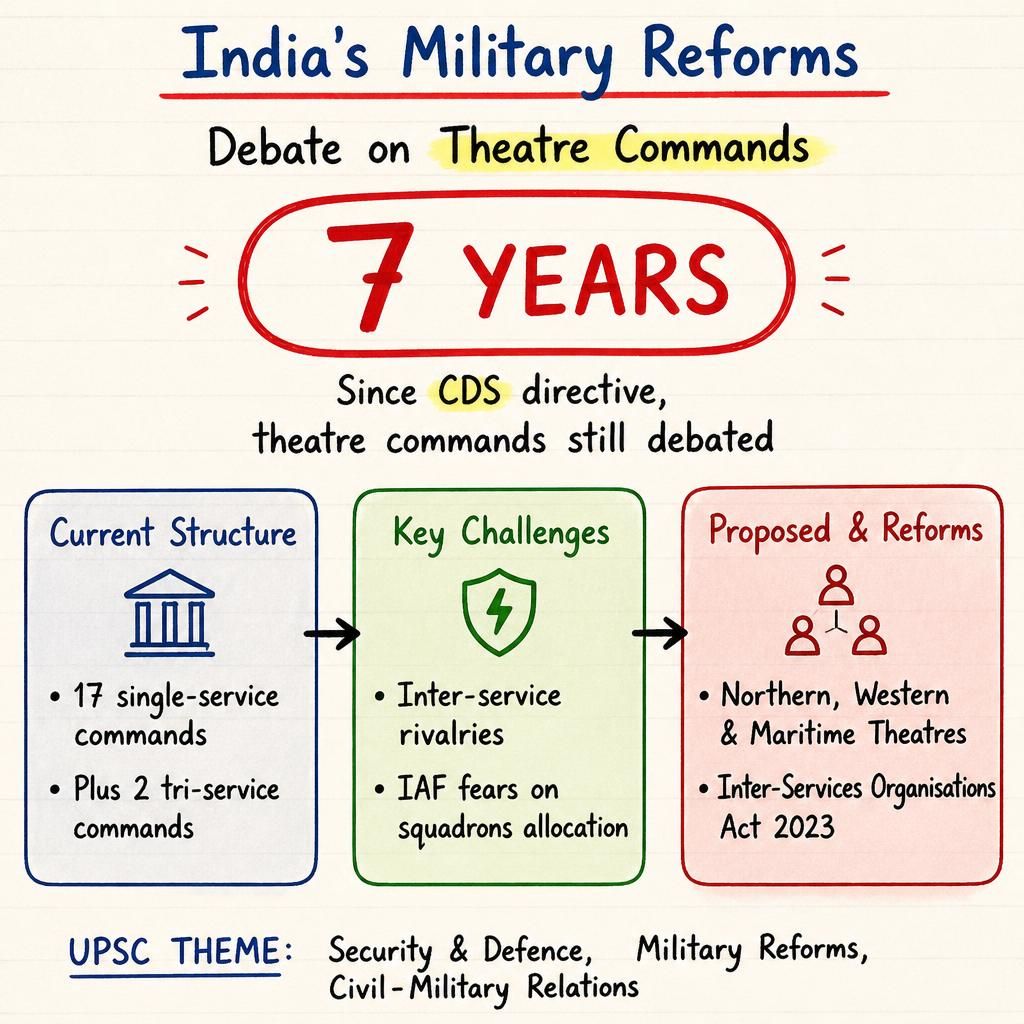
- India's military has been debating the establishment of theatre commands for seven years, despite a directive from the Chief of Defence Staff (CDS).
- The current structure of 17 geographically dispersed single-service commands is deemed archaic and inefficient for modern warfare.
- Inter-service rivalries, particularly concerning air power allocation, are hindering the integration process.
- The proposed theatre commands aim to replace the fragmented structure with unified commanders having operational authority over combined forces.
- Historical examples from the US, such as the Key West Agreement and the Goldwater-Nichols Act of 1986, demonstrate successful resolution of inter-service disputes and achievement of jointness.
Military Reforms.jpg
Detailed Insights:
- The Chief of Defence Staff (CDS) position was created in January 2020 with a mandate to facilitate the restructuring of military commands and promote jointness.
- India currently operates 17 single-service commands (seven Army, seven Air Force, three Navy), plus two existing tri-service commands: the Andaman and Nicobar Command and the Strategic Forces Command.
- The Indian Air Force (IAF) expresses concerns that dividing its limited squadrons among theatre commanders would compromise its doctrine of "centralised control and decentralised execution" and operational flexibility.
- Proposed theatre commands for India include a Northern Theatre (focused on China), a Western Theatre (for Pakistan), and a Maritime Theatre.
- The Inter-Services Organisations (Command, Control and Discipline) Act 2023 addressed a legal hurdle by granting joint commanders disciplinary authority over personnel from all services.
- The US Goldwater-Nichols Act of 1986 significantly reorganized the US Department of Defense, strengthening the authority of the Chairman of the Joint Chiefs of Staff and combatant commanders to enhance joint operations.
- The Key West Agreement of 1948 in the US aimed to define roles and missions for the Army, Navy, and Air Force to reduce inter-service conflict.
Key Concepts Involved:
- Theatre Commands: Integrated military commands combining assets from all three services (Army, Navy, Air Force) under a single commander for a specific geographical or functional area.
- Jointness: The ability of different military services to operate together seamlessly and effectively, sharing resources and command structures.
- Chief of Defence Staff (CDS): The professional head of the Indian Armed Forces, responsible for overseeing inter-service integration and advising the government on military matters.
- Goldwater-Nichols Act of 1986: A landmark US legislation that reformed the Department of Defense to enhance joint military operations and streamline the chain of command.
- Key West Agreement: A 1948 US agreement that sought to delineate the roles and missions of the Army, Navy, and Air Force to reduce inter-service rivalry.

SuperKalam is your personal mentor for UPSC preparation, guiding you at every step of the exam journey.
Download the App


STUDY RESOURCES
CONTACT US
ⓒ Snapstack Technologies Private Limited