GS 2: GovernanceGS 3: Science & TechnologyGS 3: Environment & EcologyGS 3: EconomyPrelims
Nobel winner backs GM crop innovation in Indian labs, Pg10
Nobel laureate Richard Roberts advocates for indigenous GM crop innovation, dismissing foreign dependency fears amidst India's contentious biotechnology policy debate.
Practice MCQs
811 Students attempted
Key Highlights:
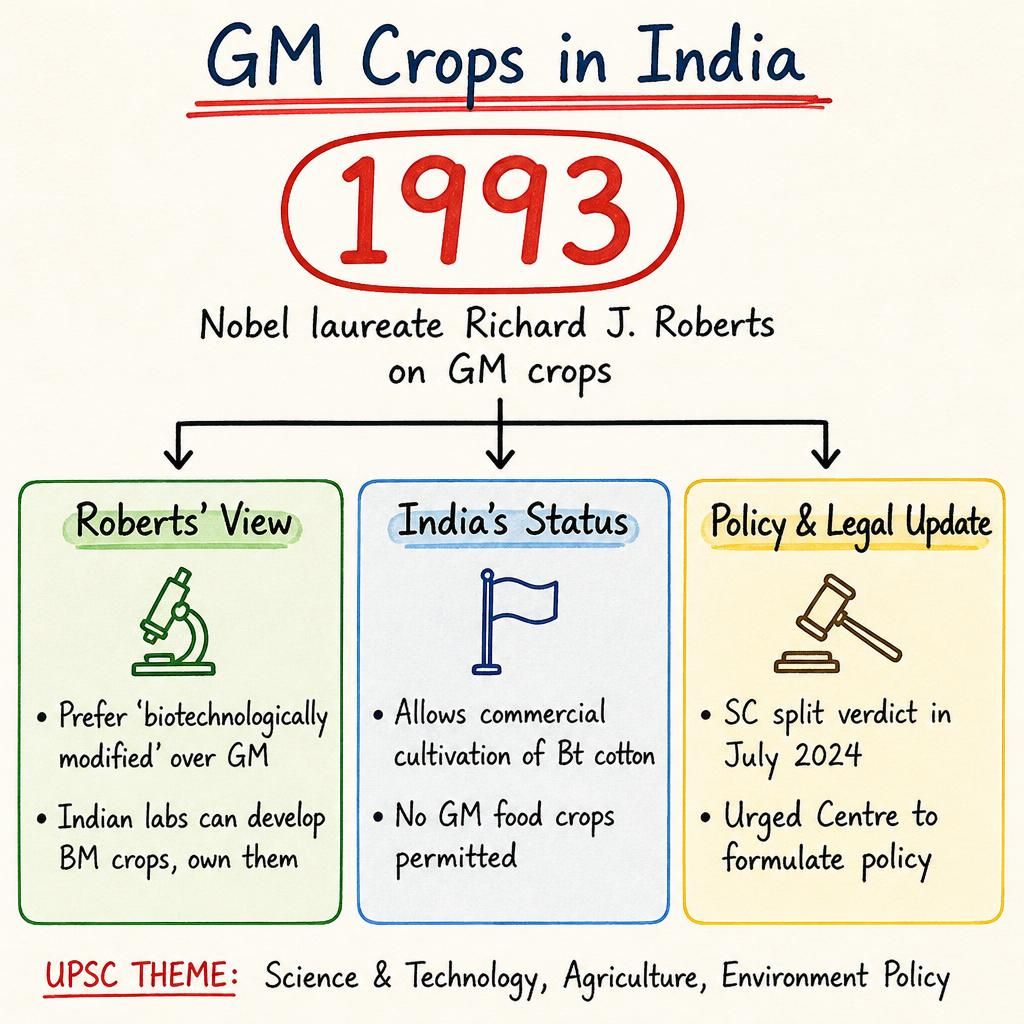
- Richard J. Roberts, a 1993 Nobel laureate, dismissed concerns about India's dependence on foreign companies for genetically modified (GM) crops, advocating for indigenous development.
- He suggested that Indian laboratories could develop biotechnologically modified (BM) crops, including those using CRISPR technology, and retain ownership.
- The Nobel laureate delivered his address at the second Emerging Science, Technology and Innovation Conclave (ESTIC) at Bharat Mandapam.
- India currently permits commercial cultivation of Bt cotton but no GM food crops.
- The Supreme Court delivered a split verdict in July 2024 on the environmental release of GM mustard and urged the Centre to formulate a national policy on GM crops.
GM Crops.jpg
Detailed Insights:
- Dr. Roberts, who received the Nobel Prize in Physiology or Medicine in 1993 for the discovery of split genes, argued that the term 'genetically modified' is misleading, preferring 'biotechnologically modified'.
- He emphasized that the technology for improving crops, such as CRISPR-modified plants, is accessible and can be mastered by Indian scientists within weeks.
- India has a contentious history with GM food crops, exemplified by the indefinite moratorium imposed on Bt brinjal in 2010 by then Environment Minister Jairam Ramesh.
- Research published in 2017 indicated that backcrossing Golden Rice into an Indian variety resulted in stunted, low-yielding plants despite high provitamin A content.
- The ongoing intellectual property dispute surrounding the foundational CRISPR-Cas9 patents highlights the complexities of global scientific innovation.
- Dr. Roberts framed the adoption of GM technology as crucial for food and nutritional security, especially in developing countries where traditional breeding investments are lower.
Scientific/Technical Concepts Involved:
- Genetically Modified (GM) Crops: Plants whose genetic material has been altered using genetic engineering techniques to introduce new traits.
- Biotechnologically Modified (BM) Crops: A term preferred by Richard J. Roberts to describe crops modified through modern biotechnology, including gene editing.
- CRISPR-Cas9: A powerful gene-editing tool that allows scientists to precisely cut and modify specific DNA sequences in an organism.
- Bt Cotton: A genetically modified cotton variety that produces an insecticide to protect against bollworm pests.
- Bt Brinjal: A genetically modified eggplant variety engineered to be resistant to the fruit and shoot borer insect.
- Golden Rice: A genetically modified rice variety engineered to produce beta-carotene, a precursor to Vitamin A, to combat Vitamin A deficiency.

SuperKalam is your personal mentor for UPSC preparation, guiding you at every step of the exam journey.
Download the App


STUDY RESOURCES
CONTACT US
ⓒ Snapstack Technologies Private Limited