GS 2: GovernanceGS 3: Environment & EcologyGS 3: EconomyPrelimsGS 3: Indian Economy, Planning, Mobilization of Resources, Growth, Development and Employment
India’s next investment cycle will shape its carbon future, Pg6
India's massive upcoming infrastructure development offers a unique opportunity to embed decarbonisation, shaping its carbon future and avoiding costly retrofits.
Practice MCQs
811 Students attempted
Key Highlights:
- The United Nations Environment Programme (UNEP) warned that the world could exceed the 1.5°C warming threshold soon, increasing pressure for faster decarbonisation.
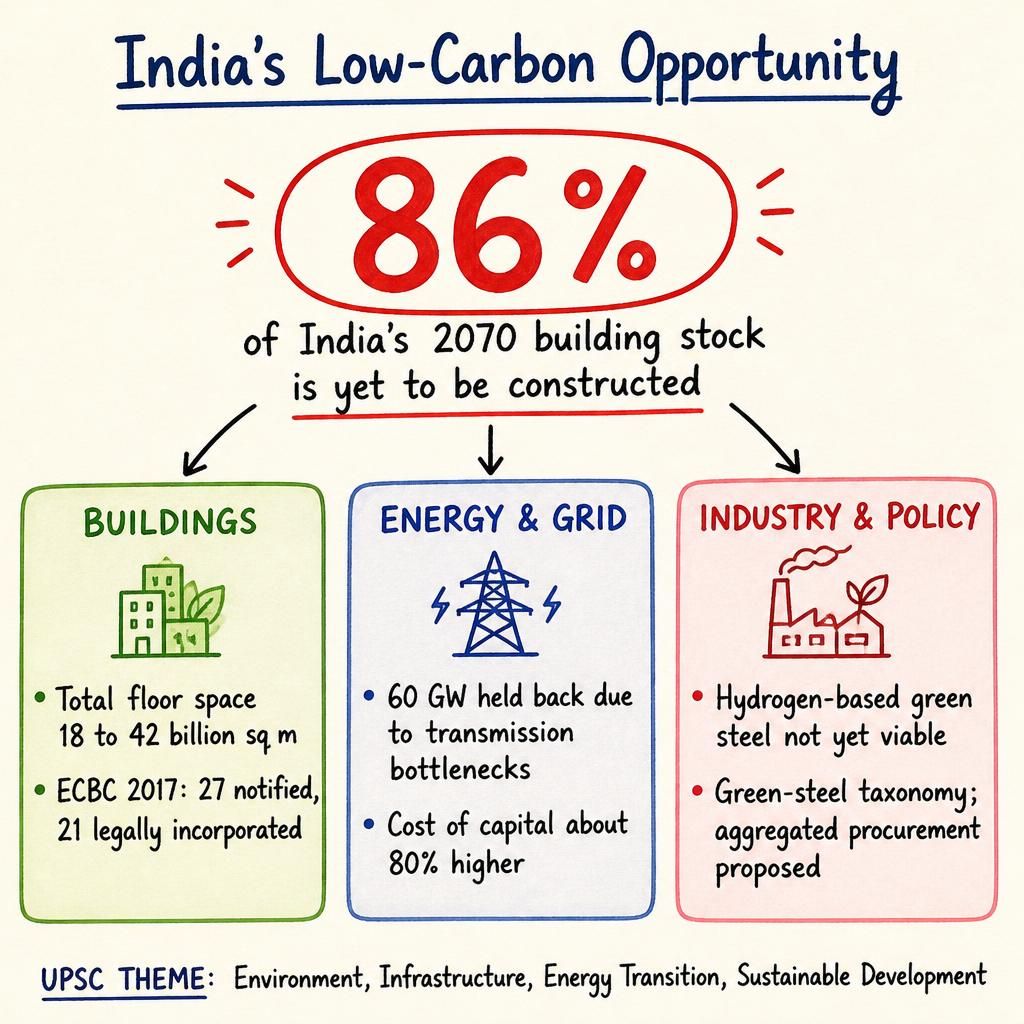
- India has a unique opportunity as an estimated 86% of its 2070 building stock is yet to be constructed, allowing for early integration of efficiency.
- Total floor space is projected to more than double from 18 billion sq m in 2020 to 42 billion sq m by 2070, alongside significant growth in steel and cement production.
- The International Energy Agency (IEA) estimates transmission bottlenecks have held back approximately 60 GW of renewable capacity in India.
- India's cost of capital for grid-scale renewables is about 80% higher than in advanced economies, impacting project viability.
Low Carbon Opportunity.jpg
Detailed Insights:
- India's future emissions will largely depend on the choices made in building new infrastructure and the technologies embedded in these investments.
- In contrast, advanced economies, according to the IEA, will use existing building stock for about 80% of their needs by 2050, facing challenges with retrofitting old structures.
- The Bureau of Energy Efficiency (BEE) reports that while 27 states notified the Energy Conservation Building Code (ECBC) 2017, only 21 legally incorporated it.
- BEE has since issued the Energy Conservation and Sustainable Building Code (ECSBC) 2024 for commercial buildings and the Eco-Niwas Samhita (ENS) 2024 for residential buildings.
- The Ministry of Power plans for roughly 590 GW of generation additions between 2023 and 2032, making the unresolved transmission gap a critical issue.
- Decarbonising sectors like steel and cement is challenging, with hydrogen-based green steel not yet viable in India and large-scale carbon capture for cement still distant.
- Public procurement by entities like Indian Railways and the National Highways Authority of India can create an early market for lower-emission materials.
- India has a green-steel taxonomy, and the Ministry of Steel proposed aggregated procurement with emissions-intensity thresholds, aligning with the Carbon Credit Trading Scheme (CCTS).
- Targeted financial instruments such as payment-security mechanisms and partial credit guarantees can help ease financing risks for clean infrastructure projects.
Key Concepts Involved:
- Decarbonisation: The process of reducing or eliminating carbon dioxide emissions from energy sources.
- Stranded Assets: Assets that have suffered unanticipated or premature write-downs, devaluations, or conversion to liabilities.
- Carbon Credit Trading Scheme (CCTS): A market-based mechanism that allows entities to trade carbon credits to meet emission reduction targets.
- Energy Conservation Building Code (ECBC): A set of guidelines and standards for energy-efficient design and construction of buildings in India.

SuperKalam is your personal mentor for UPSC preparation, guiding you at every step of the exam journey.
Download the App


STUDY RESOURCES
CONTACT US
ⓒ Snapstack Technologies Private Limited