GS 2: International RelationsPrelimsGS 3: Infrastructure: Energy, Ports, Roads, Airports, Railways etc.GS 2: Bilateral, Regional and Global Groupings and AgreementsGS 2: Effect of Policies and Politics of Developed and Developing Countries on India's Interests
A Visit To Baku, A Gateway To A Changing Eurasia, Pg12
India's EAM Jaishankar's Baku visit signals a diplomatic reset, exploring new Eurasian partnerships and challenging traditional geopolitical alignments.
Practice MCQs
811 Students attempted
Key Highlights:
- External Affairs Minister S. Jaishankar recently visited Baku, signaling a reset in India's relations with Azerbaijan.
- This diplomatic opening follows a period of strained ties, partly due to Indian perceptions of a Turkey-Azerbaijan-Pakistan strategic bloc.
- The visit underscores the growing importance of national interests over religious or ethnic affiliations in shaping foreign policy in Eurasia.
- Azerbaijan's strategic location and resources make it a crucial partner for India's engagement with the Caucasus and Central Asia.
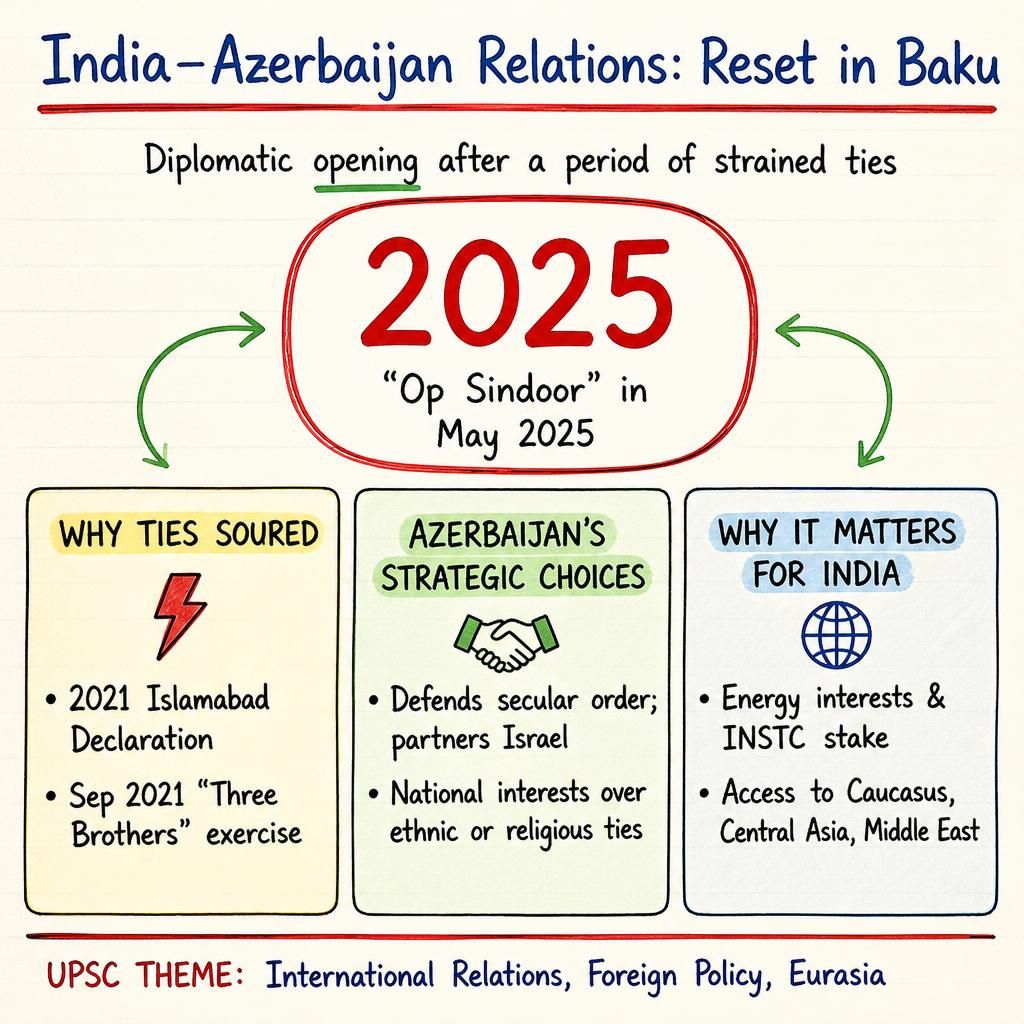
India-Azerbaijan Relations.jpg
Detailed Insights:
- India's relations with Azerbaijan had previously soured, notably during "Op Sindoor" in May 2025, and due to the 2021 Islamabad Declaration and "Three Brothers" military exercise involving Turkey, Azerbaijan, and Pakistan.
- The Islamabad Declaration in 2021 saw Turkey, Azerbaijan, and Pakistan back Pakistan's stance on Kashmir and agree to enhance cooperation on various issues.
- The "Three Brothers" military exercise in September 2021 involved special forces from Azerbaijan, Turkey, and Pakistan, aiming to strengthen ties and combat terrorism.
- Pan-Turkism, promoted by Turkey, faces limitations as national interests often override shared ethnic or religious identities, as seen in recent Turkey-Azerbaijan friction.
- Azerbaijan has defended its secular order against conservative Turkish criticism regarding headscarf restrictions and maintains a strategic relationship with Israel, despite Turkey's differing stance.
- Central Asian republics, members of the Organisation of Turkic States (OTS), pursue "multi-vector" foreign policies, welcoming Turkish investment but rejecting proposals for the OTS to become a military bloc.
- India has energy interests in Azerbaijan and a stake in the International North-South Transport Corridor (INSTC), which passes through Azerbaijan.
- Closer engagement with Azerbaijan can enhance India's access to the Caucasus, Central Asia, and the Greater Middle East, while balancing its partnership with Armenia.
Key Concepts Involved:
- Organisation of Turkic States (OTS): An intergovernmental organization promoting comprehensive cooperation among Turkic states, formed in 2009 as the Turkic Council and renamed in 2021.
- International North-South Transport Corridor (INSTC): A 7,200 km multi-modal network of ship, rail, and road routes for moving freight between India, Iran, Azerbaijan, Russia, Central Asia, and Europe.
- Multi-vector foreign policy: A foreign policy approach where a state seeks to develop relations with multiple international actors, rather than aligning exclusively with one power bloc.

SuperKalam is your personal mentor for UPSC preparation, guiding you at every step of the exam journey.
Download the App


STUDY RESOURCES
CONTACT US
ⓒ Snapstack Technologies Private Limited