GS 2: International RelationsGS 3: EconomyPrelimsGS 3: Changes in Industrial Policy and Effects on Industrial GrowthGS 2: Effect of Policies and Politics of Developed and Developing Countries on India's Interests
The paradox of de-Sinification in global production, Pg6
De-Sinification presents a paradox for global production, challenging firms to move beyond factories and rebuild complex industrial ecosystems, creating opportunities for India.
Practice MCQs
804 Students attempted
Key Highlights:
- SpaceX's reported efforts in July 2026 to remove Chinese components from its supply chain highlight a new phase in global production restructuring.
- The challenge of "de-Sinification" is two-sided, affecting both foreign firms seeking to reduce reliance on China and Chinese firms expanding overseas.
- Chinese companies like BYD and Xpeng are establishing manufacturing abroad but face difficulties in replicating their domestic industrial ecosystems.
- India is emerging as a beneficiary of this reorganisation, attracting investments from companies like TDK and Murata Manufacturing as part of the China-plus-one strategy.
- India's opportunity lies in developing its own robust industrial ecosystem, beyond just attracting individual factories, by fostering domestic suppliers and capabilities.
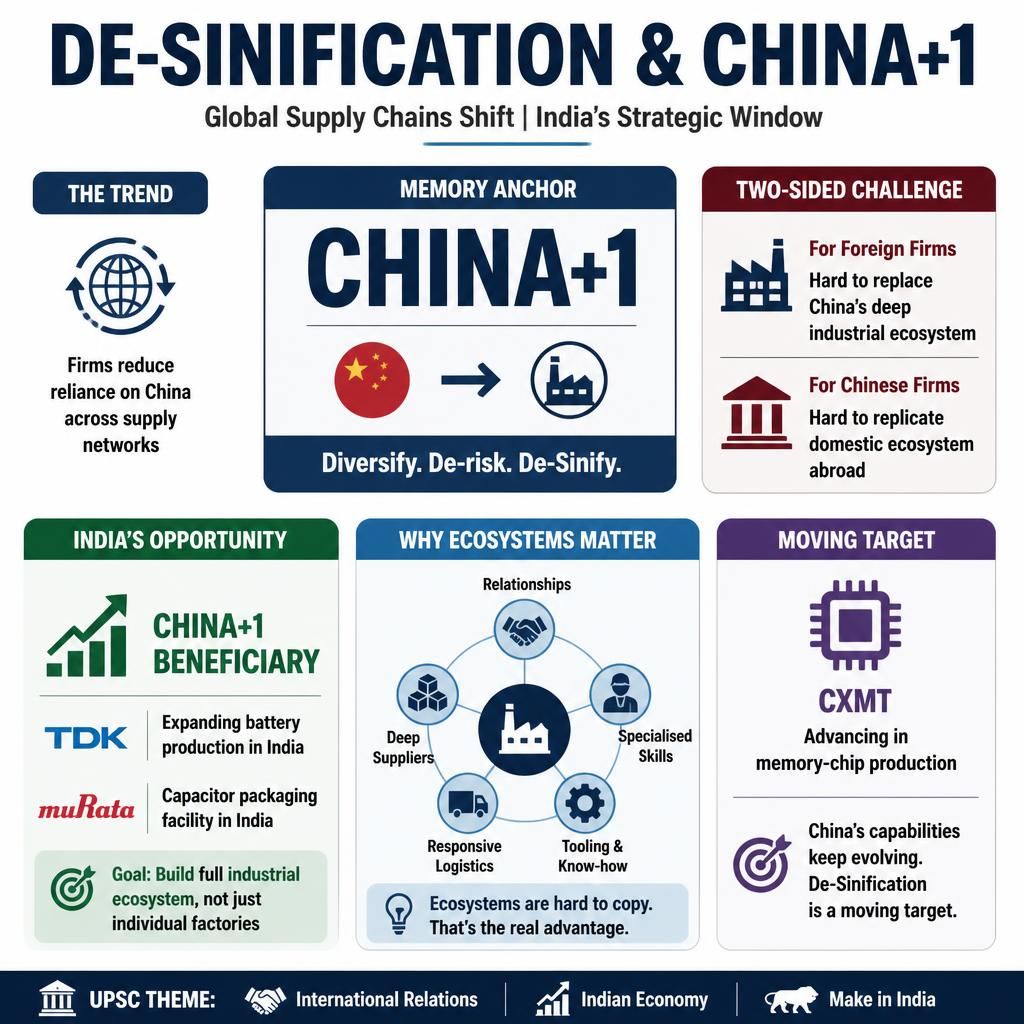
China + 1.jpg
Detailed Insights:
- Global production is shifting from simple assembly location to the deeper layers of complex supply networks, making disentanglement from existing ecosystems challenging.
- Foreign firms find it difficult to replace deeply embedded Chinese suppliers and capabilities due to the intricate nature of China's industrial ecosystem.
- Chinese firms expanding internationally, such as BYD in Hungary and Xpeng with Magna Steyr in Austria, struggle to port their competitive domestic ecosystems abroad.
- China's industrial capabilities are continuously evolving, with companies like CXMT advancing in memory-chip production, making "de-Sinification" a moving target.
- Industrial ecosystems are more than just suppliers; they encompass accumulated relationships, specialized skills, tooling, production knowledge, and responsive logistics networks.
- India's strategic importance is growing as companies diversify their manufacturing bases, with TDK expanding battery production and Murata Manufacturing establishing capacitor packaging in India.
- To fully capitalize on this trend, India needs to cultivate domestic suppliers, ensure reliable logistics, develop skilled labor, and provide access to critical inputs.
- The true measure of new investments in India should be their ability to deepen linkages with Indian firms and integrate specialized capabilities into the domestic economy.
Key Concepts Involved:
- De-Sinification: The process of reducing economic dependence on China, particularly in manufacturing and supply chains.
- Industrial Ecosystem: A complex network of interconnected businesses, suppliers, infrastructure, and skilled labor that supports a particular industry.
- China-plus-one strategy: A business strategy where companies diversify their manufacturing and supply chain operations by adding at least one country outside of China to mitigate risks.

SuperKalam is your personal mentor for UPSC preparation, guiding you at every step of the exam journey.
Download the App


STUDY RESOURCES
CONTACT US
ⓒ Snapstack Technologies Private Limited