GS 3: Science & TechnologyGS 2: International RelationsGS 3: EconomyPrelimsGS 2: Bilateral, Regional and Global Groupings and Agreements
Reading Sino-US signals: ‘Strategic competition’ vs ‘strategic stability’, Pg9
US-China summit reveals 'stabilisation without settlement' amidst strategic competition, trade disputes, and AI technology race, with Taiwan remaining a key fault line.
Practice MCQs
804 Students attempted
Key Highlights:
- US President Donald Trump and Chinese President Xi Jinping held a bilateral summit in Washington, D.C., focusing on managing competition in AI and trade, though no major breakthrough was announced.
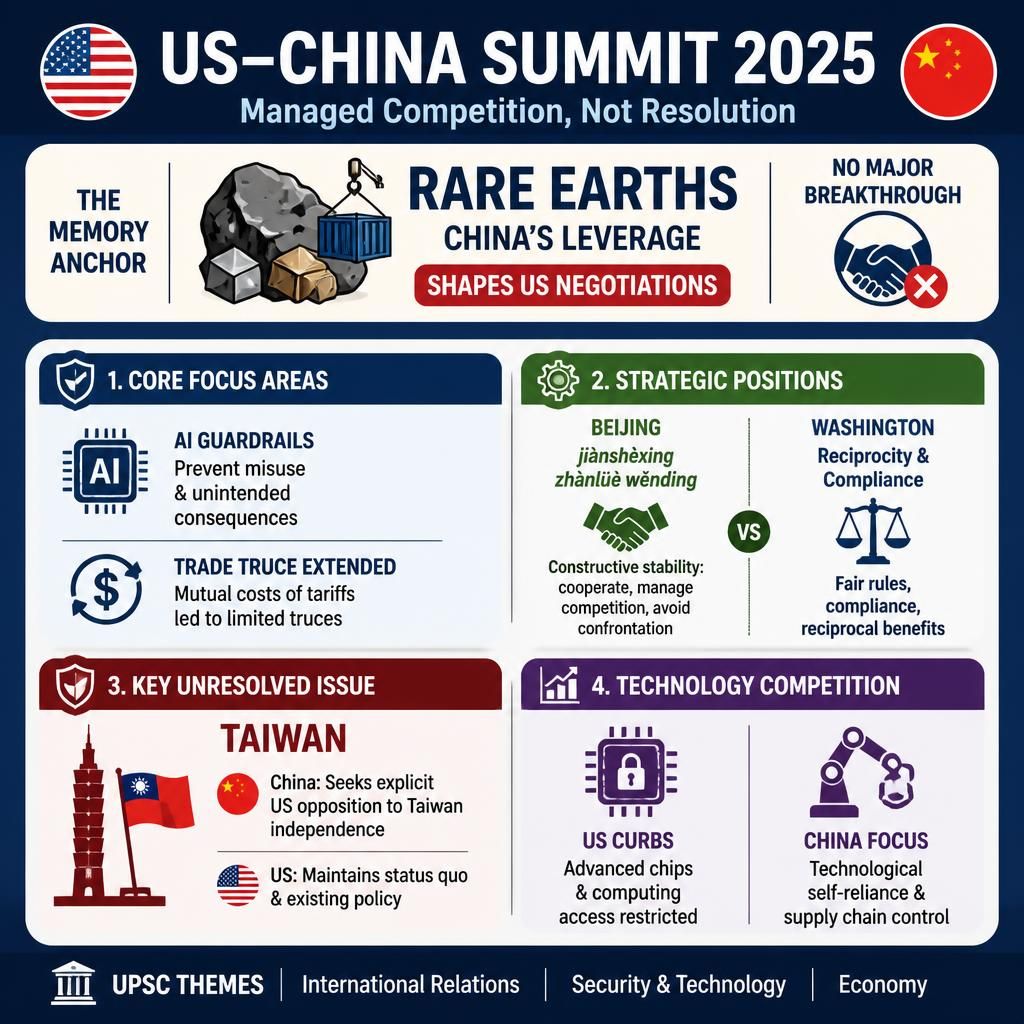
- China's leverage, particularly through Rare Earths and critical minerals, has influenced the US approach to negotiations.
- Both nations are engaged in discussions regarding AI guardrails to prevent dangerous unintended consequences of technological competition, despite differing approaches to AI governance.
- A significant unresolved issue remains Taiwan, with Beijing pressing Washington to explicitly oppose Taiwan independence, while the US maintains its stance.
- The tariff confrontation of 2025 highlighted the mutual costs of economic coercion, leading to a return to summitry and trade truces.
US-China Summit.jpg
Detailed Insights:
- The elaborate welcome for Xi Jinping signaled US recognition of China's increased bargaining leverage in the global arena.
- China's concept of xianghu zunzhong (mutual respect) implies that China expects to be treated as a major power whose interests cannot be easily overridden.
- The trade truce extensions, while limited in duration, reflect a mutual incentive to prevent uncontrolled escalation of economic disputes.
- The US continues to restrict Chinese access to advanced chips and computing capabilities, while Beijing prioritizes technological self-reliance.
- China advocates for jiànshèxìng zhànlüè wěndìng (constructive strategic stability) to ensure cooperation, manage competition, and avoid confrontation.
- Washington emphasizes reciprocity and compliance in economic engagement, contrasting with Beijing's focus on hùlì gòngyíng (mutual benefit and win-win cooperation).
- The AI dialogue includes discussions on a notification mechanism for AI incidents with national security implications, despite public differences on AI regulation.
- Disagreements persist over the broader Asian security order and the US's alliances and commitments in the region.
Key Concepts Involved:
- Strategic Competition: The framework used by the US to describe its rivalry with China across various domains, including economic, technological, and geopolitical.
- Strategic Stability: China's proposed framework (jiànshèxìng zhànlüè wěndìng) for managing major power relations, aiming for cooperation, controlled competition, and avoidance of confrontation.
- Rare Earths: A group of 17 chemical elements critical for high-tech industries, where China holds significant global dominance in production and processing, providing it with economic leverage.
- AI Guardrails: Mechanisms or agreements designed to prevent unintended, dangerous consequences arising from the development and deployment of Artificial Intelligence, particularly in a competitive environment.

SuperKalam is your personal mentor for UPSC preparation, guiding you at every step of the exam journey.
Download the App


STUDY RESOURCES
CONTACT US
ⓒ Snapstack Technologies Private Limited