GS 3: EconomyPrelimsGS 3: Indian Economy, Planning, Mobilization of Resources, Growth, Development and EmploymentGS 2: Government policies and interventions for development in various sectors
Life of buildings to gold: Lesser known changes in GDP series, Pg13
MoSPI introduces lesser-known changes to India's GDP series, refining enterprise classification, asset valuation, household savings data, and including rooftop solar output.
Practice MCQs
804 Students attempted
Key Highlights:
- India's new GDP series, with a base year of 2022-23, incorporates several methodological changes beyond the widely discussed ones.
- Enterprise classification now allocates Gross Value Added (GVA) proportionally across sectors using data from MGT-7 and MGT-7A forms.
- Housing services provided by the government to its employees are now valued and included in the GDP calculation.
- The 'average useful life' for various assets, including dwellings, has been revised downwards in the new series.
- Data for household financial savings is now sourced from the Securities and Exchange Board of India (SEBI), enabling the inclusion of instruments like REITs, InvITs, and AIFs.
- Electricity generated by households through rooftop solar panels is now accounted for in the 'electricity, gas, water supply & other utility services' sub-sector.
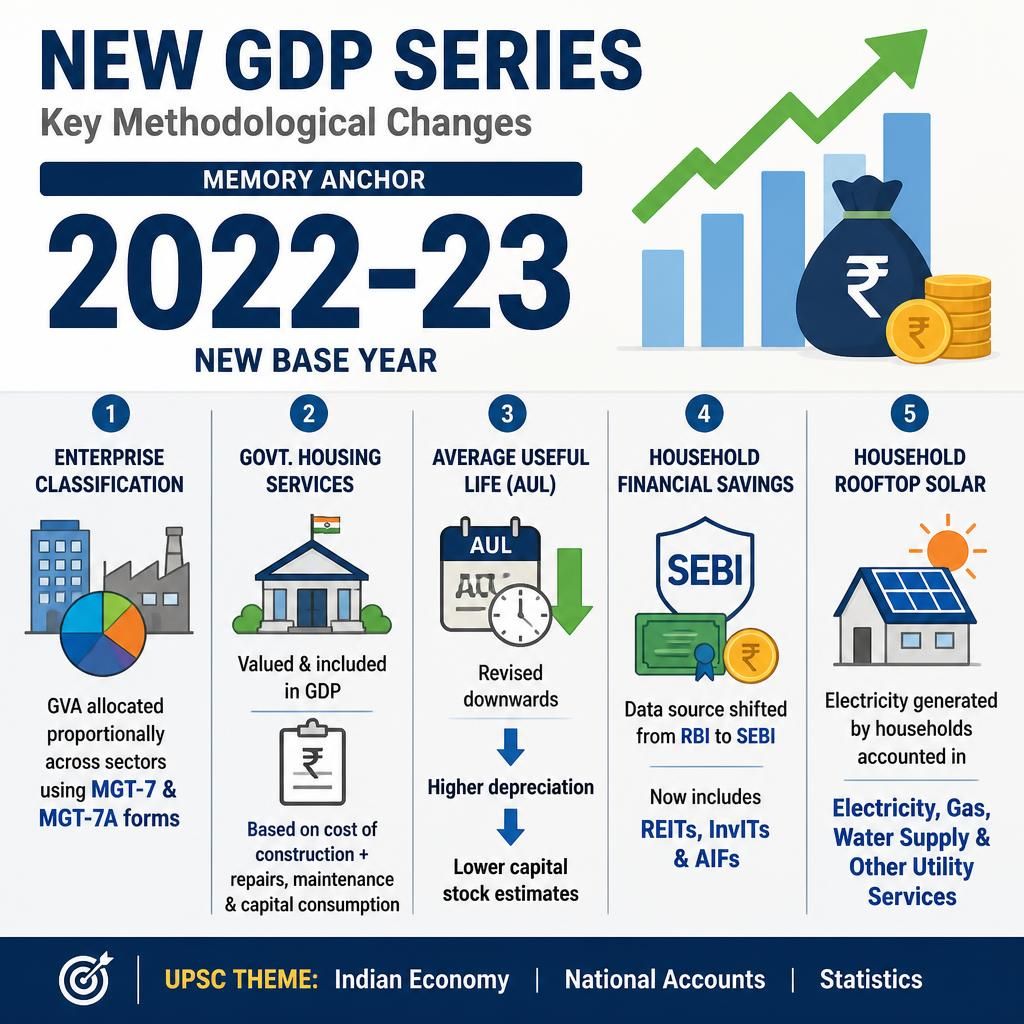
New GDP Series Changes.jpg
Detailed Insights:
- The previous GDP series (base year 2011-12) classified multi-activity enterprises based solely on their 'major activity'.
- The new proportional allocation method provides a more accurate sectoral distribution of economic output.
- MGT-7 and MGT-7A forms are annual returns filed by companies with the Ministry of Corporate Affairs, providing granular financial and operational data.
- The valuation of government housing services is based on the cost of construction, adjusted for repair, maintenance, and capital consumption.
- A shorter 'average useful life' for assets impacts the calculation of depreciation and the overall capital stock estimates.
- The shift from the Reserve Bank of India (RBI) to SEBI as the primary data source for financial savings enhances the coverage and accuracy of these statistics.
- The inclusion of Real Estate Investment Trusts (REITs), Infrastructure Investment Trusts (InvITs), and Alternative Investment Funds (AIFs) broadens the scope of financial savings.
- Accounting for household rooftop solar generation reflects the growing contribution of decentralized renewable energy to the economy.
Key Concepts Involved:
- Gross Value Added (GVA): A measure of the value of goods and services produced in an area, industry, or sector of an economy.
- Base Year: A reference year for calculating economic indicators like GDP, allowing for comparison of real growth over time.
- MGT-7 and MGT-7A: Annual return forms filed by companies with the Ministry of Corporate Affairs providing financial and operational details.
- Real Estate Investment Trust (REIT): A company that owns, operates, or finances income-generating real estate.
- Alternative Investment Fund (AIF): Privately pooled investment vehicles that invest in various asset classes like venture capital or private equity.
Previous12/12

SuperKalam is your personal mentor for UPSC preparation, guiding you at every step of the exam journey.
Download the App


STUDY RESOURCES
CONTACT US
ⓒ Snapstack Technologies Private Limited