GS 2: GovernanceGS 3: Science & TechnologyGS 3: Environment & EcologyGS 3: EconomyPrelims
As Fungal Disease Hits Sugar Output In UP, New Cane Variety Holds Hope, Pg1
India's solar capacity surges, with PM-KUSUM and agri-PV offering transformative potential for farmers' income and rural industrialization, despite sugarcane output challenges.
Practice MCQs
804 Students attempted
Key Highlights:
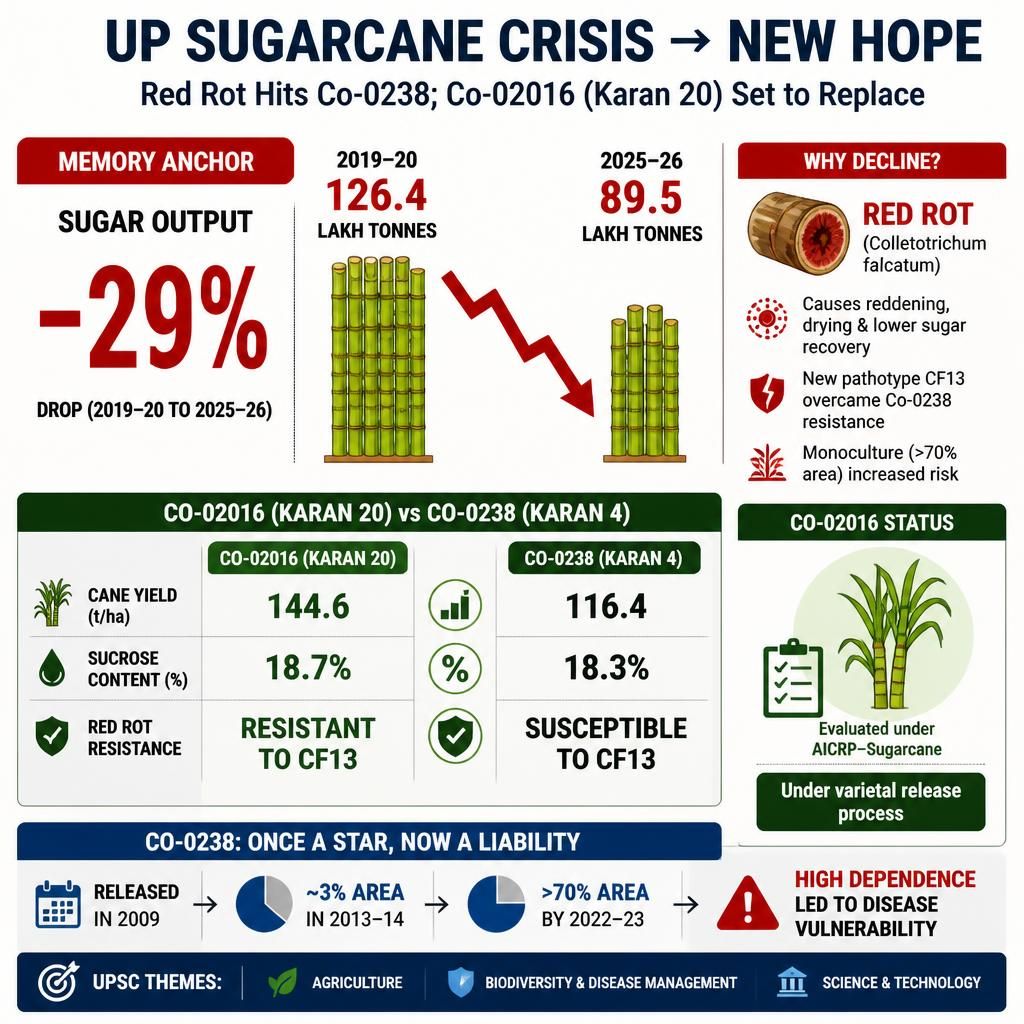
- Uttar Pradesh’s sugar output fell sharply from 126.4 lakh tonnes in 2019-20 to about 89.5 lakh tonnes in 2025-26, partly due to red rot disease.
- The widely cultivated sugarcane variety Co-0238 (Karan 4) has become increasingly susceptible to red rot, contributing to lower cane yields and sugar recovery.
- A new variety, Co-02016 (Karan 20), developed by ICAR-Sugarcane Breeding Institute (ICAR-SBI), is being considered as a potential replacement for Co-0238.
- Co-02016 recorded an average cane yield of about 144.6 tonnes/hectare in industry trials, compared with 116.4 tonnes/hectare for Co-0238.
- Co-02016 also recorded higher mean sucrose content at around 18.7%, compared with 18.3% for Co-0238.
- The variety has shown resistance to the highly virulent CF13 red-rot pathotype and is undergoing the varietal release process before commercial cultivation.
Sugarcane Crisis.jpg
Detailed Insights:
- Co-0238 was released in 2009 for north-western India and combined early maturity, high cane yield and high sugar recovery.
- Its acreage in Uttar Pradesh rose from about 3% in 2013-14 to over 70% by 2022-23, creating heavy dependence on a single variety.
- Large-scale monoculture increases genetic uniformity, allowing evolving pathogens to spread rapidly and overcome resistance developed for earlier pathogen strains.
- Red rot is caused by the fungus Colletotrichum falcatum and can cause reddening of internal tissues, drying, reduced cane weight and lower sucrose recovery.
- Co-0238 was initially moderately resistant to prevalent red-rot races, but emergence of newer pathotypes such as CF13 weakened its field resistance.
- Co-02016 has undergone multi-location evaluation under the All India Coordinated Research Project on Sugarcane (AICRP-Sugarcane) to assess yield, quality and disease resistance.
- Diversifying cultivated varieties, using disease-free planting material, crop rotation and removing infected plants can reduce pathogen build-up and monoculture-related vulnerability.
- Disease-resistant varieties are important beyond sugar production because sugarcane also supports ethanol, jaggery, molasses, cogeneration and farmers' incomes.
Scientific/Technical Concepts Involved:
- Red Rot: A fungal sugarcane disease caused by Colletotrichum falcatum that damages stalk tissues and reduces yield and sugar recovery.
- Pathotype: A pathogen variant distinguished by its ability to infect particular host varieties with different resistance traits.
- Monoculture: Repeated large-scale cultivation of one crop or variety, increasing vulnerability to pests and diseases.
- Sugar Recovery: Percentage of sugar obtained from crushed sugarcane, indicating the efficiency and sugar content of the harvested cane.

SuperKalam is your personal mentor for UPSC preparation, guiding you at every step of the exam journey.
Download the App


STUDY RESOURCES
CONTACT US
ⓒ Snapstack Technologies Private Limited