GS 2: GovernanceGS 2: PolityPrelimsGS 2: Indian Constitutional Evolution, Features, Amendments, Basic Structure DoctrineGS 2: Parliament and State Legislatures
Why 543 Should Remain 543, Pg8
Article argues against enlarging Lok Sabha beyond 543 seats, advocating for preserving federal balance and improving parliamentary deliberation amidst delimitation and women's reservation debates.
Practice MCQs
796 Students attempted
Key Highlights:
- A debate is ongoing regarding whether the Lok Sabha should be enlarged beyond its current 543 seats during the upcoming delimitation exercise.
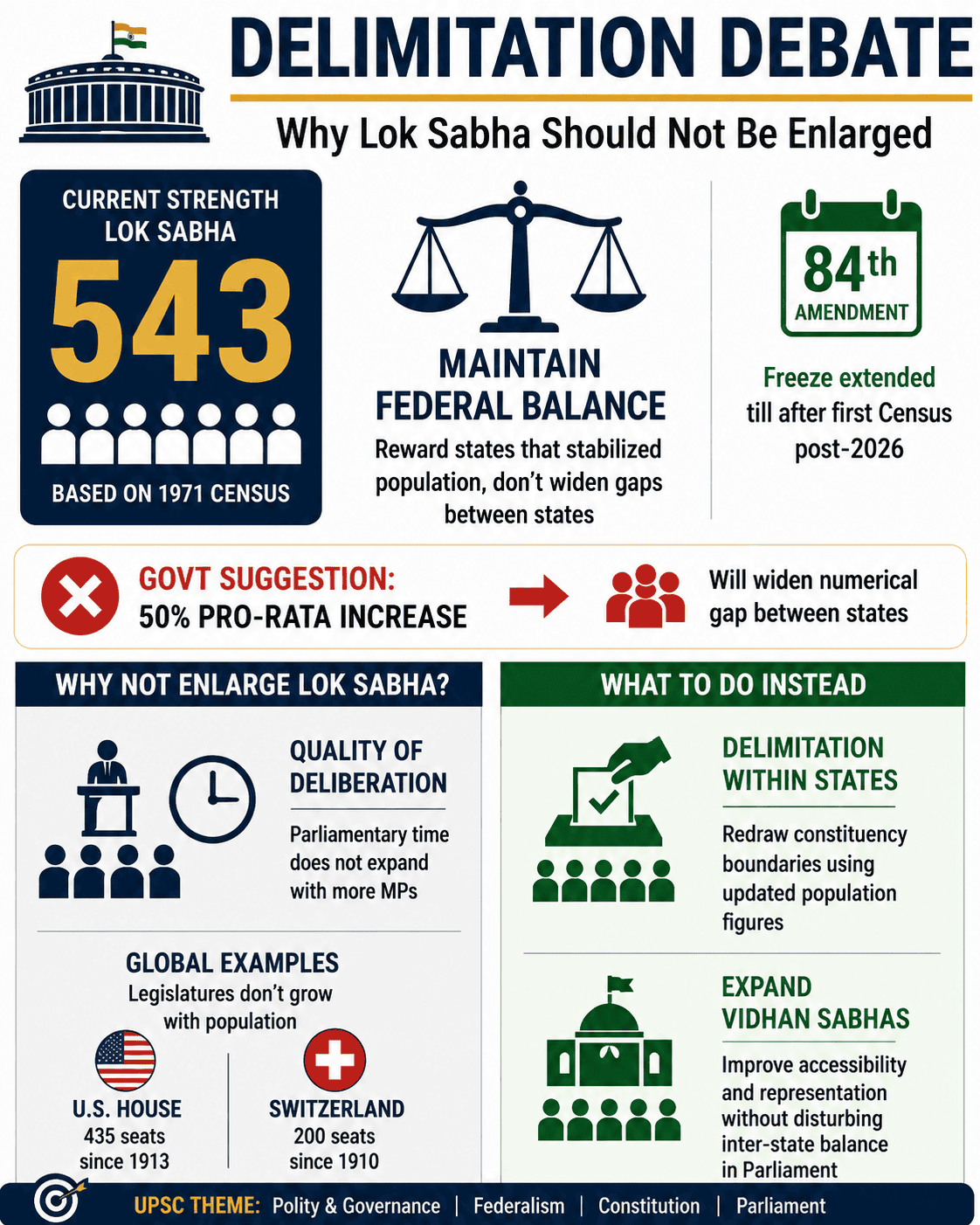
- The article argues against increasing the number of seats, emphasizing the importance of maintaining the existing federal balance and quality of parliamentary deliberation.
- The current freeze on Lok Sabha seats, based on the 1971 Census, was extended by the 84th Amendment until after the first Census post-2026.
- The government has reportedly suggested a 50% pro-rata increase in seats, which critics argue would widen the numerical gap between states.
Delimitation.jpg
Detailed Insights:
- The 42nd Constitutional Amendment in 1976 froze the inter-state allocation of Lok Sabha seats based on the 1971 Census to avoid penalizing states successful in family planning.
- This freeze established a federal compact, ensuring states that stabilized population would not lose political voice.
- Enlarging the Lok Sabha could weaken the quality of deliberation, as parliamentary time does not expand with the number of Members of Parliament.
- International examples like the U.S. House of Representatives and Switzerland's National Council show that legislatures do not necessarily grow with population.
- The article suggests that delimitation can occur within states to redraw constituency boundaries based on updated population figures without increasing the total number of seats.
- Expanding Vidhan Sabhas (State Legislative Assemblies) is proposed as a solution to address increased accessibility needs due to population growth, without disturbing the inter-state balance in Parliament.
- Women's reservation, now linked to delimitation, can be implemented within the existing 543 seats, as one-third of the current Lok Sabha is approximately 181 seats.
Key Concepts Involved:
- Delimitation: The process of redrawing boundaries of electoral constituencies to ensure equal representation.
- Prorogation: The formal ending of a parliamentary session by the President, distinct from adjournment sine die.
- Federal Compact: An unwritten agreement or understanding between the Union and states, particularly regarding the distribution of political power.
- Vidhan Sabhas: The State Legislative Assemblies in India, responsible for law-making at the state level.

SuperKalam is your personal mentor for UPSC preparation, guiding you at every step of the exam journey.
Download the App


STUDY RESOURCES
CONTACT US
ⓒ Snapstack Technologies Private Limited