GS 1: Physical GeographyGS 3: Disaster ManagementGS 3: Environment & EcologyPrelimsGS 3: Disaster and Disaster Management
Hanging Glacier Collapse in Focus, NDMA for Hard Look to Reduce Future Risks, Pg1
NDMA plans comprehensive study on Nepal's devastating glacier collapse, reinforcing India's urgent need for robust early warning systems against similar Himalayan flash flood risks.
Practice MCQs
796 Students attempted
Key Highlights:
- A hanging glacier collapse is identified as the likely trigger for a devastating flash flood in Nepal.
- The National Disaster Management Authority (NDMA) plans a comprehensive study on the Nepal incident due to similar vulnerabilities in India.
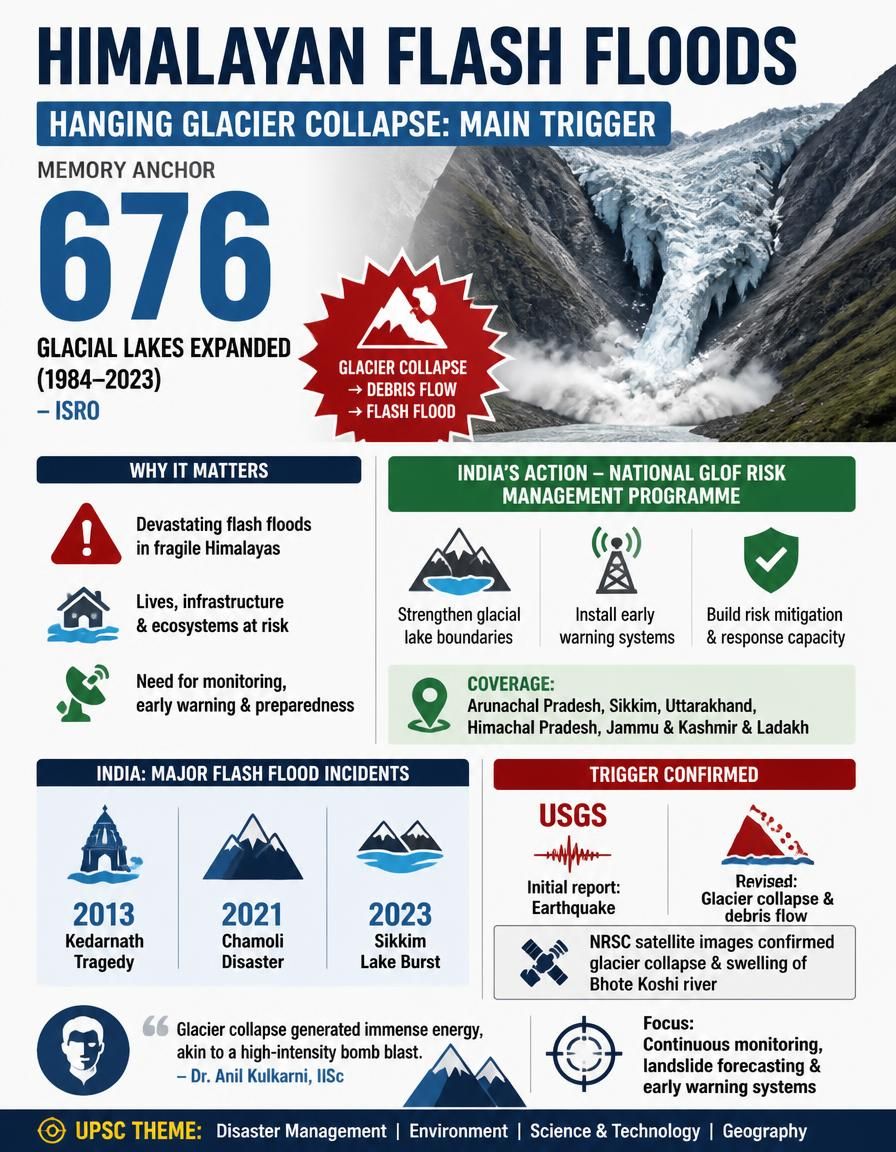
- India has experienced several major flash flood incidents, including the Kedarnath tragedy (2013), Chamoli disaster (2021), and Sikkim lake burst (2023).
- The NDMA initiated the National GLOF Risk Management Programme to mitigate risks from glacial lake outburst floods.
- ISRO reported that 676 glacial lakes in the Indian Himalayan river basins expanded significantly between 1984 and 2023.
- The US Geological Services initially reported an earthquake but later revised its assessment, attributing the seismic signal to the glacial collapse and debris flow.
Flash Floods.jpg
Detailed Insights:
- The Nepal flash flood highlights the vulnerability of Himalayan regions to similar disasters, reinforcing the need for robust disaster management strategies.
- The National GLOF Risk Management Programme aims to strengthen glacial lake boundaries and install early warning systems in Arunachal Pradesh, Sikkim, Uttarakhand, Himachal Pradesh, Jammu & Kashmir, and Ladakh.
- Glaciologist Anil Kulkarni of the Indian Institute of Science described the glacier collapse as generating immense energy, akin to a high-intensity bomb blast.
- Satellite images from the National Remote Sensing Centre confirmed the collapse of a glacier mass and the subsequent swelling of the Bhote Koshi river.
- The incident underscores the importance of continuous monitoring of glacial lakes and developing capabilities for landslide forecasting and early warning systems.
- The revised assessment by the US Geological Services indicates the seismic signal was generated by the glacial collapse itself, rather than an earthquake triggering it.
Scientific/Technical Concepts Involved:
- Hanging Glacier: A glacier that terminates abruptly on a steep slope, often leading to icefalls or avalanches.
- Glacial Lake Outburst Flood (GLOF): A sudden release of water from a glacial lake due to the failure of its natural dam.
- Moraine: Accumulations of unconsolidated glacial debris (soil and rock) that have been transported and deposited by a glacier.
- Early Warning Systems: Technologies and procedures designed to detect hazards and disseminate timely alerts to enable preparedness and response.

SuperKalam is your personal mentor for UPSC preparation, guiding you at every step of the exam journey.
Download the App


STUDY RESOURCES
CONTACT US
ⓒ Snapstack Technologies Private Limited