GS 2: GovernanceGS 3: Science & TechnologyGS 3: EconomyPrelims
What is India’s policy on urea production?, Pg10
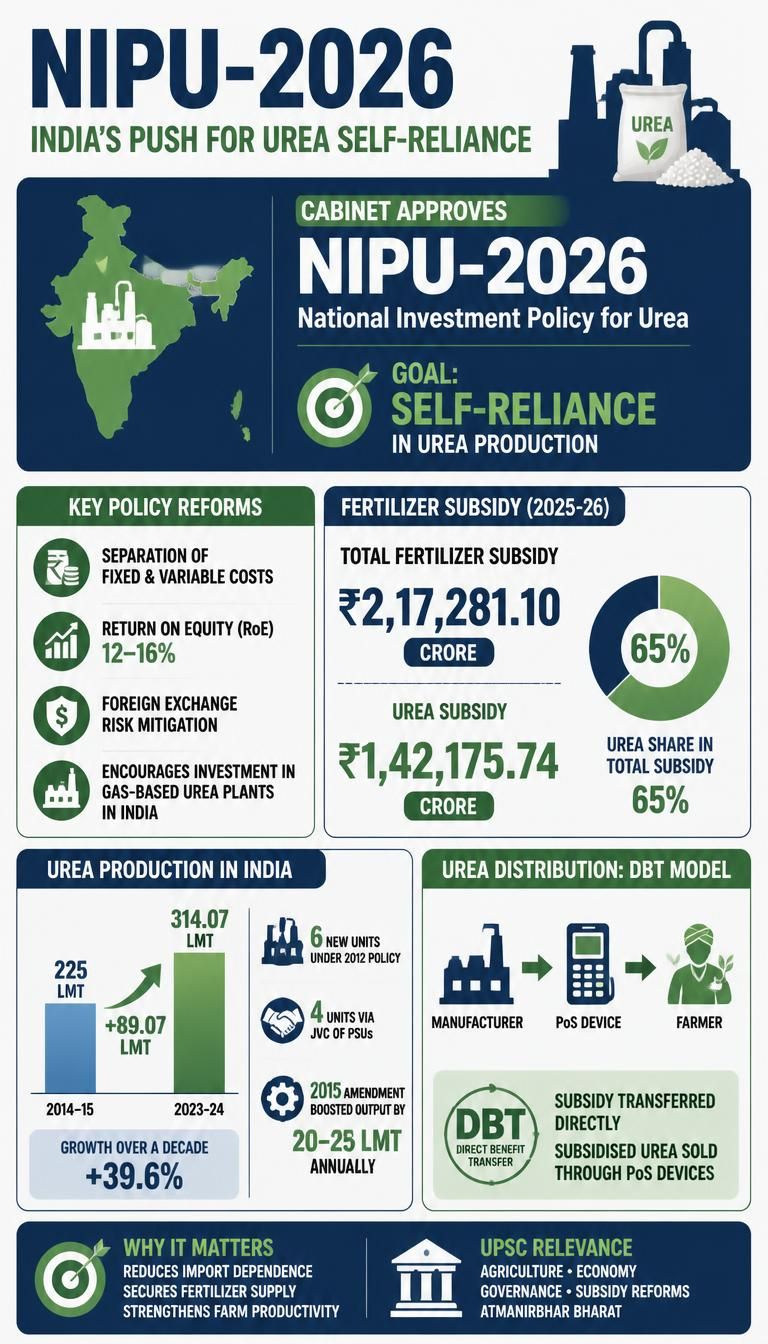
Cabinet approves National Investment Policy for Urea (NIPU)-2026, aiming for self-reliance in domestic production amidst rising import costs and fertilizer shortages.
Practice MCQs
789 Students attempted
Key Highlights:
- The Cabinet Committee on Economic Affairs approved the National Investment Policy for Urea (NIPU)-2026 to achieve self-reliance in urea production.
- The new policy aims to encourage investments in gas-based urea manufacturing units within India.
- Key changes include separating fixed and variable costs, introducing a Return on Equity (RoE) band of 12-16%, and mitigating foreign exchange risk.
- India's total fertilizer subsidy for 2025-26 is projected at ₹2,17,281.10 crore, with urea alone accounting for ₹1,42,175.74 crore.
- The country's urea production increased from 225 LMT in 2014-15 to 314.07 LMT in 2023-24.
NIPU.jpg
Detailed Insights:
- The NIPU-2026 addresses concerns about fertilizer shortages due to geopolitical situations and increased demand from El Niño effects.
- Previous urea policies were announced in 2012 and 2013, with amendments in October 2014 to facilitate fresh investments.
- Six new urea units were established under the 2012 policy, including four through Joint Venture Companies (JVC) of PSUs.
- An amendment in May 2015 for 25 existing gas-based urea units led to an additional production of 20-25 LMT annually.
- Urea is made available through a Direct Benefit Transfer (DBT) system, where subsidized fertilizers are sold via Point of Sale (PoS) devices.
- The government promotes Integrated Nutrient Management (INM) for balanced and efficient fertilizer use, combining organic, chemical, and biological inputs.
- The DBT system identifies beneficiaries using Aadhaar Card, Kisan Credit Card (KCC), or Voter Identity Card.
Key Concepts Involved:
- National Investment Policy for Urea (NIPU)-2026: A government policy aimed at boosting domestic urea production and achieving self-reliance through new investments.
- Direct Benefit Transfer (DBT): A system where subsidies are directly transferred to beneficiaries, ensuring transparent and efficient delivery of subsidized fertilizers.
- Integrated Nutrient Management (INM): An approach that combines various nutrient sources (organic, chemical, biological) to optimize crop nutrition and maintain soil health sustainably.

SuperKalam is your personal mentor for UPSC preparation, guiding you at every step of the exam journey.
Download the App


STUDY RESOURCES
CONTACT US
ⓒ Snapstack Technologies Private Limited