GS 2: GovernanceGS 2: PolityPrelims
SC seeks Centre’s reply on plea over anti-defection law, Pg14
Supreme Court seeks Centre's response on plea challenging anti-defection law's 'merger' exception, fearing manipulation of electoral verdicts.
Practice MCQs
789 Students attempted
Key Highlights:
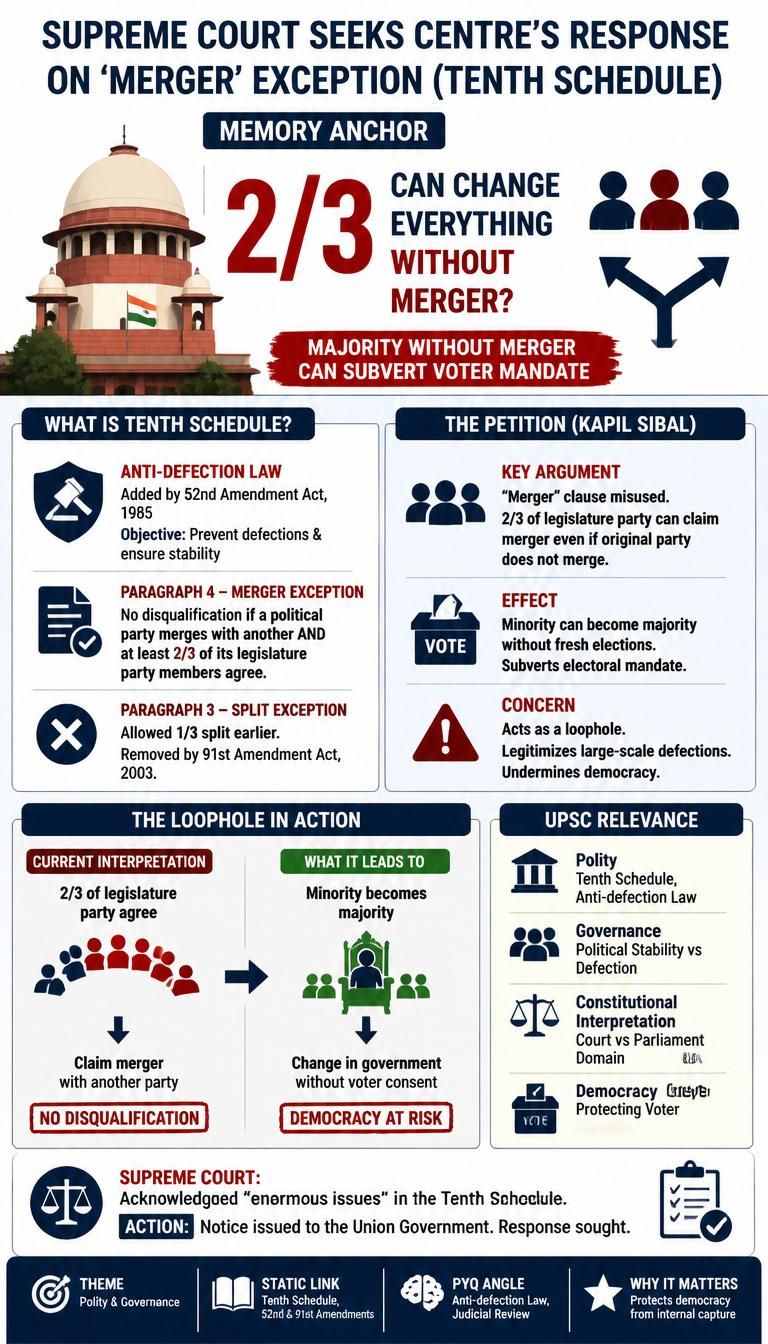
- The Supreme Court has sought the Union government’s response on a petition challenging the interpretation of the "merger" exception under the Tenth Schedule of the Constitution.
- Senior advocate Kapil Sibal, the petitioner, argues that the current interpretation of Paragraph 4 of the Tenth Schedule allows a legislature party to claim a merger with another party if two-thirds of its members agree, even without the original political party formally merging.
- Sibal contends that this interpretation can subvert electoral mandates by enabling a minority to become a majority without fresh elections.
- The Supreme Court, while acknowledging "enormous issues" with the Tenth Schedule, issued notice to the Centre on the plea.
10th Schedule.jpg
Detailed Insights:
- The Tenth Schedule, commonly known as the Anti-defection law, was introduced by the 52nd Amendment Act, 1985, to prevent political defections and ensure governmental stability.
- Paragraph 4 of the Tenth Schedule provides an exception to disqualification if a political party merges with another, and at least two-thirds of its legislature party members agree to the merger.
- Sibal's petition highlights the critical distinction between a political party (the overarching organization) and a legislature party (elected members in the House).
- The 91st Amendment Act, 2003, removed the "split" exception (Paragraph 3) which allowed one-third of a legislature party to break away without disqualification, but retained the "merger" exception.
- The Supreme Court initially expressed that issues concerning the Tenth Schedule are primarily matters for Parliament to address.
- The plea suggests that the current interpretation of the merger clause acts as a loophole, legitimizing large-scale defections and undermining the democratic process.
Key Concepts Involved:
- Tenth Schedule: Part of the Indian Constitution containing the Anti-defection law, added by the 52nd Amendment Act, 1985.
- Anti-defection law: Legislation aimed at preventing elected representatives from changing political parties for personal gain or to destabilize governments.
- Political party: The registered organization outside the legislature that contests elections and forms a government.
- Legislature party: The group of elected members representing a political party within a legislative body.

SuperKalam is your personal mentor for UPSC preparation, guiding you at every step of the exam journey.
Download the App


STUDY RESOURCES
CONTACT US
ⓒ Snapstack Technologies Private Limited