GS 3: Science & TechnologyGS 3: EconomyPrelims
RBI to trial Rs 3k cr worth of Rs 10, Rs 20 plastic notes, Pg13
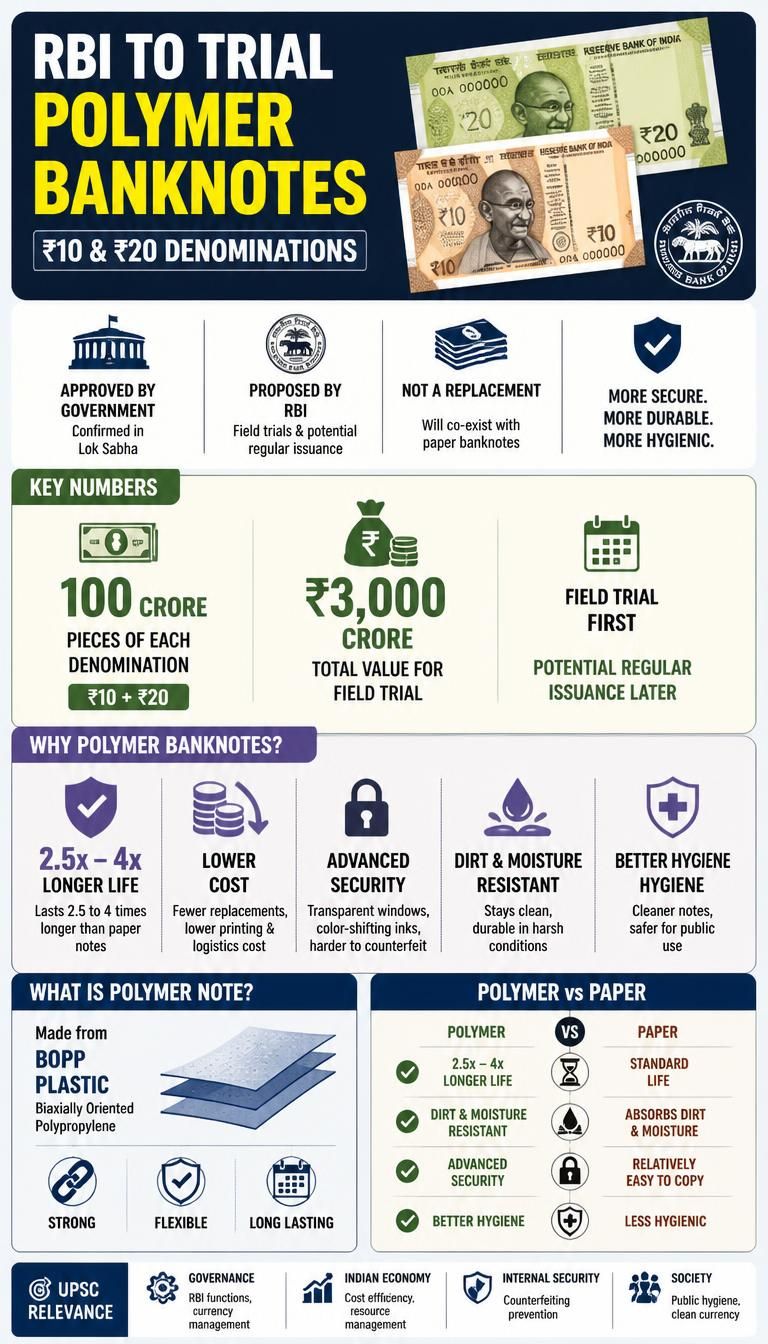
RBI to trial 100 crore pieces each of Rs 10, Rs 20 plastic notes, totaling Rs 3,000 crore.
Practice MCQs
789 Students attempted
Key Highlights:
- The Reserve Bank of India (RBI) will conduct field trials for polymer banknotes of ₹10 and ₹20 denominations.
- A total of 100 crore pieces of each denomination, amounting to ₹3,000 crore, will be introduced for the trial.
- Minister of State for Finance Pankaj Chaudhary confirmed the government's approval of the RBI's proposal in the Lok Sabha.
- The initiative aims for field trials and potential regular issuance alongside paper banknotes, with no plan to replace existing paper currency.
RBI Notes.jpg
Detailed Insights:
- Polymer banknotes are manufactured from specialized biaxially oriented polypropylene (BOPP) plastic, offering greater durability than traditional cotton-rag paper notes.
- These notes are expected to last 2.5 to 4 times longer than paper currency, particularly for frequently handled lower denominations, thereby reducing replacement costs.
- They incorporate advanced anti-counterfeiting features, such as transparent windows and color-shifting inks, making them more secure.
- Polymer banknotes are resistant to dirt and moisture, contributing to better hygiene and cleanliness in circulation.
- While initial production costs are higher, their extended lifespan leads to lower overall lifecycle costs and a reduced environmental footprint due to fewer replacements.
- Over 60 countries globally, including Australia (the pioneer in 1988), Canada, and the UK, utilize polymer banknotes in some form.
- India had a previous attempt at a field trial for ₹10 plastic notes in 2009/2012 across five diverse climatic zones, which was shelved due to technical issues, particularly with ATM compatibility.
- The current proposal was submitted by the RBI under Section 25 of the Reserve Bank of India Act, 1934.
- Bharatiya Reserve Bank Note Mudran Private Limited (BRBNMPL), an RBI subsidiary, is involved in the procurement of polymer sheets for printing.
Key Concepts Involved:
- Polymer Banknotes: Currency notes made from biaxially oriented polypropylene (BOPP) plastic, designed for enhanced durability, security, and longevity compared to paper notes.
- Reserve Bank of India (RBI): India's central banking institution responsible for issuing and regulating currency, formulating monetary policy, and overseeing the financial system.
- Lok Sabha: The lower house of the Parliament of India, where government decisions and policies are often announced and debated.
- Bharatiya Reserve Bank Note Mudran Private Limited (BRBNMPL): A wholly-owned subsidiary of the Reserve Bank of India responsible for the printing of Indian banknotes.
Previous16/16

SuperKalam is your personal mentor for UPSC preparation, guiding you at every step of the exam journey.
Download the App


STUDY RESOURCES
CONTACT US
ⓒ Snapstack Technologies Private Limited