GS 2: GovernanceGS 3: Environment & EcologyGS 3: EconomyPrelims
Beyond compliance, India’s road to cleaner mobility, Pg8
India's CAFE III norms spark debate over effective stringency, balancing cleaner mobility and energy security amidst industry lobbying and global EV transition.
Practice MCQs
789 Students attempted
Key Highlights:
- India is currently debating the proposed Corporate Average Fuel Efficiency (CAFE) III norms for its automobile industry.
- The Power Ministry issued a draft notification on July 16, outlining the third iteration of these norms.
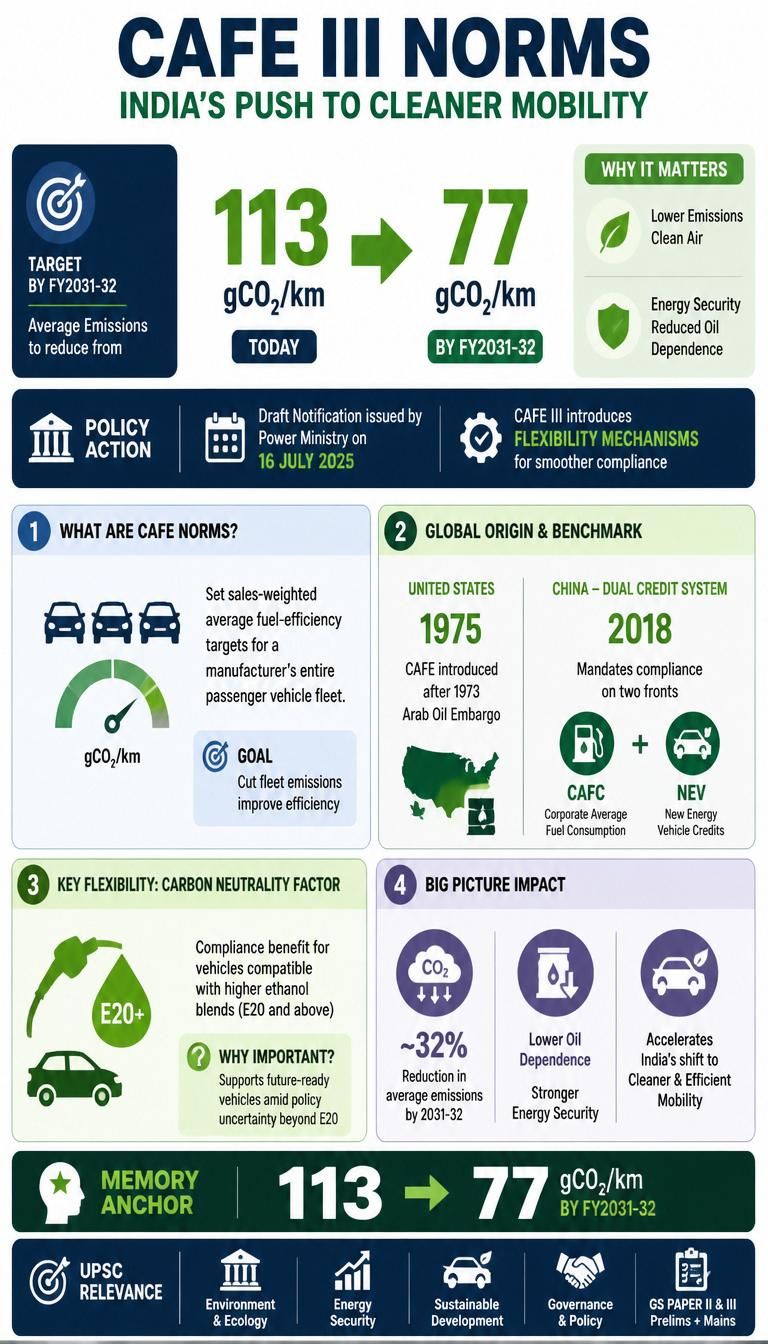
- The new norms aim to reduce average emissions from approximately 113 gCO2/km to 77 gCO2/km by FY2031-32.
- The framework introduces several flexibility mechanisms, including the Carbon Neutrality Factor and Super Credits.
- The implementation of these norms is critical for India's transition to cleaner mobility and enhancing energy security.
CAFE III.jpg
Detailed Insights:
- CAFE norms establish sales-weighted average fuel-efficiency targets for a manufacturer's entire passenger vehicle fleet.
- The concept originated in the United States in 1975 following the 1973 Arab oil embargo to reduce oil dependence.
- China's Dual Credit System, introduced in 2018, mandates manufacturers to meet both Corporate Average Fuel Consumption (CAFC) and New Energy Vehicle (NEV) credit requirements.
- The Carbon Neutrality Factor in India's proposed norms offers compliance benefits for vehicles compatible with higher ethanol blends, despite policy uncertainties beyond E20 blending.
- Super Credits provide additional weight to Battery EVs, plug-in hybrids, strong hybrids, and flex-fuel vehicles in fleet calculations.
- Manufacturers can bank, trade, or purchase compliance credits from the Bureau of Energy Efficiency (BEE), potentially allowing some to meet targets without significant technological upgrades.
- Compliance is assessed over three-year blocks, later shifting to two-year blocks, allowing manufacturers to average performance over multiple years.
- Strengthening fuel-efficiency standards is considered an energy-security strategy, an industrial policy, and a macroeconomic imperative for India.
- These revised norms offer an opportunity to address India's macroeconomic vulnerability and contribute to its Glasgow commitment on energy efficiency.
Key Concepts Involved:
- Corporate Average Fuel Efficiency (CAFE) Norms: Regulations that set average fuel efficiency targets for an automaker's entire fleet of vehicles sold in a given year.
- Dual Credit System: A regulatory framework, notably in China, requiring automakers to meet both fuel consumption and new energy vehicle production targets.
- Carbon Neutrality Factor: A mechanism in India's proposed CAFE III norms that awards compliance benefits for vehicles compatible with higher ethanol blends and other alternative fuels.
- Super Credits: Additional weight given to low-emission vehicles (like EVs, hybrids) in fleet calculations to help manufacturers meet overall fuel efficiency targets more easily.
- Bureau of Energy Efficiency (BEE): A statutory body under the Ministry of Power, responsible for promoting energy efficiency and conservation in India.

SuperKalam is your personal mentor for UPSC preparation, guiding you at every step of the exam journey.
Download the App


STUDY RESOURCES
CONTACT US
ⓒ Snapstack Technologies Private Limited