GS 2: GovernanceGS 3: Science & TechnologyGS 3: Environment & EcologyGS 3: EconomyPrelims
AI data centres' power load seen 26.3 GW by 2031-32, Pg13
India's AI data centers project a staggering 26.3 GW power demand by 2031-32, driving urgent policy shifts towards green energy integration and grid balancing.
Practice MCQs
789 Students attempted
Key Highlights:
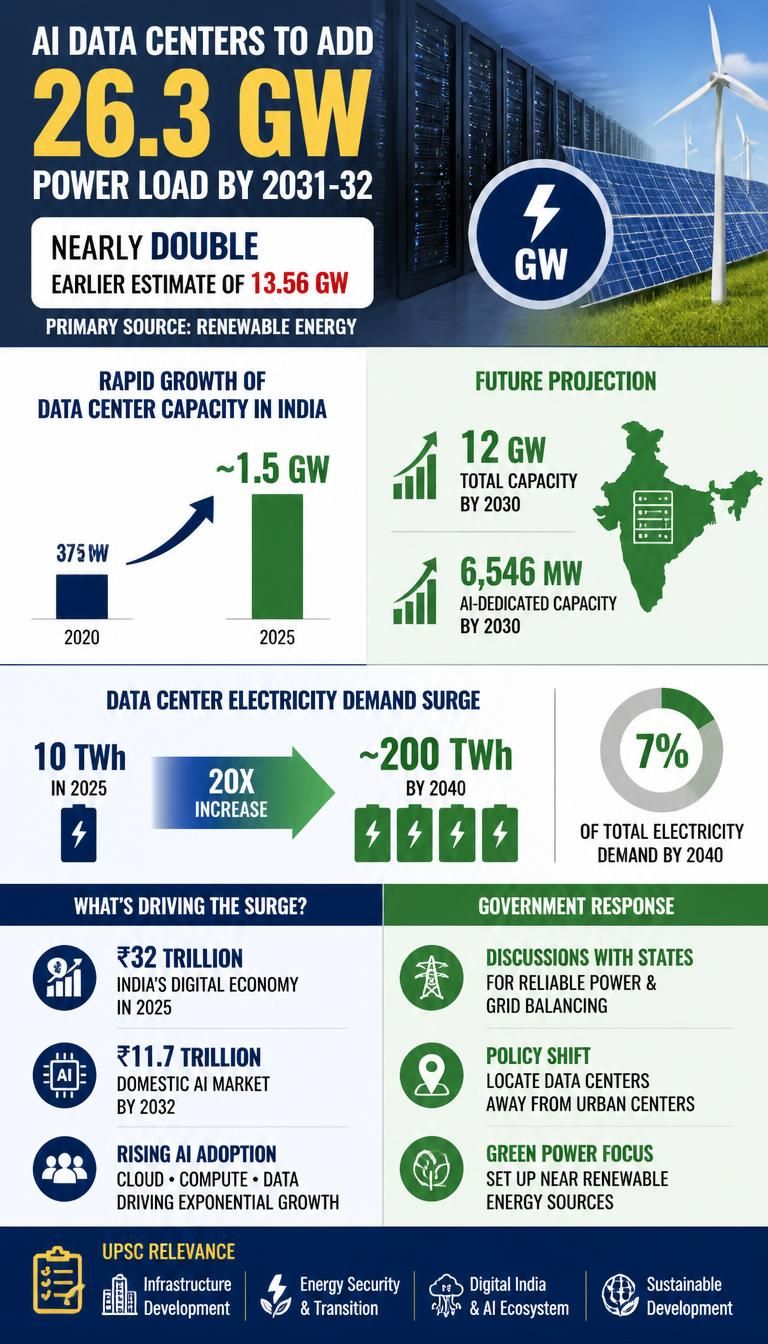
- The Ministry of Power informed Parliament that Artificial Intelligence (AI) data centers are projected to add an additional load of 26.3 gigawatts (GW) by 2031-32.
- This new projection is nearly double the earlier estimate of 13.56 GW for the same period.
- The increased power demand is expected to be primarily met by renewable energy capacity.
- India's data center capacity grew from 375 megawatts (MW) in 2020 to approximately 1.5 GW by 2025.
Data Centre.jpg
Detailed Insights:
- The revised projection is based on proposals received from various states for setting up new data centers.
- Discussions are underway with stakeholders like state transmission and distribution utilities regarding reliable power supply and grid balancing.
- The Ministry of Power is considering policy-level changes, including locating data centers away from urban centers to mitigate transmission congestion.
- There is also a proposal to establish data centers near green energy sources to optimize power supply and reduce transmission losses.
- A report by Wood Mackenzie forecasts India's operational data center capacity to reach 12 GW by 2030, with AI-dedicated capacity expanding to 6,546 MW.
- India's digital economy, valued at INR 32 trillion in 2025, and a projected INR 11.7 trillion domestic AI market by 2032, are driving this demand.
- Data center electricity demand is predicted to increase 20-fold by 2040 from 10 TWh in 2025, potentially accounting for 7% of the total electricity demand.
Key Concepts Involved:
- Data Centre: A dedicated facility housing computer systems and associated components for data storage, processing, and networking.
- Grid Balancing: The process of maintaining a stable and reliable electricity supply by matching generation with demand in real-time.
- Transmission Congestion: A condition where the flow of electricity through transmission lines is limited due to capacity constraints, leading to inefficiencies.
- Renewable Energy Capacity: The maximum potential power output that can be generated from renewable sources like solar, wind, and hydro.

SuperKalam is your personal mentor for UPSC preparation, guiding you at every step of the exam journey.
Download the App


STUDY RESOURCES
CONTACT US
ⓒ Snapstack Technologies Private Limited