GS 2: International RelationsPrelimsGS 2: Bilateral, Regional and Global Groupings and AgreementsGS 2: Effect of Policies and Politics of Developed and Developing Countries on India's Interests
Shenzhen Trilateral Dynamics: Global Power Shifts and Weaponised Interdependence
Rising trilateral power plays among the United States, China, and Russia erode multilateral institutions while intensifying supply chain weaponisation against India.
Source: Indian Express (Pg. 12)
Practice MCQs
811 Students attempted
Key Highlights:
- The Shenzhen Trilateral dialogue brought together leaders of the United States, China, and the Russian Federation, reflecting shifting tripolar geopolitical dynamics.
- China's diplomatic posture marks an overt departure from Deng Xiaoping’s foreign policy principle of Taoguang Yanghui towards direct power projection.
- Beijing has increasingly leveraged supply chain monopolies, imposing targeted export restrictions on critical heavy industrial machinery such as tunnel boring machines destined for India.
- Strategic convergence between Beijing and Moscow persists despite global sanctions, impacting enforcement mechanisms under the United Nations Security Council.
- Rising unilateral economic measures by Washington and Beijing have progressively eroded the multilateral framework governed by the World Trade Organization.
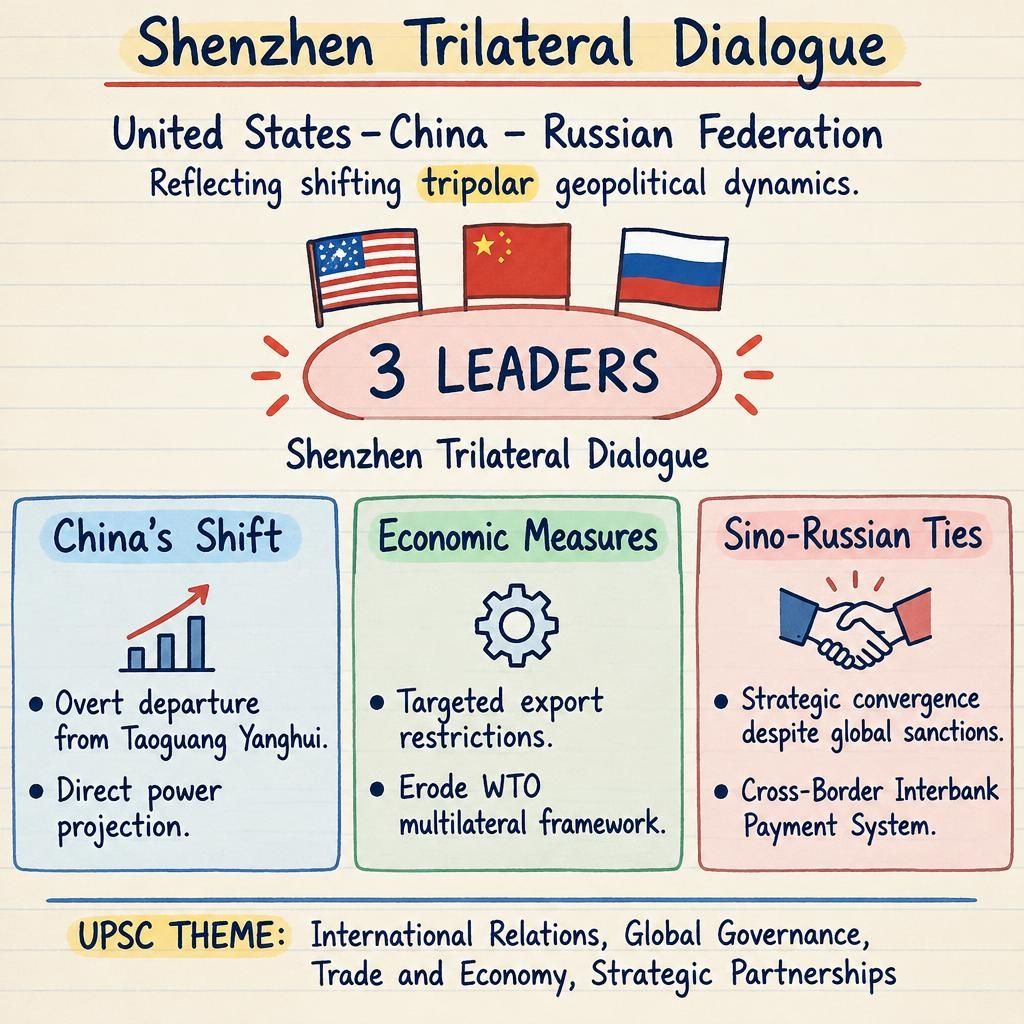
Shenzhen Trilateral Dialogue
Detailed Insights:
- Personalised foreign policy across superpowers bypasses institutional diplomatic channels and undermines norms established under the Charter of the United Nations.
- China's peripheral assertiveness has prompted regional nations to deepen defense pacts and intelligence sharing within the Quadrilateral Security Dialogue.
- Economic coercion and critical supply bottlenecks have accelerated multilateral diversification frameworks, including the trilateral Supply Chain Resilience Initiative.
- Superpower transactionalism and zero-sum diplomacy continue to weaken consensus-building platforms such as the G20 on cross-border challenges.
- Deepening Sino-Russian trade ties challenge Western sanctions frameworks, expediting cross-border settlements via the Cross-Border Interbank Payment System.
Key Concepts Involved:
- Middle Kingdom Concept: Sinocentric geopolitical worldview historically positioning China as the paramount civilization and primary global power center.
- Weaponised Interdependence: Exploitation of critical asymmetric nodes within global supply, trade, and financial networks for geopolitical leverage.
- Strategic Autonomy: An independent foreign policy doctrine allowing a sovereign state to make decisions without coercive external alignment.

SuperKalam is your personal mentor for UPSC preparation, guiding you at every step of the exam journey.
Download the App


STUDY RESOURCES
CONTACT US
ⓒ Snapstack Technologies Private Limited