EthicsGS 2: International RelationsPrelimsGS 4: Ethical Issues in International Relations and FundingGS 2: Bilateral, Regional and Global Groupings and Agreements
Balancing Strategic Realism and Moral Principles in India-Israel Relations
India navigates strategic defence ties with Israel alongside its historical commitment to Palestine's two-state solution amid shifting West Asian geopolitical dynamics.
Source: Indian Express (Pg. 13)
Practice MCQs
811 Students attempted
Key Highlights:
- Cross-party political stances in India increasingly reflect a consensus on maintaining robust strategic and technological relations with Israel.
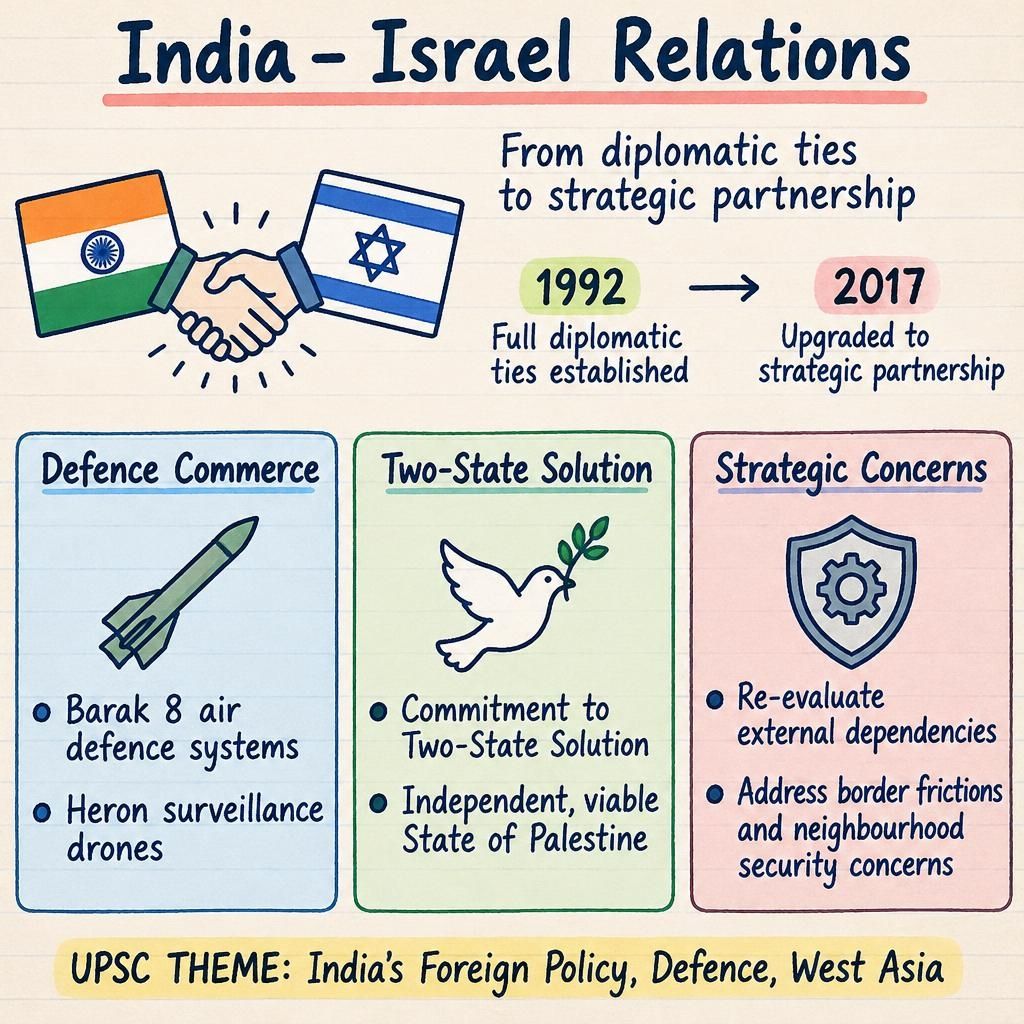
- India established full diplomatic ties with Israel in 1992 under the Ministry of External Affairs, subsequently upgrading the relationship to a strategic partnership in 2017.
- Bilateral defence commerce serves as a major pillar, featuring critical procurements such as Barak 8 air defence systems and Heron surveillance drones.
- India officially maintains its commitment to the Two-State Solution, supporting an independent, viable State of Palestine living peacefully alongside Israel.
- Critics advocate re-evaluating external strategic dependencies by addressing border frictions and neighbourhood security concerns through regional diplomatic engagements.
India-Israel Relations.jpg
Detailed Insights:
- India's West Asia diplomacy has transitioned from non-aligned ideological solidarity to pragmatic de-hyphenation, treating ties with Israel and Palestine independently.
- Heavy reliance on external arms acquisitions challenges indigenous defence production goals formulated under the Atmanirbhar Bharat Abhiyan.
- Excessive geopolitical alignment with specific global blocs risks constraining India's long-standing foreign policy principle of Strategic Autonomy.
- Revitalizing regional diplomatic forums, such as the South Asian Association for Regional Cooperation, is proposed to mitigate local border disputes.
- Foreign policy debates continuously balance realist national security compulsions with normative values enshrined under the United Nations Charter.
Key Concepts Involved:
- Two-State Solution: A diplomatic framework envisioning an independent State of Palestine coexisting peacefully alongside the State of Israel.
- Strategic Autonomy: A foreign policy doctrine ensuring independent national decision-making without binding commitments to military alliances.
- De-hyphenation Policy: An approach of pursuing separate, independent bilateral relations with two rival countries on their own merits.

SuperKalam is your personal mentor for UPSC preparation, guiding you at every step of the exam journey.
Download the App


STUDY RESOURCES
CONTACT US
ⓒ Snapstack Technologies Private Limited