GS 1: Indian GeographyGS 3: Science & TechnologyGS 1: Art & CultureGS 3: Environment & EcologyPrelims
Kashmir’s rice holds clues to a journey from East Asia, Pg II
Kashmir's traditional rice varieties, genetically linked to East Asia, possess unique cold-tolerance genes, offering crucial resilience against increasing climate change stress.
Practice MCQs
804 Students attempted
Key Highlights:
- A study by Sher-e-Kashmir University of Agricultural Sciences and Technology (SKUAST-Kashmir) found that Kashmir's traditional rice varieties possess unique genetic history, including cold-tolerance genes.
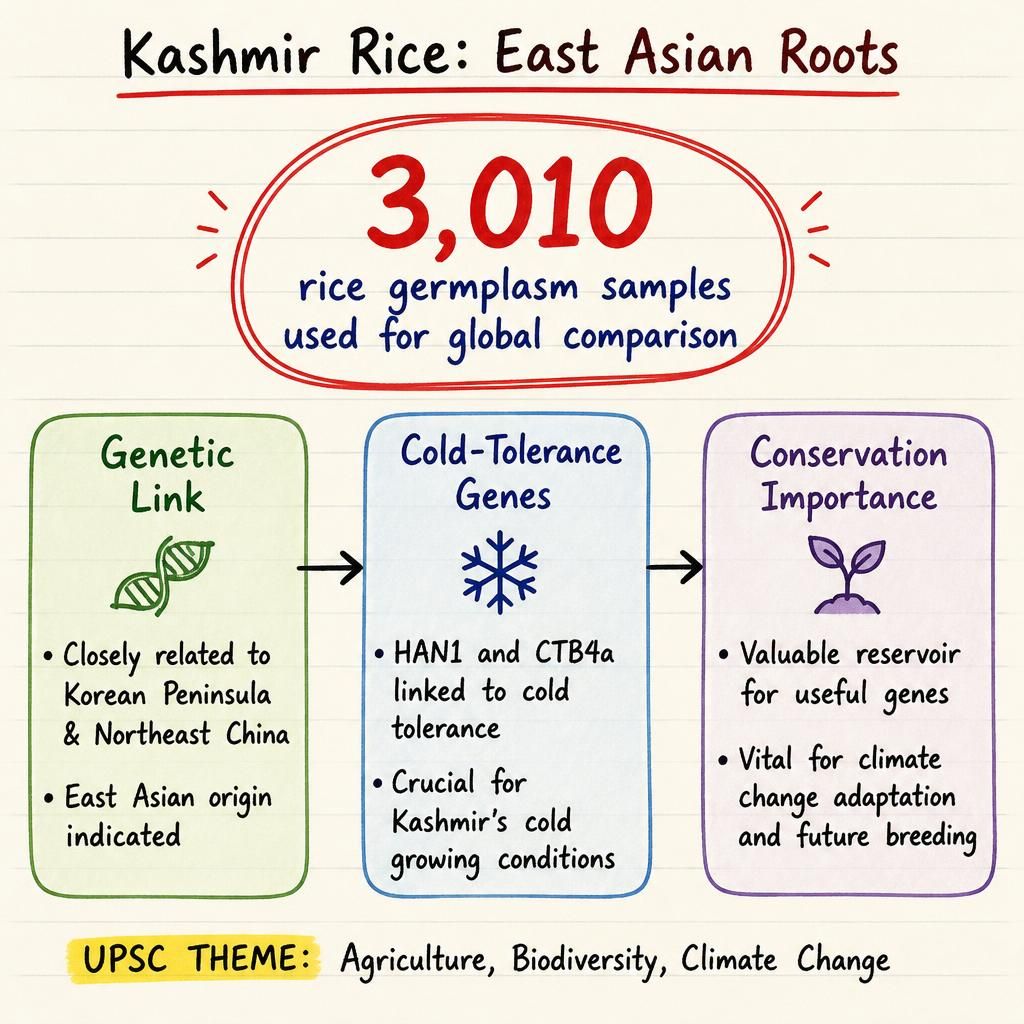
- Genetic analysis indicated these varieties are closely related to rice from the Korean Peninsula and Northeast China, suggesting an East Asian origin.
- The research utilized a comparison with the 3K rice panel, a global collection of 3,010 rice germplasm samples.
- These traditional landraces are considered a valuable reservoir of useful genes, particularly for climate change adaptation, which modern varieties have partly lost.
Kashmir Rice.jpg
Detailed Insights:
- The SKUAST-Kashmir study sequenced 142 rice germplasm accessions from Kashmir, comparing them with the global 3K rice panel.
- Researchers focused on 21 agriculturally relevant traits, including grain characteristics, starch content, aroma, and adaptation features.
- Genes like HAN1 and CTB4a, associated with cold tolerance, showed strong affinity with East Asian rice, crucial for Kashmir's cold growing conditions.
- The findings suggest potential historical movement of rice germplasm, possibly through Central Asia along early trade routes like the Silk Road, or directly across the Himalayas.
- Modern rice varieties in Kashmir, bred for higher yield, have often lost the cold tolerance present in traditional landraces.
- Archaeological evidence suggests wheat and barley were dominant crops in Kashmir during the Neolithic period, with rice likely introduced later, around 1000-1500 BC during the Megalithic period.
- The study emphasizes the need for active conservation of these landraces due to their genetic value for future crop breeding and climate resilience.
Scientific/Technical Concepts Involved:
- Germplasm: Genetic material, such as seeds or tissues, that can be used to propagate plants.
- Landraces: Traditional, locally adapted varieties of a domesticated animal or plant species that have evolved over time through natural selection and human cultivation.
- 3K rice panel: A comprehensive collection of 3,010 diverse rice varieties (Oryza sativa) from around the world, used for genetic studies.
- Holocene: The current geological epoch, which began approximately 11,700 years ago after the last major glacial period.

SuperKalam is your personal mentor for UPSC preparation, guiding you at every step of the exam journey.
Download the App


STUDY RESOURCES
CONTACT US
ⓒ Snapstack Technologies Private Limited