GS 2: GovernanceGS 3: Science & TechnologyGS 3: Internal SecurityPrelimsGS 3: Infrastructure: Energy, Ports, Roads, Airports, Railways etc.
Beyond Kudankulam’s fence, a cybersecurity challenge, Pg6
Kudankulam data breach exposes critical gaps in India's cybersecurity policy for vital infrastructure, highlighting risks beyond facility perimeters and contractor networks.
Practice MCQs
804 Students attempted
Key Highlights:
- A data breach involving nearly 19,000 files related to the Kudankulam Nuclear Power Plant was reported on July 15, 2026.
- The leaked material, spanning 2016-2025, included engineering drawings and supplier information, posted by the "World Leaks" group.
- The breach originated from a server at Yotta, a third-party data center used by Reliance Infrastructure, a contractor for KNPP Units 3 and 4.
- Nuclear Power Corporation of India Limited (NPCIL) clarified that the information pertained to non-nuclear infrastructure and did not affect nuclear safety systems.
- The incident highlights significant vulnerabilities in India's critical infrastructure cybersecurity due to reliance on third-party supply chains.
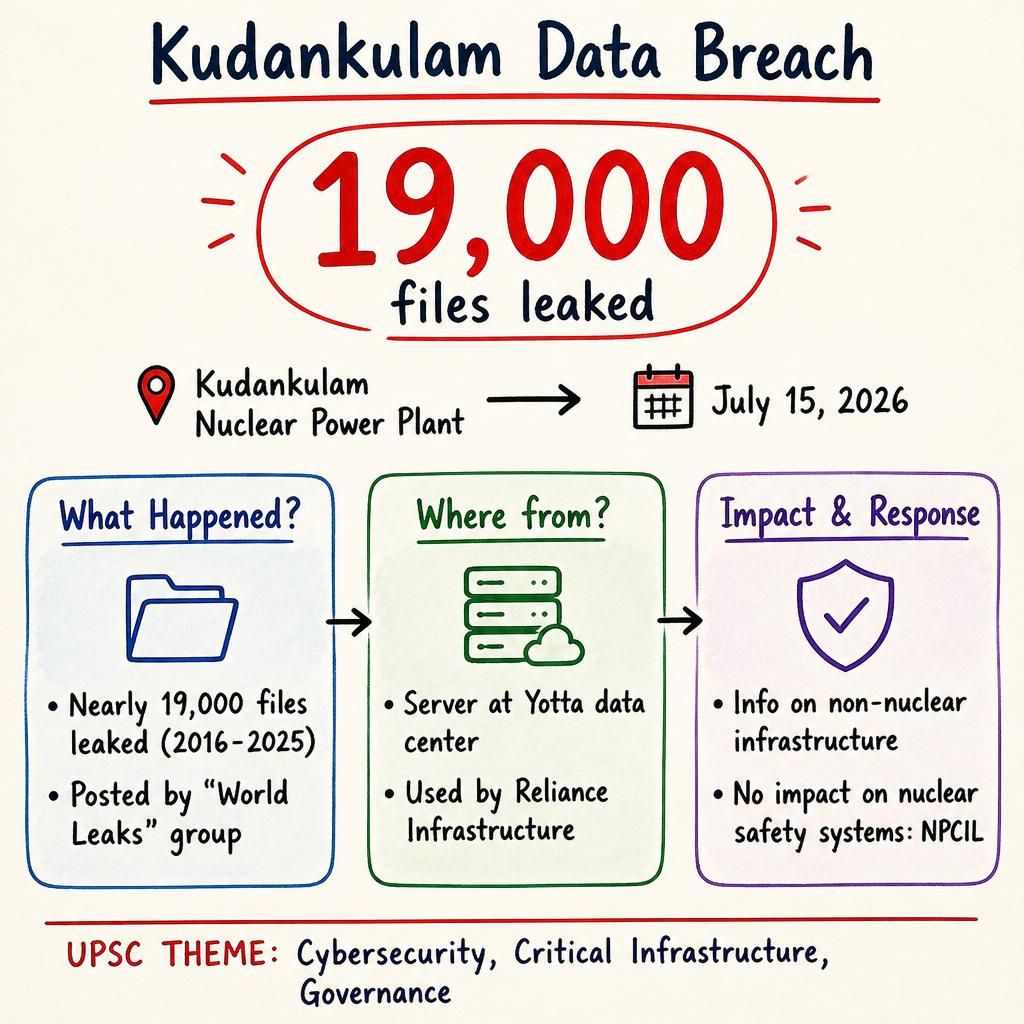
Kudankulam Data Breach.jpg
Detailed Insights:
- The breach underscores that cybersecurity risks for critical infrastructure extend beyond the physical perimeter to contractors' networks and commercial data centers.
- This incident follows a 2019 Dtrack malware infection on KNPP's administrative network, which was attributed to North Korea's Lazarus Group.
- Modern critical infrastructure relies on a complex ecosystem of public and private entities, each potentially holding sensitive data not protected by the main facility's security.
- Existing cybersecurity governance bodies like CERT-In and NCIIPC and laws such as the Information Technology Act have limitations in ensuring uniform protection across the supply chain.
- The Digital Personal Data Protection Act does not generally cover technical information like engineering drawings, creating accountability gaps for non-personal data breaches.
- India's expansion of critical infrastructure and initiatives like Atmanirbhar Bharat increase reliance on private entities, amplifying supply chain cyber risks.
- Recommendations include making security obligations follow the data, implementing real data classification, conducting third-party risk assessments, and adopting a zero-trust policy.
Key Concepts Involved:
- Critical Information Infrastructure: Systems whose incapacitation would have a debilitating impact on national security, economy, or public health.
- Supply Chain Cybersecurity: Protecting an organization's information and systems from risks originating from its suppliers and third-party vendors.
- Zero-Trust Policy: A security model requiring strict identity verification for every person and device trying to access resources on a private network.
- Ransomware: Malicious software designed to block access to a computer system until a sum of money is paid.

SuperKalam is your personal mentor for UPSC preparation, guiding you at every step of the exam journey.
Download the App


STUDY RESOURCES
CONTACT US
ⓒ Snapstack Technologies Private Limited