GS 2: GovernanceGS 2: PolityPrelimsGS 2: Constitutional BodiesGS 2: Structure and Functioning of Executive and Judiciary
SC Had Warned Against Leaving EC’s Powers In The Hands Of One Person, Pg7
Supreme Court warned against concentrating Election Commission's vast powers in one person, emphasizing collegiality for democratic rule.
Practice MCQs
796 Students attempted
Key Highlights:
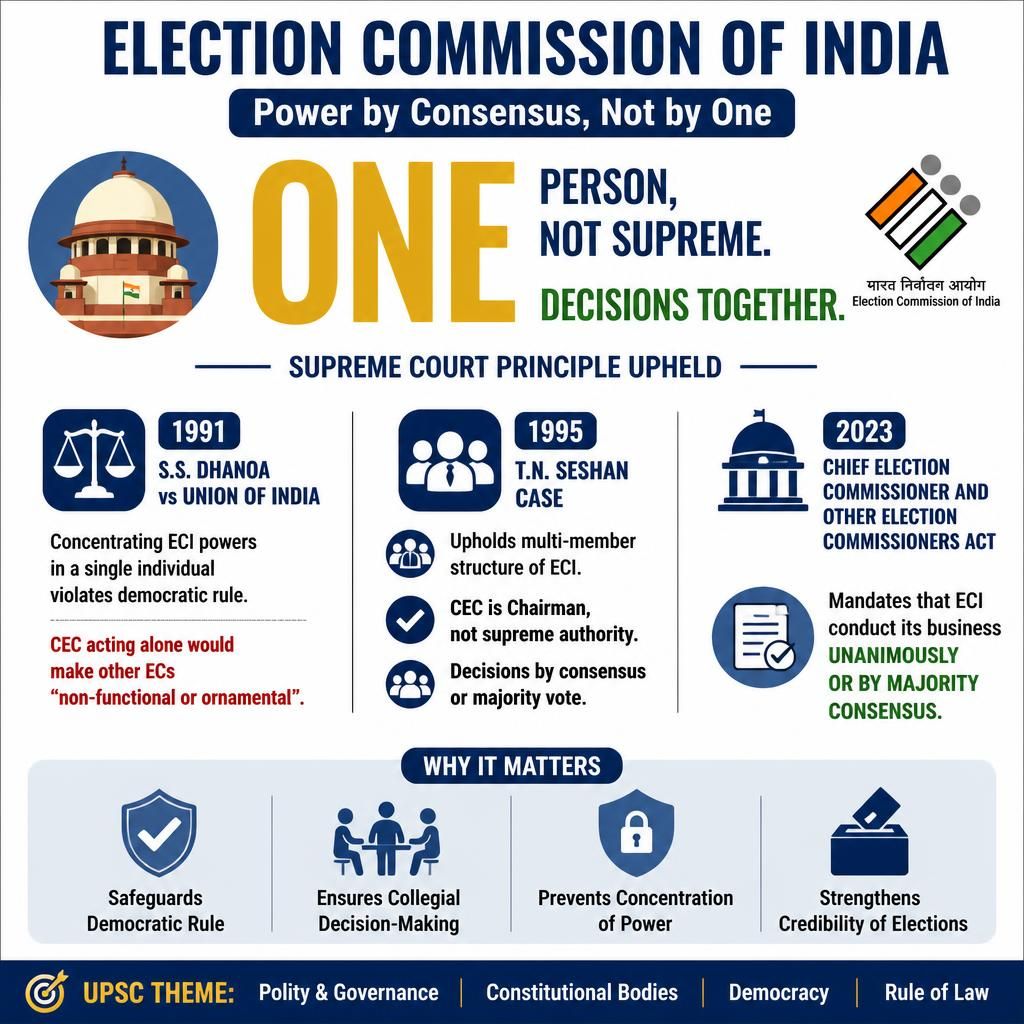
- The Supreme Court, in S.S. Dhanoa versus Union of India (1991), warned against concentrating the Election Commission of India's (ECI) powers in a single individual, stating it would violate democratic rule.
- The apex court emphasized that a Chief Election Commissioner (CEC) acting unilaterally would render other Election Commissioners (ECs) "non-functional or ornamental".
- The T.N. Seshan case (1995) upheld the multi-member structure of the ECI, affirming that the CEC does not hold superior powers over other ECs.
- The Chief Election Commissioner and Other Election Commissioners Act, 2023, mandates that the ECI conduct its business unanimously or by majority consensus, reflecting the spirit of these judgments.
ECI.jpg
Detailed Insights:
- The Supreme Court's observations highlighted the importance of a collegial and multi-member ECI for safeguarding democracy.
- The court reasoned that vast discretionary powers, with minimal checks and balances, should not be entrusted to a single individual.
- The T.N. Seshan judgment clarified that Election Commissioners are integral to the ECI and must have an equal say in decision-making, rejecting the idea of their role being merely advisory.
- The 1995 ruling established that the CEC functions as the chairman, but not as a supreme authority, with decisions made through consensus or majority vote.
- The Chief Election Commissioner and Other Election Commissioners Act, 2023, provides a statutory framework for the appointment, tenure, and service conditions of the CEC and ECs.
- This Act replaced the earlier convention-based appointment process and aims to give legislative effect to Article 324(2) of the Constitution.
Key Concepts Involved:
- Election Commission of India (ECI): A constitutional body responsible for conducting free and fair elections to Parliament, State Legislatures, and the offices of President and Vice-President.
- Chief Election Commissioner (CEC): The head of the Election Commission of India, appointed by the President, who chairs the multi-member body.
- Election Commissioners (ECs): Other members of the Election Commission of India who, along with the CEC, collectively make decisions regarding electoral processes.
- S.S. Dhanoa versus Union of India (1991): A Supreme Court case that emphasized the need for a multi-member ECI to prevent concentration of power.
- T.N. Seshan case (1995): A landmark Supreme Court judgment that upheld the multi-member structure of the ECI and established the equality of powers among the CEC and ECs.
- Chief Election Commissioner and Other Election Commissioners Act, 2023: A parliamentary law that provides a statutory framework for the appointment, conditions of service, and transaction of business for the CEC and ECs.

SuperKalam is your personal mentor for UPSC preparation, guiding you at every step of the exam journey.
Download the App


STUDY RESOURCES
CONTACT US
ⓒ Snapstack Technologies Private Limited