GS 2: GovernanceGS 1: Indian GeographyGS 3: Disaster ManagementGS 3: EconomyPrelims
Marathwada worst-hit, cloud over Rabi season, Pg1
Maharashtra braces for severe drought, potentially surpassing 1972's famine, impacting Marathwada and Rabi crops, highlighting past relief efforts.
Practice MCQs
796 Students attempted
Key Highlights:
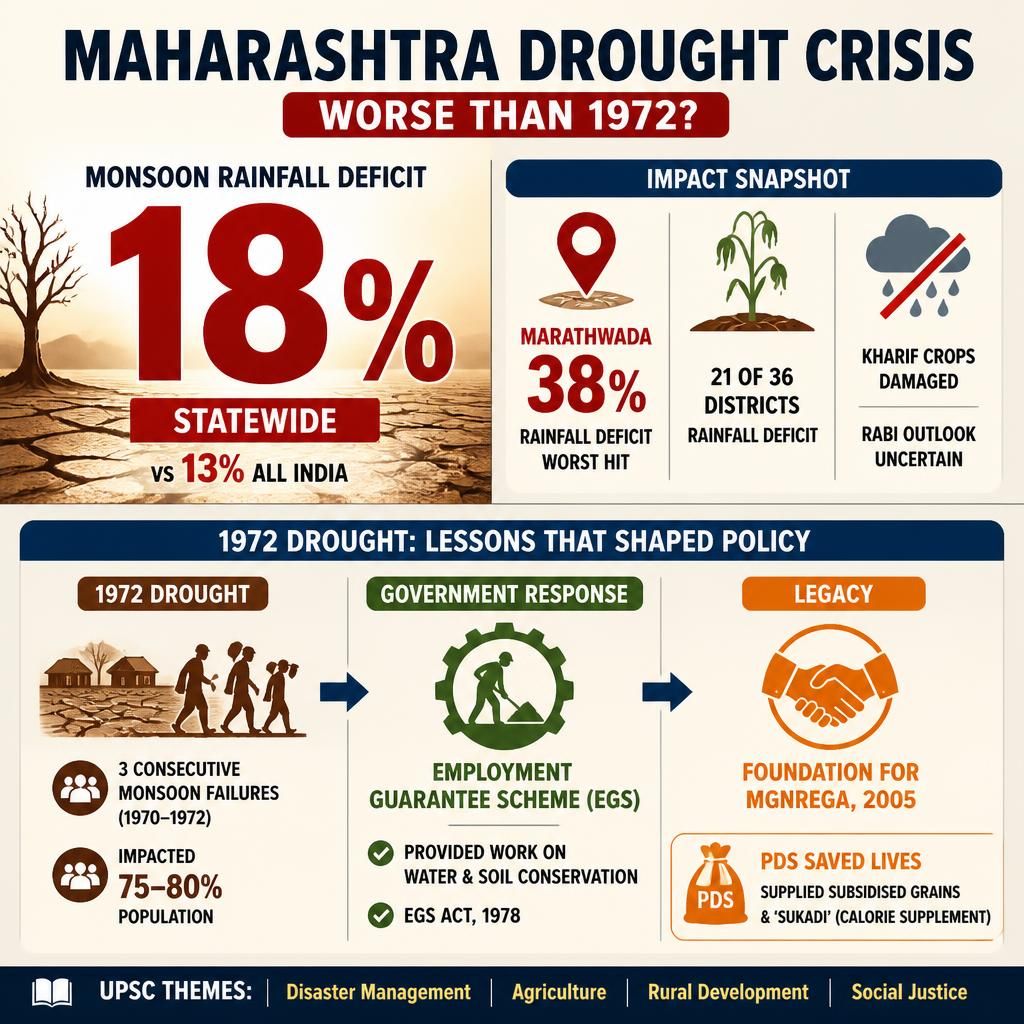
- Maharashtra is currently facing a severe drought, with a rainfall deficit of 18% during the monsoon season, exceeding the national deficit of 13%.
- The situation is intensified by El Niño conditions and is being compared to the devastating 1972 drought, with fears it could be worse.
- The Marathwada region is the most severely affected, experiencing a 38% rainfall deficit, while Vidarbha also faces significant shortfalls.
- 21 of Maharashtra's 36 districts have recorded rainfall deficits, leading to widespread damage to Kharif crops and uncertainty for the upcoming Rabi season.
Marathwada Droughts.jpg
Detailed Insights:
- The 1972 drought in Maharashtra was a result of three consecutive monsoon failures starting in 1970, impacting 75-80% of the state's population and causing mass rural-to-urban migration.
- During the 1972 crisis, the Maharashtra government, under CM Vasantrao Naik, introduced the Employment Guarantee Scheme (EGS) to provide alternative work through public projects like water and soil conservation.
- The EGS was formalized by the EGS Act of 1978 and later served as a foundational model for the nationwide Mahatma Gandhi National Rural Employment Guarantee Act (MGNREGA) in 2005.
- The Public Distribution System (PDS) played a critical role in preventing starvation deaths in 1972 by supplying subsidized food grains and a calorie-dense supplement called "sukadi."
- Current agricultural concerns include the continued reliance on outdated irrigation systems and inadequate water conservation measures, making the state highly vulnerable to climate change impacts.
- Districts within Marathwada, such as Latur, Dharashiv, Beed, and Parbhani, have reported severe damage to Kharif crops, with some areas experiencing up to 90% crop loss.
Key Concepts Involved:
- El Niño: A climate phenomenon characterized by the warming of surface waters in the eastern equatorial Pacific Ocean, often leading to suppressed monsoon rainfall in India.
- Rabi Season: The winter cropping season in India, where crops are sown in mid-November after the monsoon and harvested in April-May, relying on residual moisture or irrigation.
- Employment Guarantee Scheme (EGS): A pioneering scheme launched by Maharashtra in 1972, guaranteeing employment to rural unskilled laborers, which later inspired MGNREGA.
- Public Distribution System (PDS): A government-managed food security program in India that ensures the distribution of essential food grains and commodities at subsidized rates through Fair Price Shops.
- Mahatma Gandhi National Rural Employment Guarantee Act (MGNREGA): A social welfare legislation enacted in 2005, guaranteeing 100 days of wage employment annually to rural households whose adult members volunteer for unskilled manual work.
- Marathwada: A historically drought-prone region in Maharashtra, largely dependent on rain-fed agriculture and highly susceptible to water scarcity.
- Kharif Crops: Crops cultivated during the monsoon season, typically sown in June-July and harvested in September-October, with their success heavily dependent on adequate rainfall.

SuperKalam is your personal mentor for UPSC preparation, guiding you at every step of the exam journey.
Download the App


STUDY RESOURCES
CONTACT US
ⓒ Snapstack Technologies Private Limited