GS 2: GovernanceGS 3: Science & TechnologyGS 1: Indian SocietyGS 3: EconomyPrelims
How wealth shapes our view of artificial intelligence, Pg11
Pew Research survey reveals wealthier nations express greater anxiety about AI's impact on jobs and inequality, while poorer countries remain uncertain.
Practice MCQs
796 Students attempted
Key Highlights:
- A Pew Research Centre Survey across 37 countries indicates that anxiety about Artificial Intelligence (AI) is not universally shared.
- Worry regarding AI's potential to cause job losses and widen inequality is strongly correlated with a country's wealth.
- High-income nations show significantly greater concern about AI's negative impacts compared to middle-income countries.
- Poorer countries often display lower awareness or uncertainty about the effects of AI on their societies.
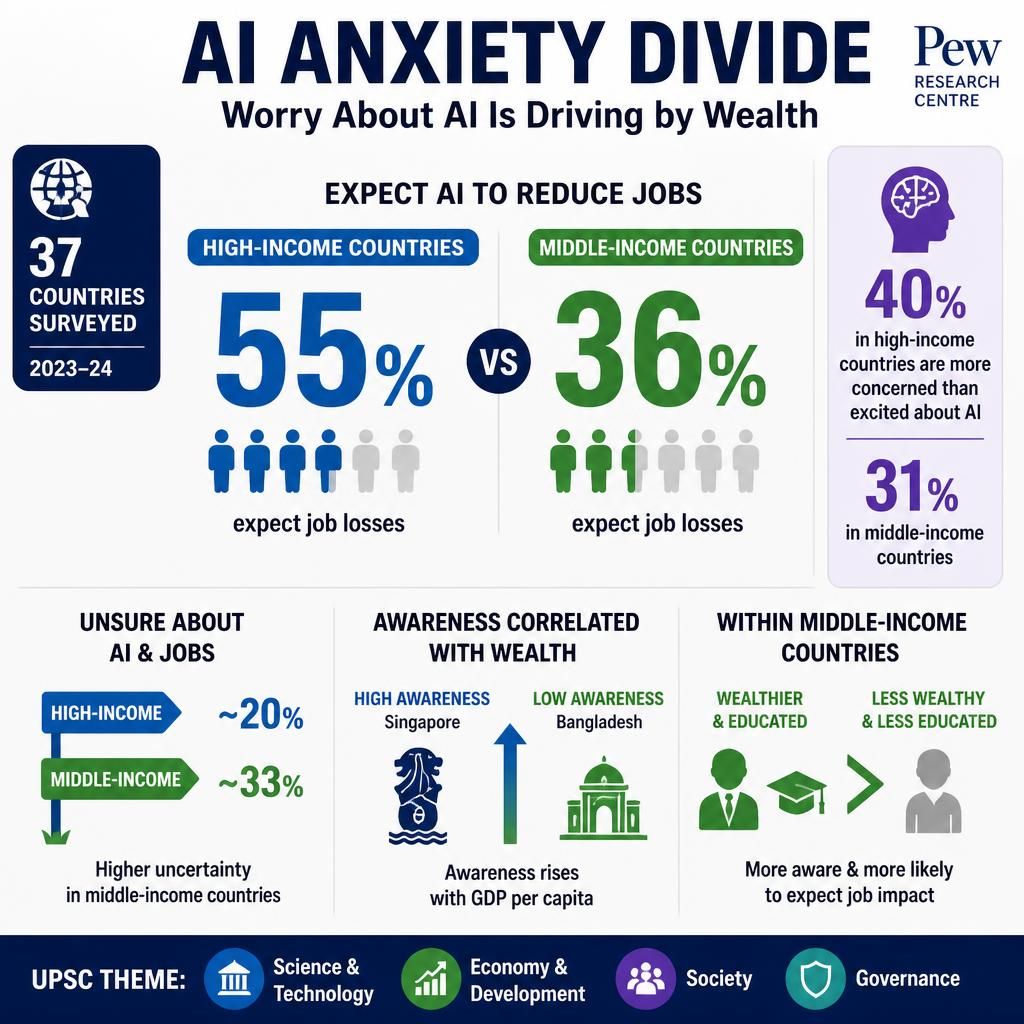
AI Divide.jpg
Detailed Insights:
- The survey classified 36 core countries into "high-income" and "middle-income" categories using World Bank's classifications based on gross national income per capita.
- A median of 55% of adults in high-income countries expect AI to reduce jobs, while only 36% in middle-income countries hold this view.
- Roughly one-third of adults in middle-income nations are unsure about AI's impact on employment, contrasting with about one-fifth in wealthier countries.
- 40% of respondents in wealthy nations expressed more concern than excitement about AI, compared to 31% in middle-income nations.
- Awareness of AI also shows a strong correlation with GDP per capita, exemplified by Singapore's high awareness versus Bangladesh's low awareness.
- In middle-income countries, wealthier and more educated individuals within those nations are more likely to anticipate AI causing job losses or increasing inequality.
- The survey implies that countries most anxious about AI are also best positioned to drive demand for regulation and worker protections.
Key Concepts Involved:
- Artificial Intelligence (AI): The simulation of human intelligence processes by machines, especially computer systems, including learning, reasoning, and self-correction.
- GDP per capita: A measure of a country's economic output per person, calculated by dividing the total Gross Domestic Product by the population.
- Pew Research Centre: A nonpartisan American think tank that conducts public opinion polling, demographic research, and social science research.
- World Bank classifications: A system used by the World Bank to categorize countries based on their gross national income (GNI) per capita, typically into low, lower-middle, upper-middle, and high-income groups.

SuperKalam is your personal mentor for UPSC preparation, guiding you at every step of the exam journey.
Download the App


STUDY RESOURCES
CONTACT US
ⓒ Snapstack Technologies Private Limited