GS 3: Science & TechnologyPrelimsGS 3: Infrastructure: Energy, Ports, Roads, Airports, Railways etc.GS 3: IT and ComputersGS 3: Space Technology
As AI's energy needs grow, Google takes the data centre race to outer space, Pg12
Google launches experimental 'Project Suncatcher' satellite, MVP, to test AI data centers in space, addressing growing energy demands.
Practice MCQs
796 Students attempted
Key Highlights:
- Google initiated Project Suncatcher to establish artificial intelligence data centers in space, powered by solar energy.
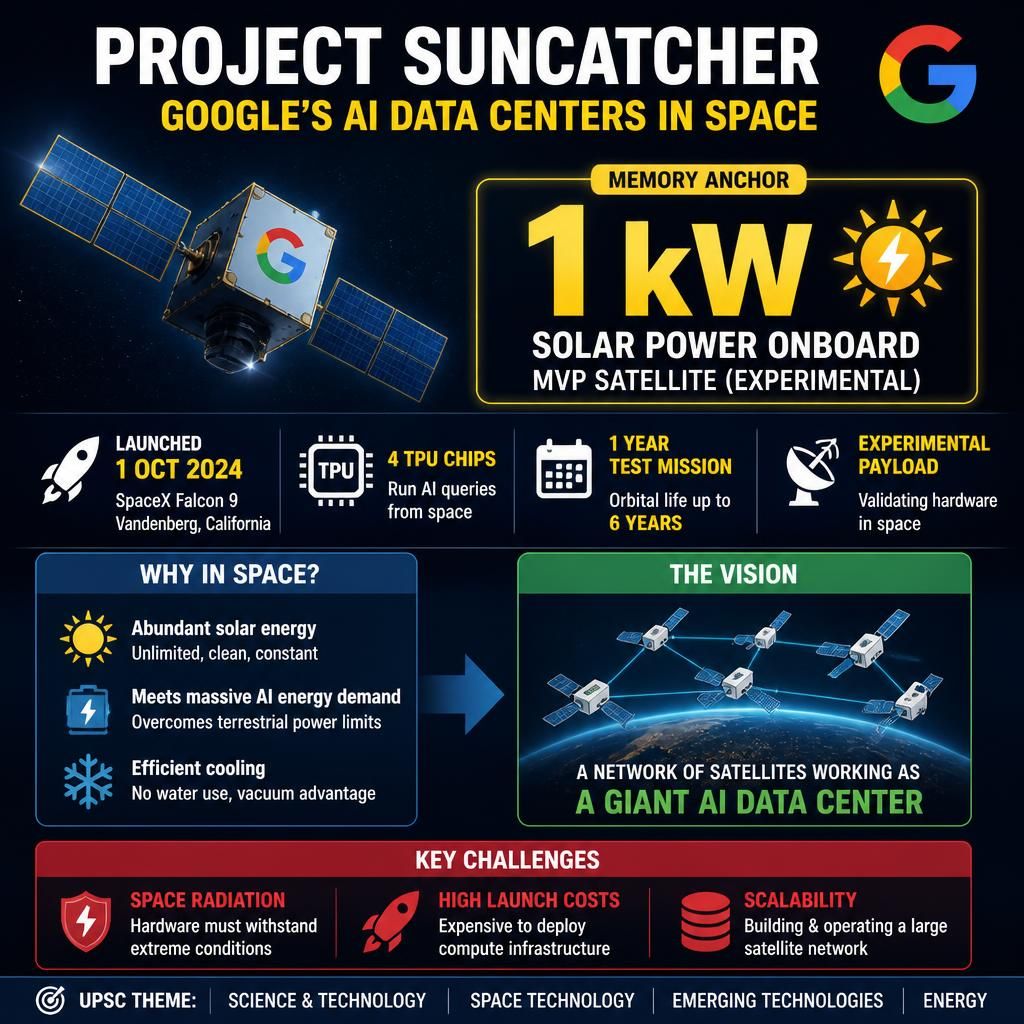
- An experimental satellite, named MVP, was launched on October 1 by Google as the first step in this ambitious project.
- The MVP satellite was carried into orbit by a SpaceX Falcon 9 rocket from Vandenberg Space Force Base in California.
- The satellite contains four specialized Tensor Processing Units (TPUs), designed to answer simple AI queries from space.
Project Suncatcher.jpg
Detailed Insights:
- The primary motivation for Project Suncatcher is to address the escalating energy demands of AI systems and overcome terrestrial limitations for data centers.
- The MVP satellite is equipped with solar panels providing approximately one kilowatt of power, sufficient for its experimental TPU chips.
- It is designed to operate for one year, testing hardware resilience against harsh space conditions, and is expected to orbit for up to six years before re-entering the atmosphere.
- The project's long-term vision, conceived by Google VP Blaise Agüera y Arcas, involves creating a vast network of satellites functioning as a large-scale data center.
- Key challenges include ensuring hardware withstands space radiation and managing the significant costs associated with launching computing infrastructure beyond Earth's atmosphere.
Scientific/Technical Concepts Involved:
- Artificial Intelligence (AI): The simulation of human intelligence processes by machines, especially computer systems.
- Data Center: A facility used to house computer systems and associated components, such as telecommunications and storage systems.
- Tensor Processing Unit (TPU): A specialized integrated circuit developed by Google for accelerating machine learning workloads.
- SpaceX Falcon 9: A reusable two-stage rocket designed and manufactured by SpaceX for transporting payloads into Earth orbit and beyond.
Previous10/10

SuperKalam is your personal mentor for UPSC preparation, guiding you at every step of the exam journey.
Download the App


STUDY RESOURCES
CONTACT US
ⓒ Snapstack Technologies Private Limited