GS 1: Indian GeographyGS 3: EconomyPrelimsGS 3: Changes in Industrial Policy and Effects on Industrial GrowthGS 3: Inclusive Growth
6 States Had 67% Share In Cost Of Pvt Projects Sanctioned By Banks In FY26, Pg11
RBI study shows six states, led by Maharashtra, secured 67% of private project costs sanctioned by banks in FY26, indicating robust investment growth.
Practice MCQs
796 Students attempted
Key Highlights:
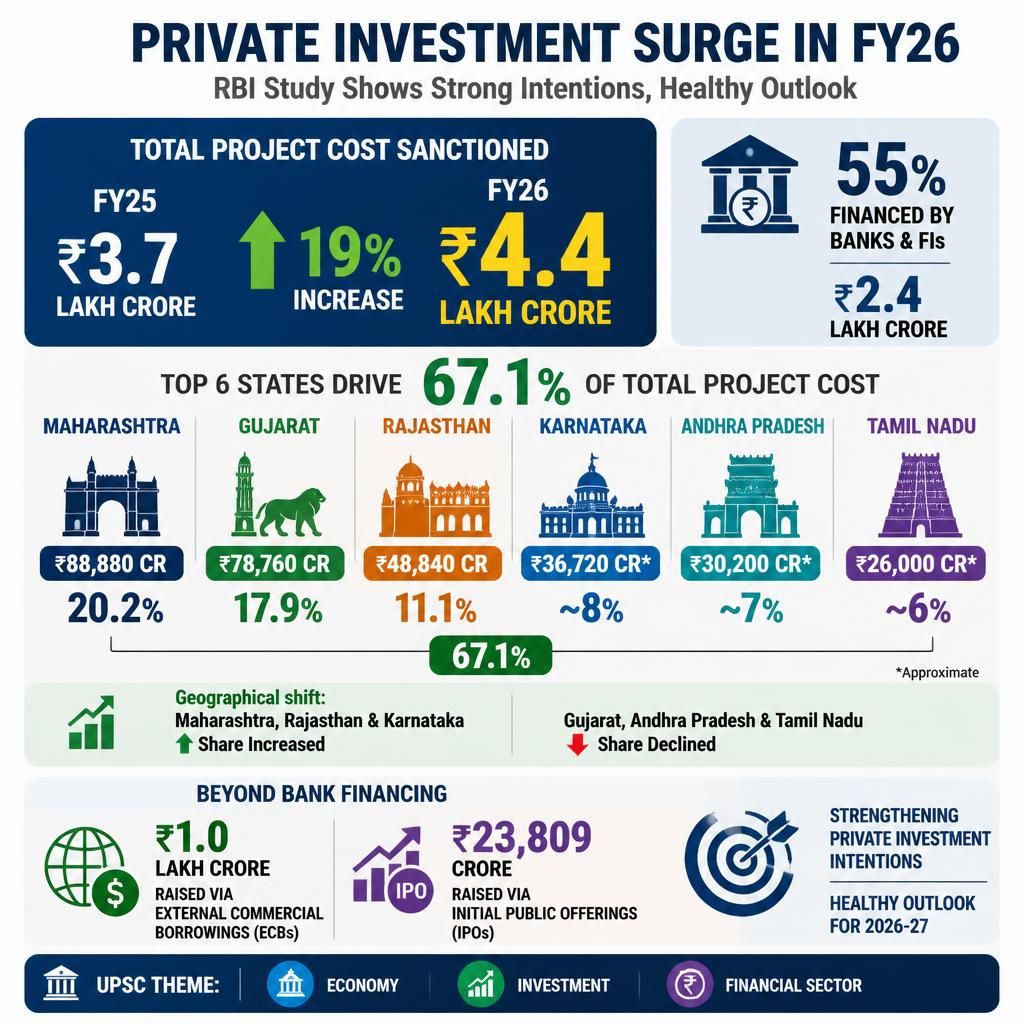
- Six states, led by Maharashtra and Gujarat, accounted for 67.1% of the total private project costs sanctioned by banks and financial institutions in FY26.
- Maharashtra emerged as the top destination, attracting projects worth Rs 88,880 crore (20.2%), surpassing Gujarat.
- The aggregate cost of projects sanctioned by banks and financial institutions increased by 19% to Rs 4.4 lakh crore in FY26 from Rs 3.7 lakh crore in FY25.
- A study by the Reserve Bank of India (RBI) indicated strengthening private-sector investment intentions and a healthy outlook for 2026-27.
Private Investment Surge.jpg
Detailed Insights:
- Gujarat followed Maharashtra with Rs 78,760 crore (17.9%), while Rajasthan secured Rs 48,840 crore (11.1%) of the sanctioned projects.
- Karnataka, Andhra Pradesh, and Tamil Nadu were also significant recipients, contributing to the top six states' share.
- The combined share of Maharashtra and Gujarat in FY26 was approximately 38% of the total project cost sanctioned.
- There was a geographical shift in investment, with Maharashtra, Rajasthan, and Karnataka increasing their shares, while Gujarat, Andhra Pradesh, and Tamil Nadu saw declines.
- Banks and financial institutions financed about 55% of the aggregate project cost, amounting to roughly Rs 2.4 lakh crore.
- Beyond bank financing, private non-financial companies raised an additional Rs 1 lakh crore through External Commercial Borrowings (ECBs) and Rs 23,809 crore via Initial Public Offerings (IPOs) for capital expenditure.
- Total investment intentions across all sources for FY26 reached Rs 5.6 lakh crore across 1,839 projects, an increase from Rs 5 lakh crore and 1,581 projects in FY25.
- The post-Covid period has seen a noticeable increase in mega projects (costing Rs 5,000 crore or more) and large projects (Rs 1,000-5,000 crore).
Key Concepts Involved:
- Private-sector investment: Capital deployed by non-governmental entities for economic activities, driving growth and job creation.
- Financial Institutions (FIs): Organizations like banks, insurance companies, and investment funds that provide financial services.
- External Commercial Borrowings (ECBs): Loans raised by eligible resident entities from recognized non-resident entities.
- Initial Public Offering (IPO): The process of offering shares of a private corporation to the public in a new stock issuance.
- Capital expenditure (Capex): Funds used by a company to acquire, upgrade, and maintain physical assets such as property, plants, or equipment.

SuperKalam is your personal mentor for UPSC preparation, guiding you at every step of the exam journey.
Download the App


STUDY RESOURCES
CONTACT US
ⓒ Snapstack Technologies Private Limited