GS 2: GovernanceGS 1: Indian GeographyGS 3: Environment & EcologyPrelimsGS 3: Conservation, Pollution and Degradation
Restoring lakes by going beyond quick fixes, Pg7
Urban lakes are disappearing rapidly due to unplanned urbanization and apathy, demanding structural reforms and integrated planning for ecological restoration and climate resilience.
Practice MCQs
789 Students attempted
Key Highlights:
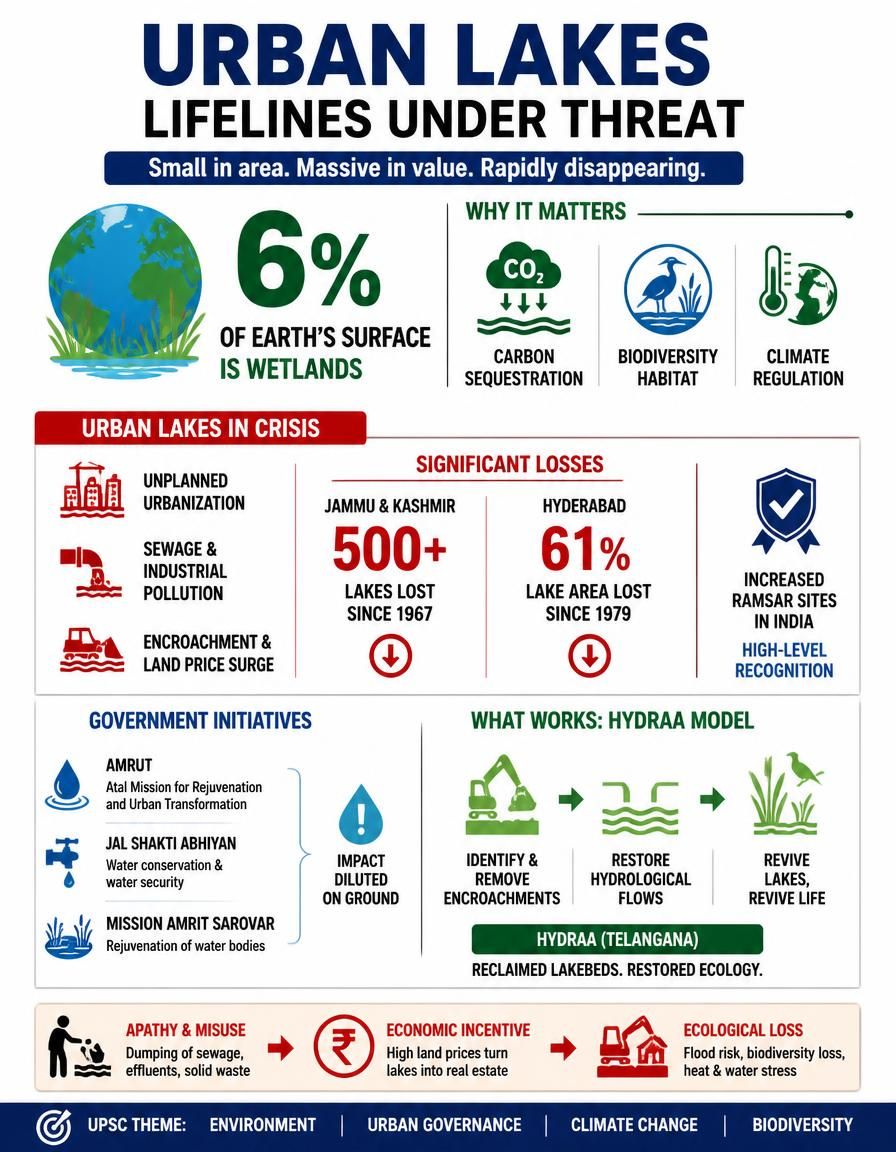
- Wetlands, including urban lakes, cover nearly 6% of the planet's surface and are vital for carbon sequestration, biodiversity, and climate regulation.
- Urban lakes are rapidly disappearing or becoming biologically dead due to unplanned urbanization, encroachment, and pollution from sewage and industrial effluents.
- Reports indicate significant shrinkage, with over 500 lakes lost in Jammu & Kashmir since 1967 and Hyderabad losing 61% of its lake area since 1979.
- India's increased tally of Ramsar Sites reflects high-level recognition, but local conservation efforts face challenges from ambiguous boundaries and encroachment.
- Government initiatives like Atal Mission for Rejuvenation and Urban Transformation (AMRUT), Jal Shakti Abhiyan, and Mission Amrit Sarovar exist but often have diluted on-the-ground impact.
- The Hyderabad Disaster Response and Asset Protection Agency (HYDRAA) in Telangana has successfully reclaimed encroached lakebeds and restored hydrological flows.
Urban Lake.jpg
Detailed Insights:
- Wetlands are highly productive ecosystems, often outperforming terrestrial forests in carbon storage per unit area.
- Rapid, unplanned urbanization leads to lakes being perceived as "vacant land" rather than critical ecological infrastructure, making them vulnerable to destruction.
- Deep-rooted institutional and public apathy contributes to lakes being used as dumping grounds for untreated sewage, industrial effluents, and solid waste.
- Exponential increases in land prices economically incentivize encroachment, transforming peri-urban lake catchments into prime real estate.
- Fragmented accountability, weak inter-departmental coordination, and a focus on beautification over ecological repair hinder genuine lake restoration.
- HYDRAA's efforts included desilting blocked feeder channels and restoring natural hydrological flows, significantly increasing the water spread of Nalla Cheruvu.
- Grassroots citizen movements in cities like Bengaluru and Hyderabad have also demonstrated success in reviving dying water bodies such as Puttenahalli and Jakkur.
- Effective long-term solutions require formal integration of water bodies into city planning, strict legal protection for lake boundaries, and unified, accountable governance.
- Institutionalizing citizen engagement within governance frameworks is crucial to ensure permanent local ownership and sustained conservation efforts.
Key Concepts Involved:
- Wetlands: Areas saturated with water, either permanently or seasonally, supporting distinctive ecosystems.
- Eutrophication: The process of excessive nutrient enrichment in a water body, leading to dense plant growth and oxygen depletion.
- Ramsar Sites: Wetlands designated as internationally important under the Ramsar Convention, an intergovernmental treaty for wetland conservation.
- Urban Heat Island Effect: A phenomenon where urban areas experience higher temperatures than surrounding rural areas due to human activities and altered land surfaces.

SuperKalam is your personal mentor for UPSC preparation, guiding you at every step of the exam journey.
Download the App


STUDY RESOURCES
CONTACT US
ⓒ Snapstack Technologies Private Limited