GS 2: GovernanceGS 3: Science & TechnologyGS 3: EconomyPrelimsGS 3: Infrastructure: Energy, Ports, Roads, Airports, Railways etc.
Nuclear power operator plans new design unit to support pvt players, Pg12
State-owned NPCIL establishes new design unit to provide indigenous PHWR technology and expertise to private players entering India's nuclear sector.
Practice MCQs
789 Students attempted
Key Highlights:
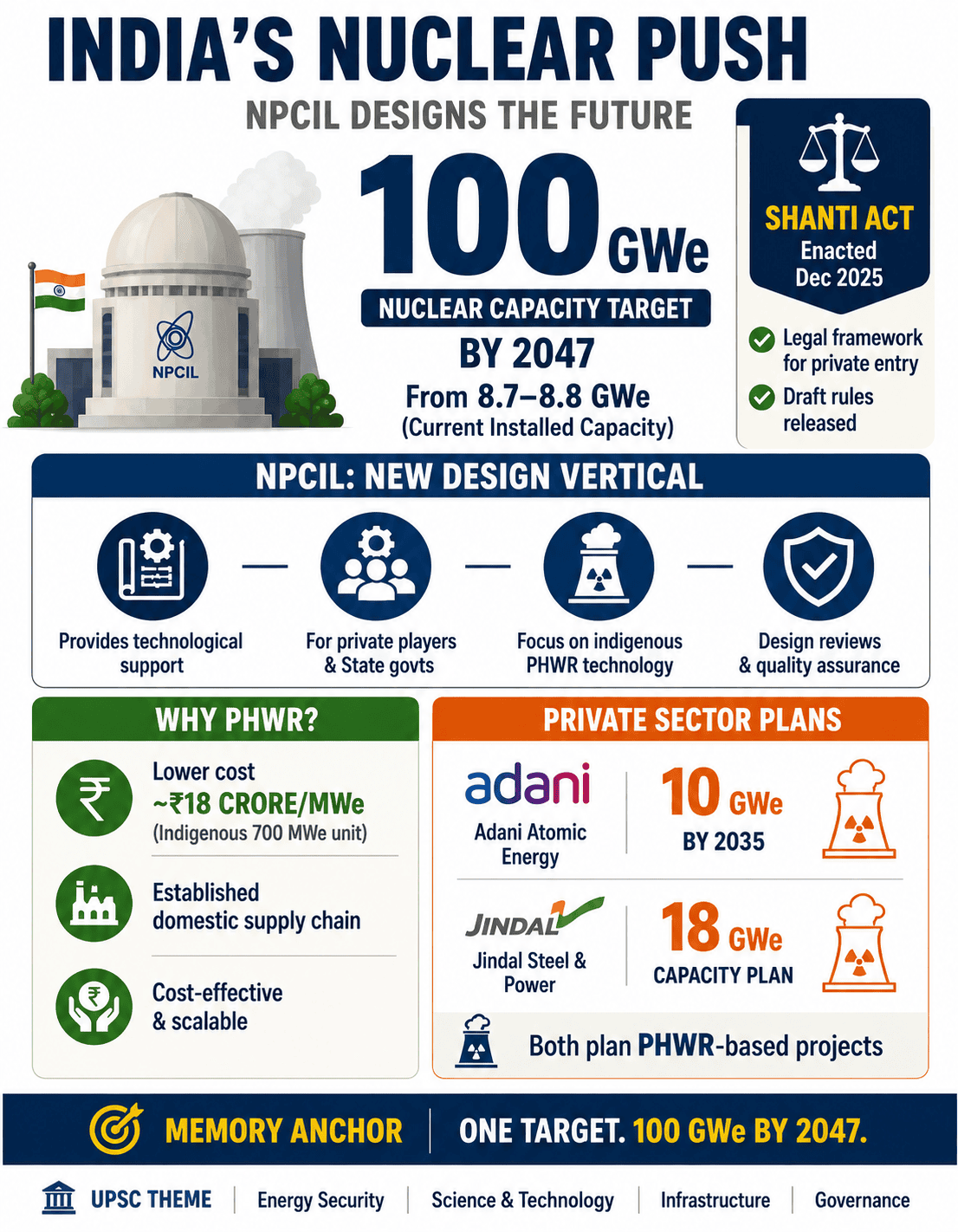
- The Nuclear Power Corporation of India Ltd (NPCIL) is establishing a new design vertical to provide technological support to private players and state governments entering the nuclear power sector.
- This initiative follows the opening of India's nuclear power sector to private participation and the enactment of the Sustainable Harnessing and Advancement of Nuclear Energy for Transforming India (SHANTI) Act in December 2025.
- The vertical will focus on indigenous Pressurised Heavy-Water Reactor (PHWR) technology, which is favored for its cost-effectiveness and established domestic supply chain.
- India aims to increase its nuclear power capacity from the current 8.7-8.8 gigawatt-electric (GWe) to 100 GWe by 2047.
- Private entities like Adani Atomic Energy and Jindal Steel are planning significant nuclear capacity additions, targeting 10 GWe by 2035 and 18 GWe respectively, primarily utilizing PHWR technology.
Nuclear Power.jpg
Detailed Insights:
- The new NPCIL vertical will serve as a gateway for entities seeking access to PHWR technology, offering expertise in design reviews and quality assurance.
- Draft rules under the SHANTI Act have been released to clarify the legal framework for licensing new nuclear projects, facilitating private sector integration.
- PHWRs are preferred over foreign reactor technologies like Light Water Reactors (LWRs) and Pressurised Water Reactors (PWRs) due to their lower cost, estimated at around Rs 18 crore per megawatt-electric (MWe) for indigenous 700 MWe units.
- The Central Electricity Authority (CEA) has outlined a roadmap for achieving the 100 GWe nuclear capacity target by 2047, identifying PHWRs as a prime candidate for adoption.
- The expansion of nuclear power is crucial for India's energy security and its commitment to achieving net-zero carbon emissions by 2070.
- While Small Modular Reactors (SMRs) are part of India's long-term nuclear expansion plans, with a target of at least five indigenous SMRs by 2033, PHWRs are seen as the practical starting point for initial private sector deployment.
Key Concepts Involved:
- Nuclear Power Corporation of India Ltd (NPCIL): A public sector undertaking under the Department of Atomic Energy (DAE) responsible for the design, construction, commissioning, and operation of nuclear power reactors in India.
- Sustainable Harnessing and Advancement of Nuclear Energy for Transforming India (SHANTI) Act: A 2025 legislation that opens India's civil nuclear sector to private and joint venture participation, reforming the legal framework.
- Pressurised Heavy-Water Reactor (PHWR): An indigenous nuclear reactor technology developed in India, using heavy water as both coolant and moderator, capable of using natural uranium fuel.
- Central Electricity Authority (CEA): A statutory organization under the Ministry of Power, responsible for advising the government on policy matters and coordinating power sector development.
- Small Modular Reactors (SMRs): Advanced nuclear reactors that are smaller than conventional reactors, designed for factory fabrication and modular construction, offering flexibility in deployment.

SuperKalam is your personal mentor for UPSC preparation, guiding you at every step of the exam journey.
Download the App


STUDY RESOURCES
CONTACT US
ⓒ Snapstack Technologies Private Limited