GS 1: World GeographyGS 1: Physical GeographyGS 3: Disaster ManagementPrelimsGS 3: Disaster and Disaster Management
Ice-rock avalanche may have triggered surge in border river, say experts, Pg1
Experts investigate ice-rock avalanche as trigger for massive flash floods and mudslides along Nepal-Tibet border river, raising secondary hazard concerns.
Practice MCQs
789 Students attempted
Key Highlights:
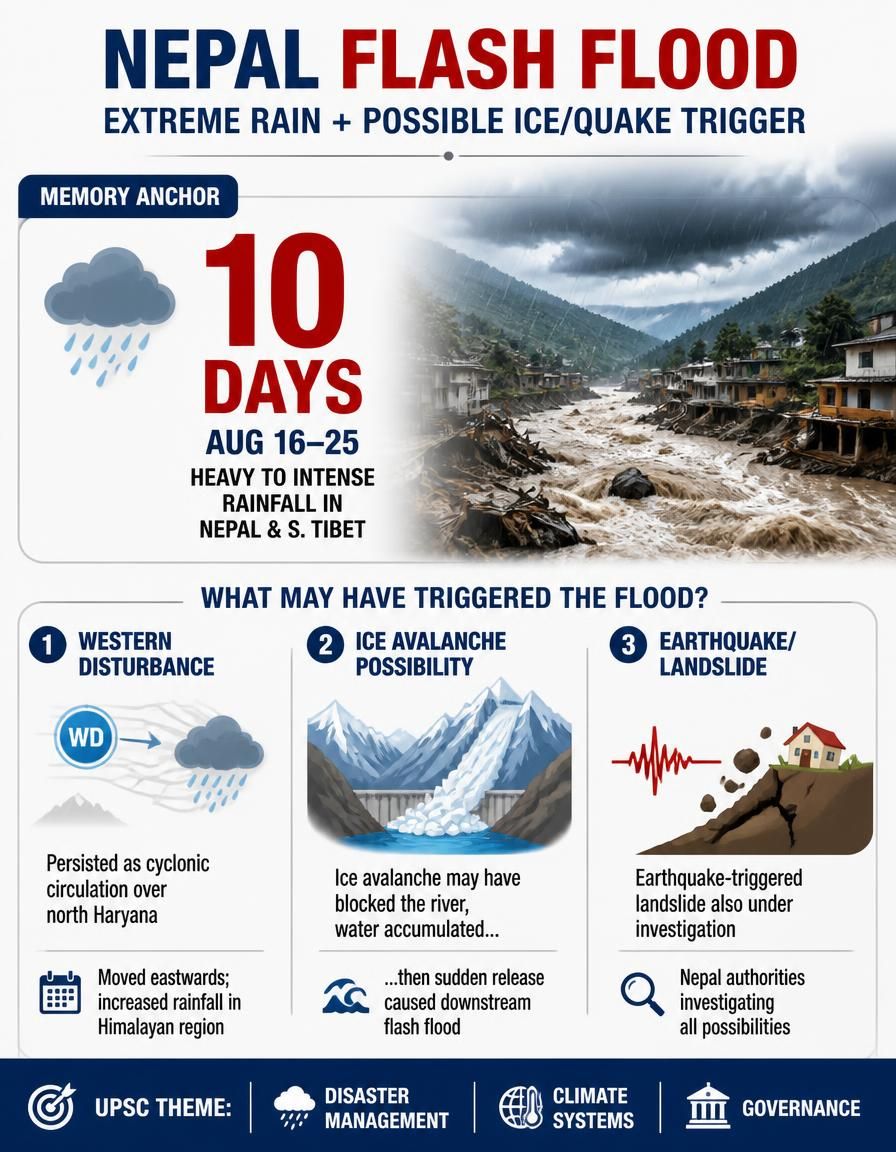
- Scientists are investigating whether an ice-rock avalanche from a high-altitude area triggered flash floods and a mudslide on the Nepal-Tibet border.
- The event occurred in the Lhende Khola, a tributary of the Bhote Koshi river, causing a sudden surge of water, sediment, and boulders downstream.
- The International Centre for Integrated Mountain Development (ICIMOD), a Nepal-based intergovernmental institution, is leading the assessment.
- Water levels in the Trishuli river reportedly rose by nine meters at Galechhi and seven meters at Malekhu within 30 minutes in Dhading district.
- Authorities have warned of a potential second flood due to a blockage still lodged upstream on the Nepal-China border.
Nepal Flooding Reasons.jpg
Detailed Insights:
- The suspected ice-rock avalanche involved the sudden collapse of a large mass of ice and rock debris into the Lhende Khola.
- Preliminary analysis of seismic records identified unusual signals during the disaster period, though a direct link to the flood is unconfirmed.
- The affected area was previously devastated by floods in Rasuwa last year, highlighting recurring vulnerability.
- ICIMOD experts are assessing if debris temporarily blocked the river, forming a landslide dam, which could create a secondary hazard if it breaches.
- The Hindu Kush Himalaya (HKH) region, where the incident occurred, is a critical mountain system spanning eight countries and is often called the "Third Pole" due to its vast ice and snow reserves.
- The Bhote Koshi river originates in Tibet and flows into Nepal, forming part of the Koshi River system.
- The Trishuli river is a major tributary of the Narayani River basin in central Nepal, formed by the merger of the Kyirong Tsangpo and the Lende Khola near the Nepal-Tibet border.
Key Concepts Involved:
- Ice-rock avalanche: A rapid downhill movement of a large mass of ice and rock debris, often from glaciers or ice-covered mountains.
- Landslide dam: A natural dam formed when a landslide blocks a river channel, impounding water upstream and posing a risk of catastrophic flooding if it fails.
- Hindu Kush Himalaya (HKH) region: An extensive mountain range spanning eight countries (Afghanistan, Bangladesh, Bhutan, China, India, Myanmar, Nepal, Pakistan), known as the "Third Pole" and a source of major Asian river systems.

SuperKalam is your personal mentor for UPSC preparation, guiding you at every step of the exam journey.
Download the App


STUDY RESOURCES
CONTACT US
ⓒ Snapstack Technologies Private Limited