GS 2: GovernanceGS 3: Disaster ManagementGS 3: Environment & EcologyGS 3: EconomyPrelims
How can States use disaster funds for heatwaves?, Pg8
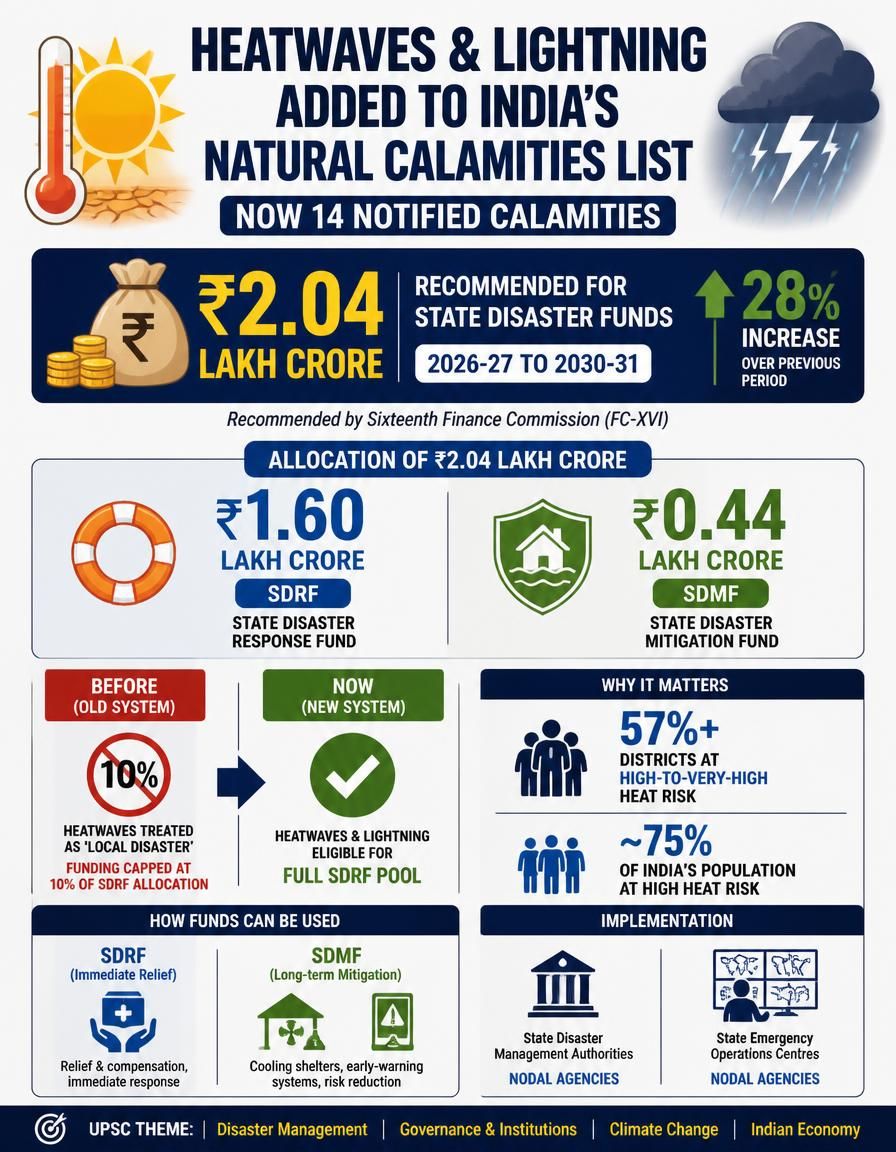
MHA notifies heatwaves and lightning as natural calamities, allowing states full access to disaster funds for mitigation and relief, following FC-XVI recommendations.
Practice MCQs
789 Students attempted
Key Highlights:
- Heatwaves and lightning have been added to India’s list of notified natural calamities, bringing the total to 14.
- This change follows a recommendation by the Sixteenth Finance Commission (FC-XVI) and new operational guidelines.
- Heatwaves are now eligible for the full State Disaster Risk Management Fund pool, removing previous funding limitations.
- The FC-XVI recommended ₹2.04 lakh crore for State disaster funds for 2026-27 to 2030-31, a 28% increase.
- Of this, ₹1.6 lakh crore is allocated to the State Disaster Response Fund (SDRF) and the remainder to the State Disaster Mitigation Fund (SDMF).
Heatwave and Lightning.jpg
Detailed Insights:
- The previous system limited heatwave funding to 10% of a State's annual SDRF allocation, treating it as a 'local disaster'.
- India faces increasing exposure to extreme heat, with over 57% of districts and roughly three-fourths of the population at high-to-very-high heat risk.
- The National Disaster Management Authority (NDMA) has urged all States, districts, and cities to develop Heat Action Plans (HAPs).
- Implementation of HAPs has been slow due to limited technical capacity, competing priorities, and inadequate funding.
- The new notification allows States to use SDRF for immediate relief and compensation, and SDMF for long-term risk reduction measures like cooling shelters and early-warning systems.
- State Disaster Management Authorities and State Emergency Operations Centres are designated as nodal agencies for these funds.
- There is a need to expand HAPs beyond the current 300 cities/districts and convert these plans into fundable projects.
- Improving health surveillance for heat-related illnesses and linking heat solutions with other government development schemes are crucial next steps.
- Parametric insurance, which provides automatic payouts upon reaching a set temperature threshold, is suggested as an effective tool.
- Article 280 of the Constitution mandates the Finance Commission to recommend arrangements for disaster management funds.
Key Concepts Involved:
- Sixteenth Finance Commission (FC-XVI): A constitutional body that recommends financial arrangements between the Union and State governments, including disaster management funds.
- State Disaster Response Fund (SDRF): Primary fund available with State governments for immediate response, relief, and reconstruction following notified disasters.
- State Disaster Mitigation Fund (SDMF): Fund established to finance interventions aimed at reducing the risk of climate events turning into disasters in the longer term.
- Heat Action Plans (HAPs): Comprehensive strategies developed by States, districts, and cities to map heat risk, identify vulnerabilities, and implement short, medium, and long-term interventions.
- Parametric Insurance: An insurance product that pays out a pre-determined amount if a specific, measurable event (e.g., temperature exceeding a threshold) occurs, rather than based on actual losses.

SuperKalam is your personal mentor for UPSC preparation, guiding you at every step of the exam journey.
Download the App


STUDY RESOURCES
CONTACT US
ⓒ Snapstack Technologies Private Limited