GS 2: GovernanceGS 3: Science & TechnologyGS 2: International RelationsPrelimsGS 2: Effect of Policies and Politics of Developed and Developing Countries on India's Interests
Why is China’s AI push gaining ground?, Pg8
China's Kimi K3 and open-source AI models challenge US dominance, leveraging abundant electricity and government support despite GPU curbs, intensifying the global tech race.
Practice MCQs
782 Students attempted
Key Highlights:
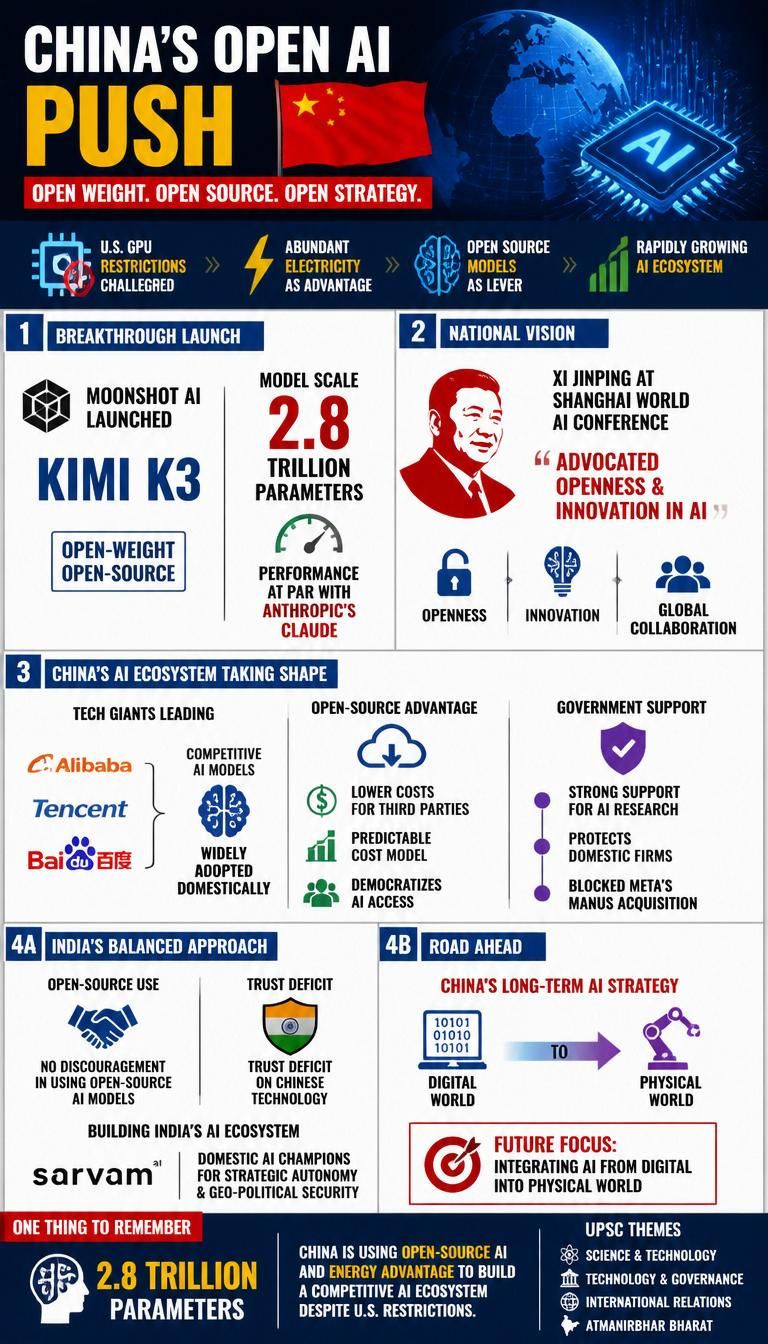
- Chinese firm Moonshot AI launched Kimi K3, an open-weight/open-source AI model comparable to Anthropic's Claude.
- Chinese President Xi Jinping advocated for openness and innovation in AI at the Shanghai World AI Conference.
- China addresses U.S. restrictions on Graphics Processing Units (GPUs) by leveraging abundant electricity and less advanced chips.
- Major Chinese companies like Alibaba, Tencent, and Baidu are developing a competitive AI ecosystem with widely adopted models.
- India maintains a trust deficit regarding Chinese technology but does not discourage the use of open-source AI models.
China AI push.jpg
Detailed Insights:
- Kimi K3 is a 2.8 trillion parameter model, demonstrating China's advanced AI capabilities despite hardware limitations.
- Alibaba has also released lightweight open-source models, enabling users to run AI inference on their own hardware.
- The Chinese government supports AI research and protects domestic firms, exemplified by blocking Meta's acquisition of Manus.
- Open-source models offer potential cost predictability for third-party providers, which could challenge the subsidized captive models of U.S. firms.
- The long-term availability of free open-source models from Chinese firms is uncertain, as some, like Alibaba, are also developing captive models.
- India is promoting domestic AI champions such as Sarvam AI to foster its own AI ecosystem and address geopolitical concerns.
- China's long-term AI strategy includes a future focus on integrating AI from the digital into the physical world.
Key Concepts Involved:
- Open-weight/Open-source AI: AI models where the underlying code, data, and parameters are freely accessible and modifiable by anyone.
- Captive AI Models: Proprietary AI models where the source code and parameters are not publicly shared, typically controlled by the developing company.
- Graphics Processing Units (GPUs): Specialized electronic circuits essential for accelerating the complex computations required for training and running AI models.
- Inference: The process where a trained AI model uses new data to make predictions, classifications, or generate outputs.

SuperKalam is your personal mentor for UPSC preparation, guiding you at every step of the exam journey.
Download the App


STUDY RESOURCES
CONTACT US
ⓒ Snapstack Technologies Private Limited