GS 1: Indian SocietyGS 2: Social JusticeGS 3: EconomyPrelimsGS 3: Public Distribution System
To understand closing of the Strait, follow the cook, Pg13
Global conflict in Strait of Hormuz sparks LPG crisis, revealing stark class divide and precarity of India's urban migrant workforce.
Practice MCQs
782 Students attempted
Key Highlights:
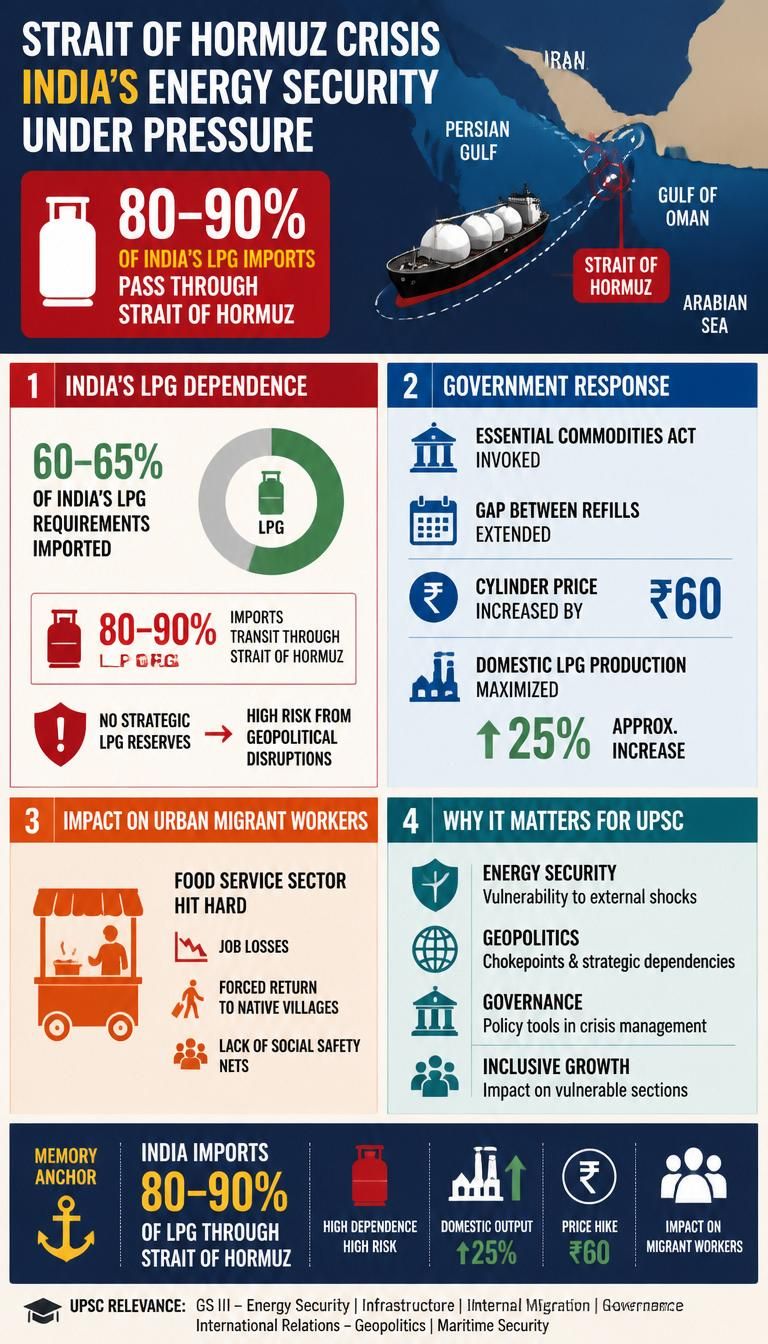
- The closure of the Strait of Hormuz, following the US-Israel war with Iran, has significantly impacted India's energy security.
- India imports approximately 60-65% of its Liquefied Petroleum Gas (LPG) requirements, with 80-90% of these imports traditionally transiting through the Strait of Hormuz.
- In response to supply disruptions, the Indian government invoked the Essential Commodities Act, extended the gap between domestic LPG refills, and increased cylinder prices by ₹60.
- The crisis disproportionately affects urban migrant workers, particularly those in the food service industry, leading to job losses and forced return to their native villages.
Strait of Hormuz.jpg
Detailed Insights:
- The Strait of Hormuz is a vital maritime chokepoint connecting the Persian Gulf to the Gulf of Oman and the Arabian Sea, crucial for global oil and gas transit.
- India's high dependence on LPG imports, coupled with a lack of strategic LPG reserves, makes the country vulnerable to geopolitical disruptions in the Middle East.
- The government directed refineries to maximize domestic LPG production, leading to an approximate 25% increase in output to mitigate the supply crunch.
- The crisis highlights the precarious economic situation of urban migrant workers, who often lack social safety nets and fallback options like land in their villages.
- Data from the CMIE household panel indicates that during previous reverse migrations, diets of returning workers deteriorated, with reduced consumption of eggs, meat, fruits, and vegetables.
- This situation underscores a societal fault line between the "rooted" (those with land or family support in villages) and the "rootless" (migrants without such fallback options).
- The behavioral concept of "scarcity" explains how individuals under pressure tend to "tunnel," focusing solely on immediate needs and neglecting long-term planning.
Key Concepts Involved:
- Strait of Hormuz: A narrow, strategically important waterway between the Persian Gulf and the Gulf of Oman, critical for global oil and gas shipments.
- Essential Commodities Act, 1955: An Indian law empowering the government to regulate the production, supply, and distribution of essential goods to ensure their availability and prevent hoarding.
- Scarcity: A psychological and economic state of having less than one feels one needs, leading to a focused but often narrow decision-making process called "tunneling."
- CMIE (Centre for Monitoring Indian Economy): An independent economic think tank in India that conducts large-scale household surveys, including the Consumer Pyramids Household Survey (CPHS).

SuperKalam is your personal mentor for UPSC preparation, guiding you at every step of the exam journey.
Download the App


STUDY RESOURCES
CONTACT US
ⓒ Snapstack Technologies Private Limited