GS 3: Internal SecurityGS 2: International RelationsGS 3: EconomyPrelimsGS 3: Indian Economy, Planning, Mobilization of Resources, Growth, Development and Employment
Do not surrender to China, do not depend on the U.S., Pg6
India urged to forge strategic autonomy, resisting economic surrender to hostile China and over-reliance on unpredictable US, post-Galwan.
Practice MCQs
782 Students attempted
Key Highlights:
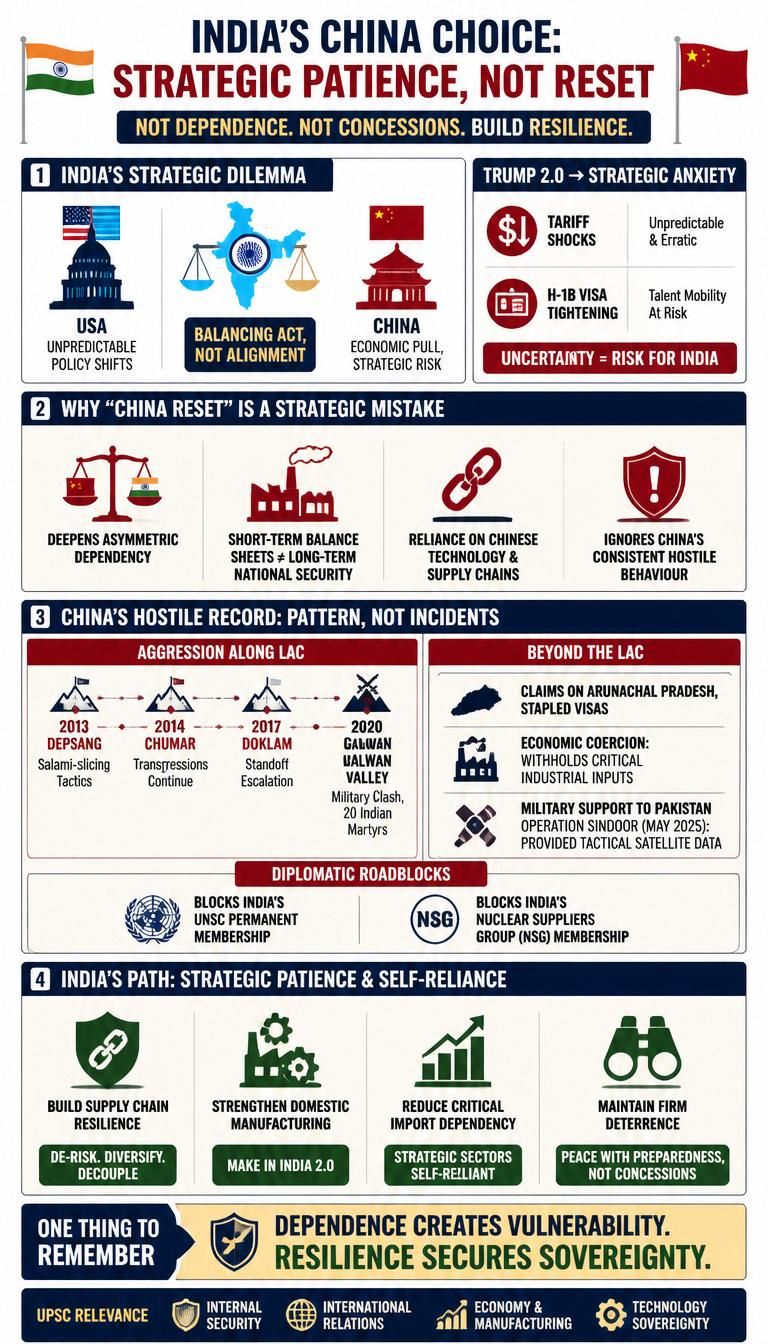
- India faces a strategic dilemma, urged not to surrender to China's economic influence nor depend solely on the unpredictable United States.
- An influential business lobby advocates for an economic reset with China, citing India's reliance on Chinese technology and supply chains.
- The article argues this approach risks deepening asymmetric dependency and ignores China's consistent hostile actions.
- It proposes India should focus on strategic patience, building supply chain resilience, and strengthening domestic manufacturing capabilities.
Ind-China.jpg
Detailed Insights:
- The Trump administration's erratic policy shifts, including tariffs and H-1B visa tightening, created strategic anxiety in New Delhi.
- The business lobby's call for a China reset is criticized for prioritizing short-term balance sheets over long-term national security.
- China's aggression includes salami-slicing tactics at Depsang (2013), Chumar (2014), Doklam (2017), and Galwan Valley (2020) along the Line of Actual Control (LAC).
- Beijing also asserts claims over Arunachal Pradesh, issues stapled visas, and employs economic coercion by withholding critical industrial inputs.
- China's military support for Pakistan during Operation Sindoor (May 2025), providing tactical satellite data, is highlighted as a hostile act.
- China has consistently blocked India's aspirations for UNSC permanent membership and Nuclear Suppliers Group (NSG) membership.
- Deepening economic ties without resolving border disputes could create an economic "kill-switch" for China over the Indian economy.
- India's post-Galwan restrictions on Chinese apps and investments are considered crucial diplomatic leverage that should not be surrendered.
Key Concepts Involved:
- Salami-slicing tactics: A strategy of gradually seizing territory or influence through a series of small, incremental actions, each too minor to provoke a major response.
- Line of Actual Control (LAC): The demarcation line that separates Indian-controlled territory from Chinese-controlled territory in the Sino-Indian border dispute.
- Economic coercion: The use of economic measures, such as trade restrictions or sanctions, to pressure another country into changing its policies.
- Supply chain resilience: The ability of a supply chain to resist disruption and recover quickly from unexpected events.

SuperKalam is your personal mentor for UPSC preparation, guiding you at every step of the exam journey.
Download the App


STUDY RESOURCES
CONTACT US
ⓒ Snapstack Technologies Private Limited