GS 3: Environment & EcologyPrelimsGS 3: Conservation, Pollution and DegradationGS 1: Changes in Critical Geographical Features, Water Bodies, Ice Caps, Flora and Fauna
3 Great Indian Bustard chicks placed in rewilding tunnel, Pg12
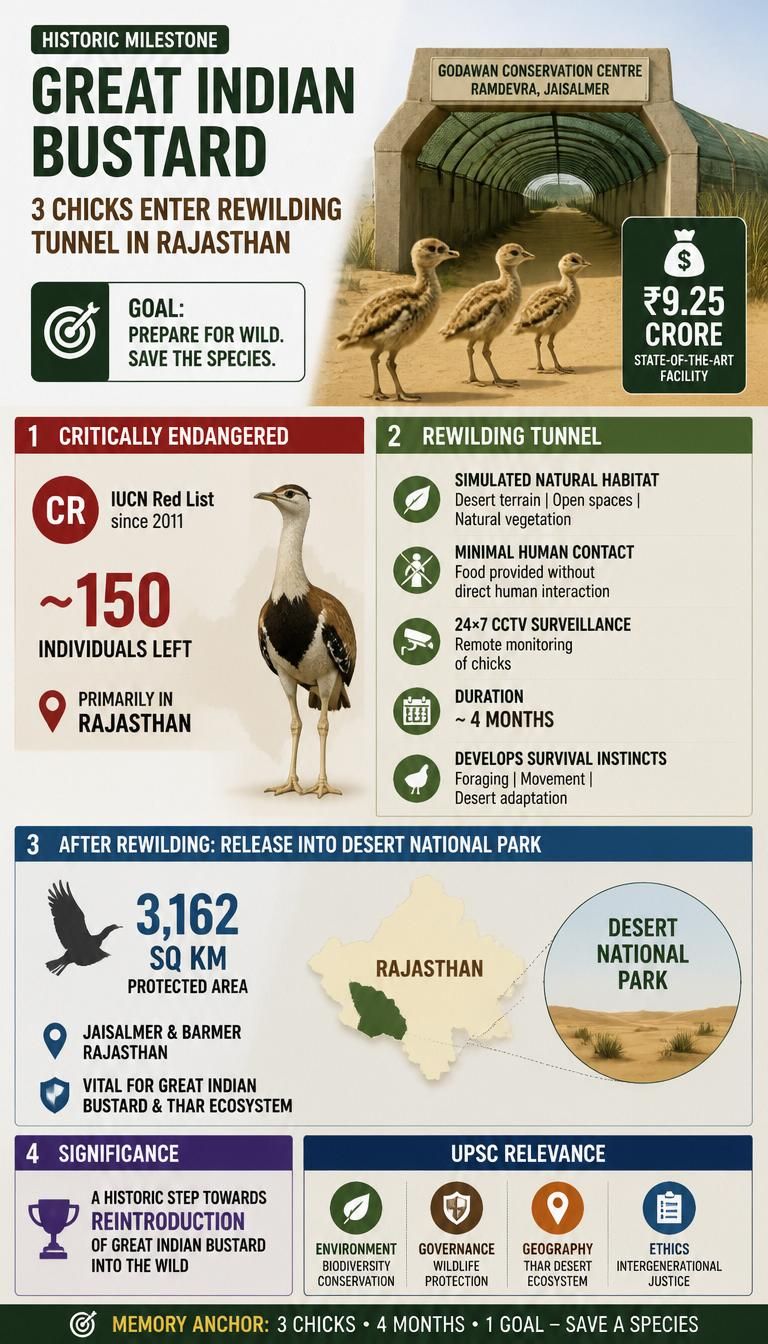
In a first, three endangered Great Indian Bustard chicks enter ₹9.25-crore rewilding tunnel at Jaisalmer's Godawan Centre, preparing for wild release.
Practice MCQs
782 Students attempted
Key Highlights:
- Three chicks of the Great Indian Bustard have been moved into a custom-built rewilding tunnel at the Godawan Conservation Centre in Ramdevra, Jaisalmer.
- The ₹9.25-crore facility aims to prepare captive-bred birds for life in the wild by minimizing human contact and simulating their natural habitat.
- The chicks will remain in the tunnel for approximately four months under CCTV surveillance, with food provided without direct human contact.
- Following the rewilding phase, the chicks are slated for release into Desert National Park.
- The Great Indian Bustard is the State bird of Rajasthan.
GIB.jpg
Detailed Insights:
- The Great Indian Bustard is listed as Critically Endangered on the IUCN Red List since 2011, with an estimated population of around 150 individuals, primarily in Rajasthan.
- The rewilding tunnel is designed to help the chicks develop crucial survival instincts such as foraging, movement in open terrain, and adaptation to desert ecology.
- This initiative is considered a "historic milestone" in the conservation program, marking a shift towards successful reintroduction into natural habitats.
- Desert National Park, spanning 3,162 sq km across Jaisalmer and Barmer, is a vital protected area for the conservation of the Great Indian Bustard and the Thar Desert ecosystem.
- Conservation efforts for the species include Project Great Indian Bustard, launched by the Rajasthan government in 2013, and a project by the Wildlife Institute of India (WII) in collaboration with the Ministry of Environment, Forest and Climate Change (MoEFCC).
- Major threats to the Great Indian Bustard include habitat loss, collisions with power lines, and poaching.
Key Concepts Involved:
- Great Indian Bustard (GIB): A Critically Endangered large ground-dwelling bird, the state bird of Rajasthan, primarily found in arid and semi-arid grasslands.
- Rewilding: The process of preparing captive-bred animals to survive independently in their natural habitat with minimal human intervention.
- Desert National Park: A large protected area in Rajasthan, India, crucial for the conservation of desert ecosystems and the Great Indian Bustard.
- Critically Endangered: The highest risk category assigned by the IUCN Red List for species facing an extremely high risk of extinction in the wild.
Previous10/10

SuperKalam is your personal mentor for UPSC preparation, guiding you at every step of the exam journey.
Download the App


STUDY RESOURCES
CONTACT US
ⓒ Snapstack Technologies Private Limited