GS 2: International RelationsGS 3: EconomyPrelimsGS 2: Bilateral, Regional and Global Groupings and AgreementsGS 2: Effect of Policies and Politics of Developed and Developing Countries on India's Interests
US Proposes 25% Tariff on Indian Imports Over Industrial Overcapacity
The United States Trade Representative proposes a 25% tariff on Indian imports under Section 301, prompting strong rejection from New Delhi.
Sources: Indian Express (Pg. 1) | The Hindu (Pg. 1)
Practice MCQs
804 Students attempted
Key Highlights:
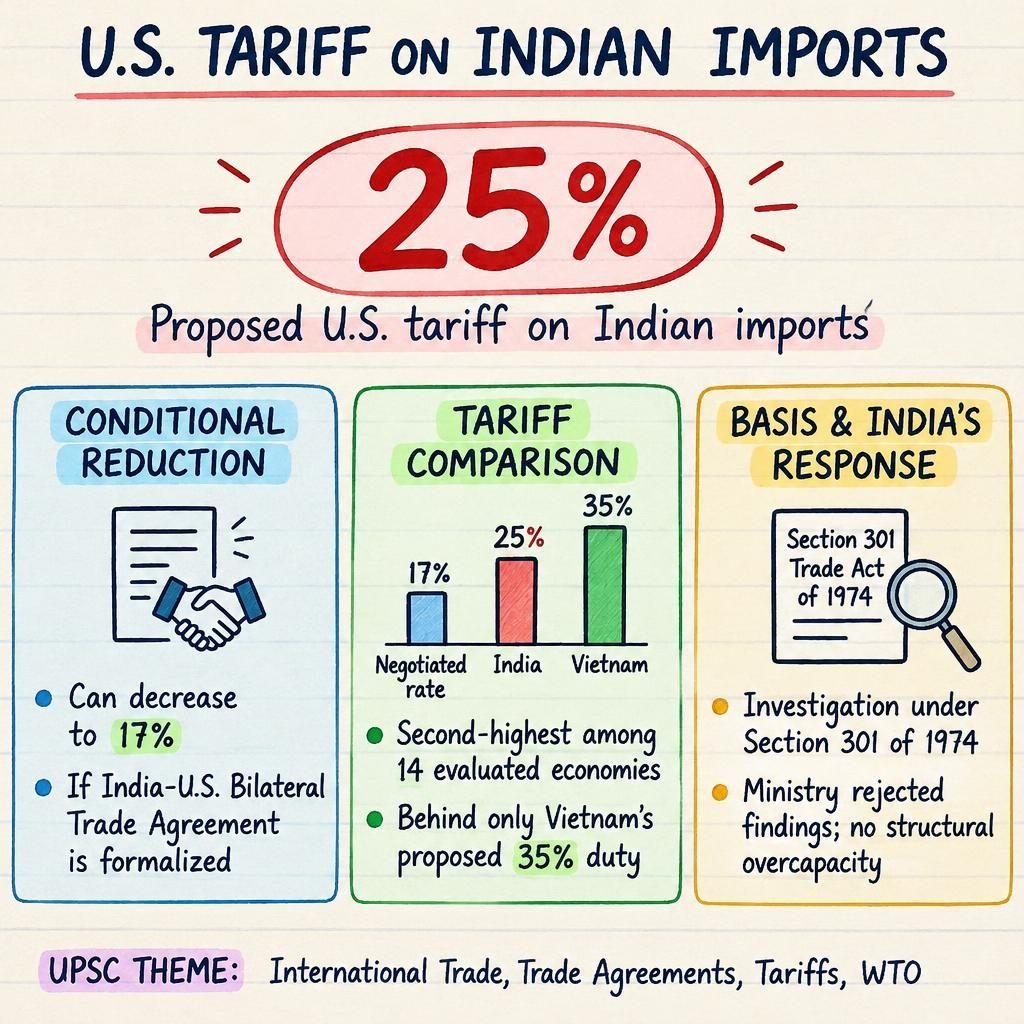
- The Office of the United States Trade Representative proposed a 25% tariff on Indian imports following an investigation into industrial overcapacity.
- The proposed duty can decrease to 17% if both nations formalize the ongoing India-U.S. Bilateral Trade Agreement.
- India faces the second-highest tariff rate among 14 evaluated economies, behind only Vietnam's proposed 35% duty.
- The investigation was conducted under Section 301 of the Trade Act of 1974, following a prior probe on forced labor practices.
- The Ministry of Commerce and Industry rejected the findings, affirming that domestic manufacturing exhibits no structural overcapacity.
- Under the proposed 17% negotiated rate, Indian exports would secure a 1% to 3% tariff advantage over competitors like China and Vietnam.
US Tariffs.jpg
Detailed Insights:
- The proposed 25% levy is net of earlier trade actions and will not compound upon existing 10% tariffs.
- The Directorate General of Foreign Trade previously restricted imports made using forced labor to address initial American concerns.
- The measures accompany separate 50% tariffs levied on global steel and aluminum imports under Section 232 of the Trade Expansion Act.
- Unilateral tariff impositions under domestic trade statutes raise compliance concerns under the rules of the World Trade Organization.
- India is targeting preferential tariff differentials against member economies of the Association of Southeast Asian Nations to safeguard export market share.
Key Concepts Involved:
- Section 301: A domestic statute enabling unilateral punitive tariffs against foreign practices deemed burdensome to American commerce.
- Structural Excess Capacity: Persistent industrial manufacturing capacity outstripping market demand, maintained primarily through market-distorting state subsidies.
- Reciprocal Trade: A bilateral framework where two trading nations grant mutually balanced market access and tariff concessions.

SuperKalam is your personal mentor for UPSC preparation, guiding you at every step of the exam journey.
Download the App


STUDY RESOURCES
CONTACT US
ⓒ Snapstack Technologies Private Limited