EthicsGS 2: PolityPrelimsGS 4: Probity in Governance, Concept and Philosophical BasisGS 2: Indian Constitutional Evolution, Features, Amendments, Basic Structure Doctrine
The Imperative of Cultivating Constitutional Morality in Indian Democracy
The Supreme Court and Ambedkar's principles champion constitutional morality to safeguard fundamental rights, curb majoritarian orthodoxy, and reinforce limited government.
Source: The Hindu (Pg. 7)
Practice MCQs
804 Students attempted
Key Highlights:
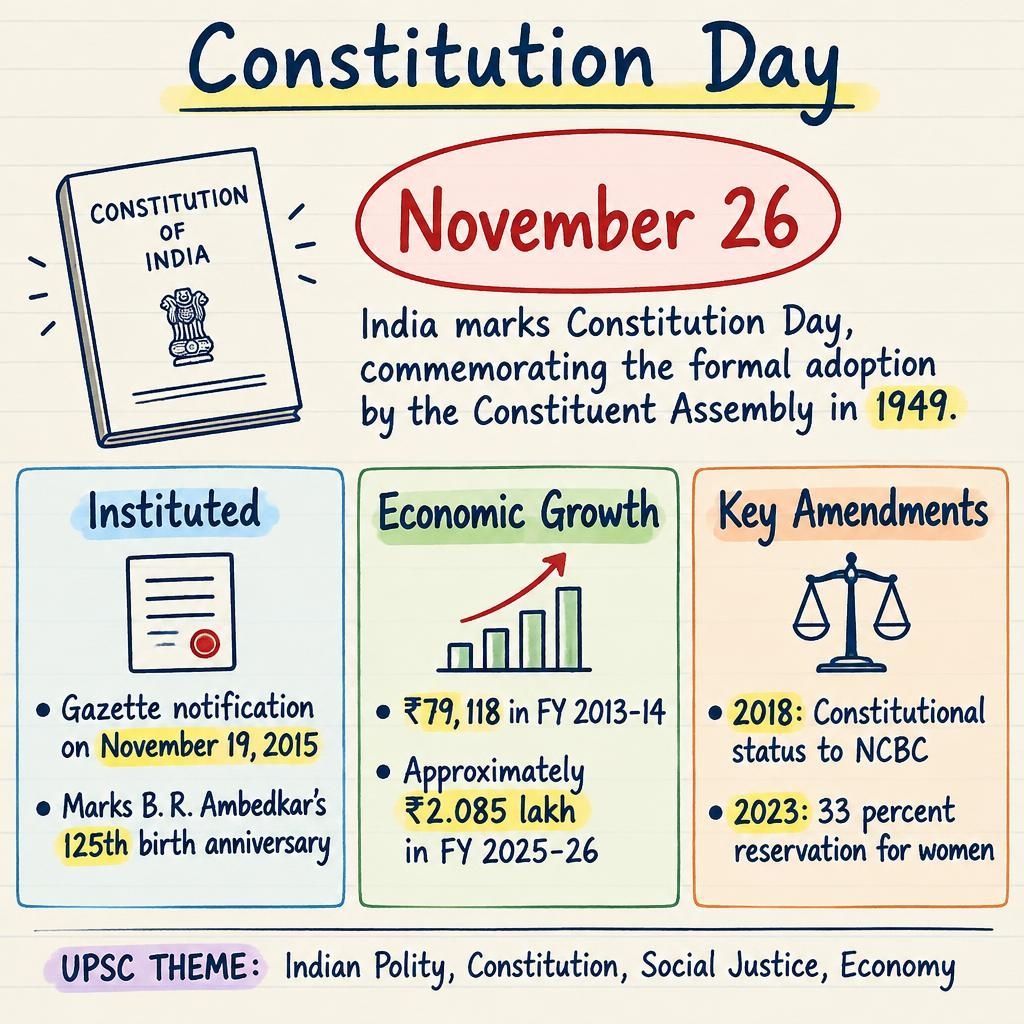
- India observes November 26 as Constitution Day, commemorating the adoption of the Constitution by the Constituent Assembly in 1949.
- The Constituent Assembly was constituted under the framework of the Cabinet Mission Plan, 1946, holding its first session on December 9, 1946.
- The assembly had a final membership of 299, comprising 229 representatives elected from British Indian provinces and 70 nominated by princely states.
- The bulk of the Constitution came into effect on January 26, 1950, commemorating the 1930 Purna Swaraj Declaration of the Indian National Congress.
- The Supreme Court of India has repeatedly invoked constitutional morality to strike down discriminatory social practices in cases like Navtej Singh Johar v. Union of India and the Indian Young Lawyers Association case.
Constitution Day.jpg
Detailed Insights:
- Constitutionalism functions as a mechanism of limited government through structural checks, balances, and judicial review under Part III of the Constitution of India.
- Dr. B. R. Ambedkar warned against hero-worship in politics and urged adherence to constitutional methods over unconstitutional agitation to avoid anarchy.
- Ambedkar emphasized that political democracy cannot survive without establishing social and economic democracy for marginalized and subaltern classes.
- Constitutional morality obligates state institutions and citizens to uphold equality, liberty, and fraternity above majoritarian orthodoxy or social morality.
- The concept of constitutional morality served as a philosophical underpinning for the Basic Structure Doctrine established in Kesavananda Bharati v. State of Kerala.
- The landmark ruling in K.S. Puttaswamy v. Union of India utilized constitutional morality to secure individual privacy against legislative and executive overreach.
Key Concepts Involved:
- Constitutionalism: A political doctrine asserting that governmental authority must be legally limited by constitutional rules and institutional safeguards.
- Constitutional Morality: The principled adherence to constitutional values and norms over transient majoritarian public opinion or customary social morality.
- Judicial Review: The authority of superior courts to review and void legislative statutes or executive actions violating constitutional provisions.
- Basic Structure Doctrine: A judicial principle prohibiting the Parliament of India from amending the core, inviolable framework of the Constitution.

SuperKalam is your personal mentor for UPSC preparation, guiding you at every step of the exam journey.
Download the App


STUDY RESOURCES
CONTACT US
ⓒ Snapstack Technologies Private Limited