GS 2: GovernanceGS 3: Science & TechnologyGS 3: EconomyPrelimsGS 3: Indian Economy, Planning, Mobilization of Resources, Growth, Development and Employment
Evaluating the Economic and Employment Impact of Hyperscale Data Centres in India
Hyperscale data centres absorb eight billion dollars in capital yet create barely one hundred jobs across India.
Source: Indian Express (Pg. 10)
Practice MCQs
804 Students attempted
Key Highlights:
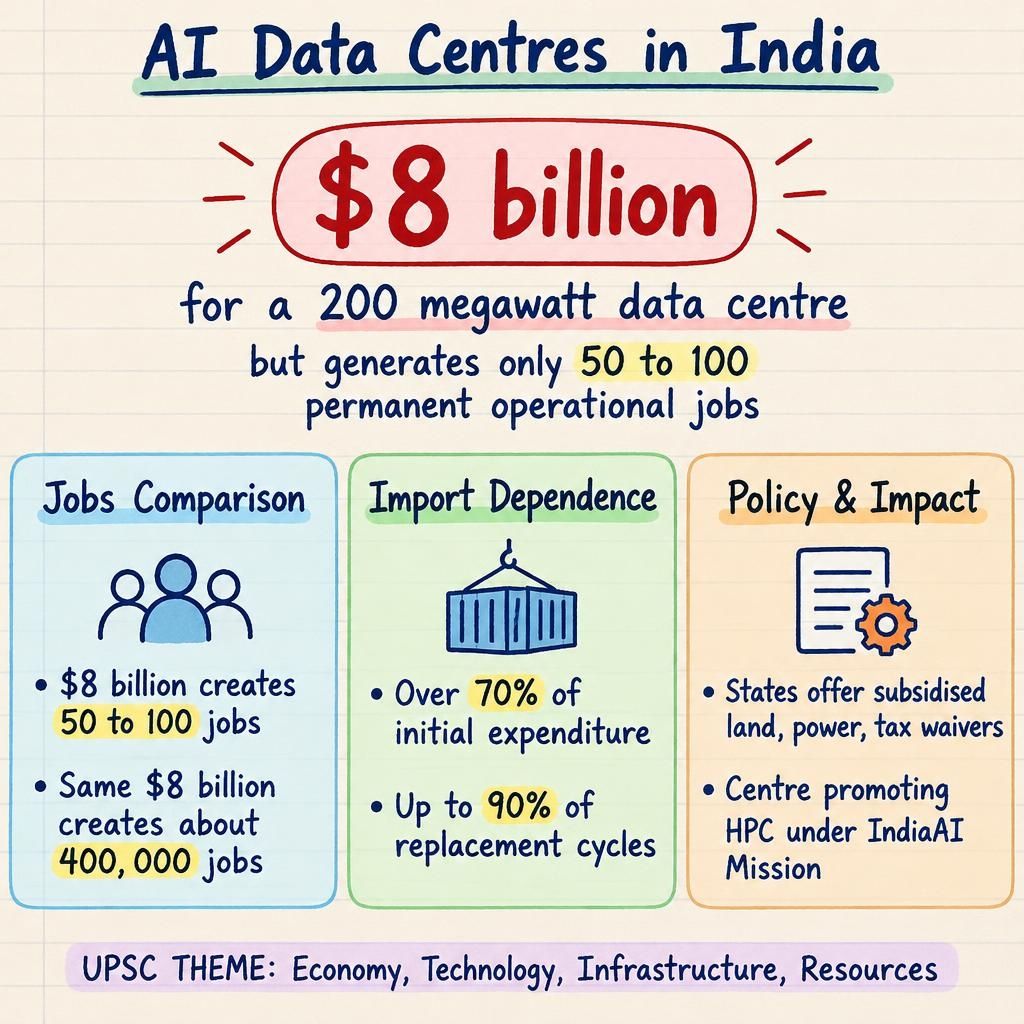
- A standard 200 megawatt artificial intelligence data centre requires approximately $8 billion in capital investment but generates only 50 to 100 permanent operational jobs.
- With India's capital stock per worker averaging $20,000, an equivalent $8 billion investment creates about 400,000 conventional jobs, making data centres 4,000 times more capital-intensive.
- Imported hardware comprises over 70% of initial data centre expenditure and up to 90% of recurring replacement cycles due to rapid hardware obsolescence.
- Over the past 25 years, capital inputs accounted for 4 percentage points of India's annual economic growth, while labour contributed only 1.7 percentage points.
- Several state governments offer subsidised land, power concessions, and tax waivers to attract hyperscale data centres despite heavy fiscal and resource costs.
- The central government is promoting domestic high-performance computing capacity under the IndiaAI Mission to support indigenous foundational model development.
AI Data Center.jpg
Detailed Insights:
- The Ministry of Electronics and Information Technology formulated the Draft National Data Centre Policy to position India as a global data hub.
- Inbound capital inflows are predominantly recycled abroad to finance foreign hardware imports, dampening positive impacts on the foreign exchange reserves.
- Data centre reliance on imported microelectronics leaves facilities vulnerable to unilateral trade restrictions issued by the U.S. Department of Commerce.
- High thermal density systems demand substantial continuous electricity and freshwater supplies, competing directly with local agricultural and municipal utility needs.
- Classical trade theory suggests India should focus on labour-intensive artificial intelligence applications rather than subsidising capital-heavy compute exports for foreign hyperscalers.
Key Concepts Involved:
- Compute: The aggregated processing capacity, memory, and networking infrastructure required to train and run machine learning models.
- Capital Intensity: The ratio of capital equipment and financial assets used in production relative to the volume of labour employed.
- Balance of Payments: A systematic record of all financial and economic transactions conducted between a nation's residents and the world.

SuperKalam is your personal mentor for UPSC preparation, guiding you at every step of the exam journey.
Download the App


STUDY RESOURCES
CONTACT US
ⓒ Snapstack Technologies Private Limited