GS 2: GovernanceGS 3: EconomyPrelimsGS 3: Changes in Industrial Policy and Effects on Industrial GrowthGS 2: Government policies and interventions for development in various sectors
Cabinet Approves ₹11,000-Crore Scheme to Boost Heavy Equipment Manufacturing
Cabinet approves ₹11,000-crore scheme to boost domestic heavy machinery manufacturing, slash import dependence, and expand critical infrastructure testing capabilities.
Sources: PIB | Indian Express (Pg. 13) | The Hindu (Pg. 8)
Practice MCQs
804 Students attempted
Key Highlights:
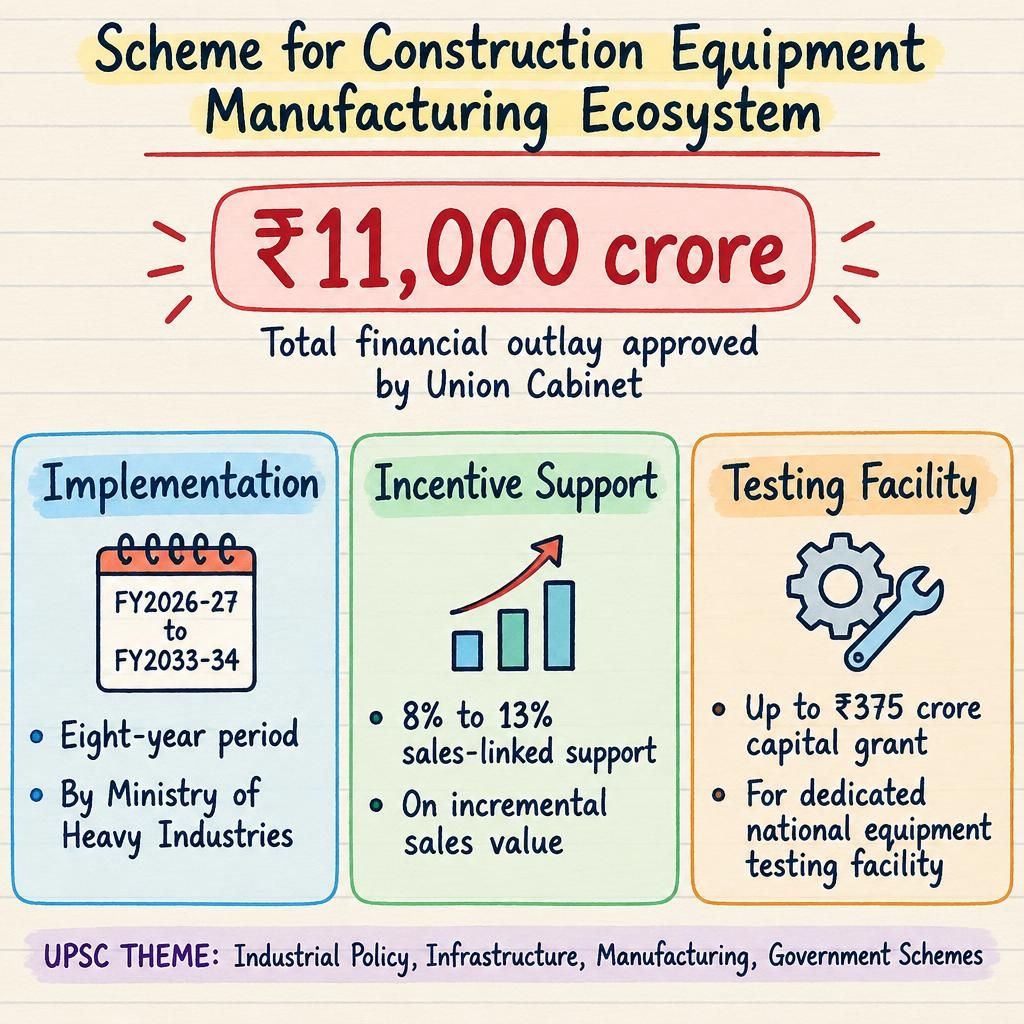
- The Union Cabinet approved the Scheme for Enhancement of Construction and Infrastructure Equipment Manufacturing Ecosystem with a total financial outlay of ₹11,000 crore.
- The scheme will be executed over an eight-year period starting from FY2026-27 to FY2033-34 by the Ministry of Heavy Industries.
- India is the world’s third-largest market for construction and infrastructure equipment, valued at approximately ₹97,500 crore in FY2024-25.
- The incentive structure offers graded sales-linked support ranging between 8% and 13% on incremental sales value over five years for eligible manufacturers.
- A capital grant of up to ₹375 crore is allocated to establish a dedicated national equipment testing facility under Viability Gap Funding.
- The intervention prioritizes critical, technologically complex heavy machinery including tunnel boring machines, ship-to-shore cranes, off-highway trucks, and hydraulic excavators.
Heavy Equipment Manufacturing.jpg
Detailed Insights:
- India currently relies on imports for nearly 45% to 50% of its heavy construction machinery, exposing critical infrastructure projects to external supply shocks.
- Chinese export controls on heavy industrial equipment accelerated New Delhi's policy shift toward domestic component localization and technological sovereignty.
- The domestic equipment sector is projected to expand to ₹2,28,100 crore by FY2029-30, driven by the National Infrastructure Pipeline.
- The scheme includes a two-year initial gestation window (FY2026-27 to FY2027-28) enabling manufacturers to build greenfield or brownfield production infrastructure.
- High capital costs and testing deficits are addressed through subsidized infrastructure, reinforcing broader industrial targets under Atmanirbhar Bharat and Viksit Bharat @2047.
Key Concepts Involved:
- Sales-linked Incentive: Financial reward paid directly to manufacturers based on incremental revenue generated from goods produced domestically.
- Viability Gap Funding: Government grant provided to support economically essential infrastructure projects that fall short of commercial financial viability.
- Import Substitution: Trade strategy aimed at replacing foreign imports with domestic industrial production to strengthen economic self-reliance.

SuperKalam is your personal mentor for UPSC preparation, guiding you at every step of the exam journey.
Download the App


STUDY RESOURCES
CONTACT US
ⓒ Snapstack Technologies Private Limited