GS 2: GovernanceGS 3: Environment & EcologyPrelimsGS 3: Conservation, Pollution and DegradationGS 2: Government policies and interventions for development in various sectors
Air Pollution in Delhi's Rural Outskirts Surpasses City Center Concentrations
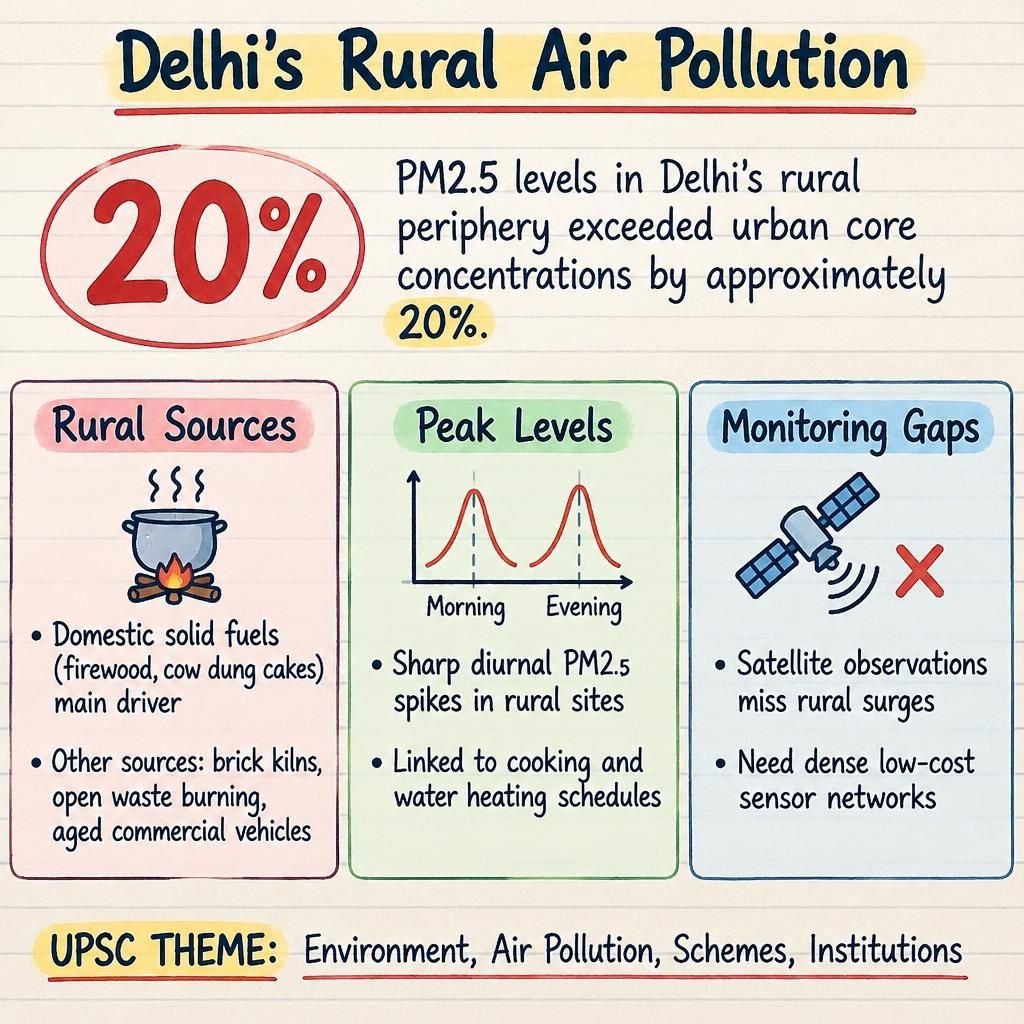
A study reveals PM2.5 levels in Delhi's rural periphery exceed urban core concentrations by 20%, driven by domestic solid fuel burning.
Source: The Hindu (Pg. 2)
Practice MCQs
804 Students attempted
Key Highlights:
- A study published in the Proceedings of the National Academy of Sciences revealed that PM2.5 levels in Delhi's rural periphery exceeded urban core concentrations by approximately 20%.
- Routine burning of domestic solid fuels, including firewood and cow dung cakes, was identified as the primary emission driver rather than seasonal crop residue burning.
- Rural monitoring sites exhibited sharp diurnal PM2.5 spikes during morning and evening intervals, correlating directly with household cooking and water heating schedules.
- Satellite remote sensing observations failed to capture hyper-local rural pollution surges, highlighting severe blind spots in top-down atmospheric observation models.
- Secondary rural emission sources included unregulated brick kilns, open waste burning, and aged commercial vehicles restricted from operating inside central Delhi.
Delhi's Rural Air Pollution.jpg
Detailed Insights:
- Urban-centric interventions under the National Clean Air Programme overlook rural airsheds, leaving significant populations without targeted mitigation policies.
- The Commission for Air Quality Management mandates regional airshed oversight in the National Capital Region, yet enforcement remains weak in rural belts.
- Sustained biomass usage highlights economic refill barriers under Pradhan Mantri Ujjwala Yojana, limiting sustained transition to liquefied petroleum gas.
- Commercial vehicles phased out under National Green Tribunal directives in municipal Delhi are routinely diverted to unregulated peri-urban transport networks.
- Researchers recommend deploying dense networks of low-cost sensor systems to complement high-maintenance monitoring stations managed by the Central Pollution Control Board.
Scientific/Technical Concepts Involved:
- PM2.5: Fine inhalable particulate matter measuring 2.5 micrometres or smaller that penetrates deep into human respiratory systems.
- Airshed: A distinct geographic region sharing common meteorological and topographical boundaries that govern atmospheric pollutant movement.
- Temperature Inversion: Atmospheric condition where warm air caps cooler surface air, trapping ground-level particulate matter and preventing dispersion.

SuperKalam is your personal mentor for UPSC preparation, guiding you at every step of the exam journey.
Download the App


STUDY RESOURCES
CONTACT US
ⓒ Snapstack Technologies Private Limited