GS 2: GovernanceGS 2: International RelationsGS 3: Environment & EcologyPrelimsGS 3: Conservation, Pollution and Degradation
Why Loss & Damage Fund for Nepal matters beyond it, Pg15
Nepal receives first $20 million allocation from Loss & Damage Fund, setting a crucial precedent for climate finance to vulnerable developing nations.
Practice MCQs
796 Students attempted
Key Highlights:
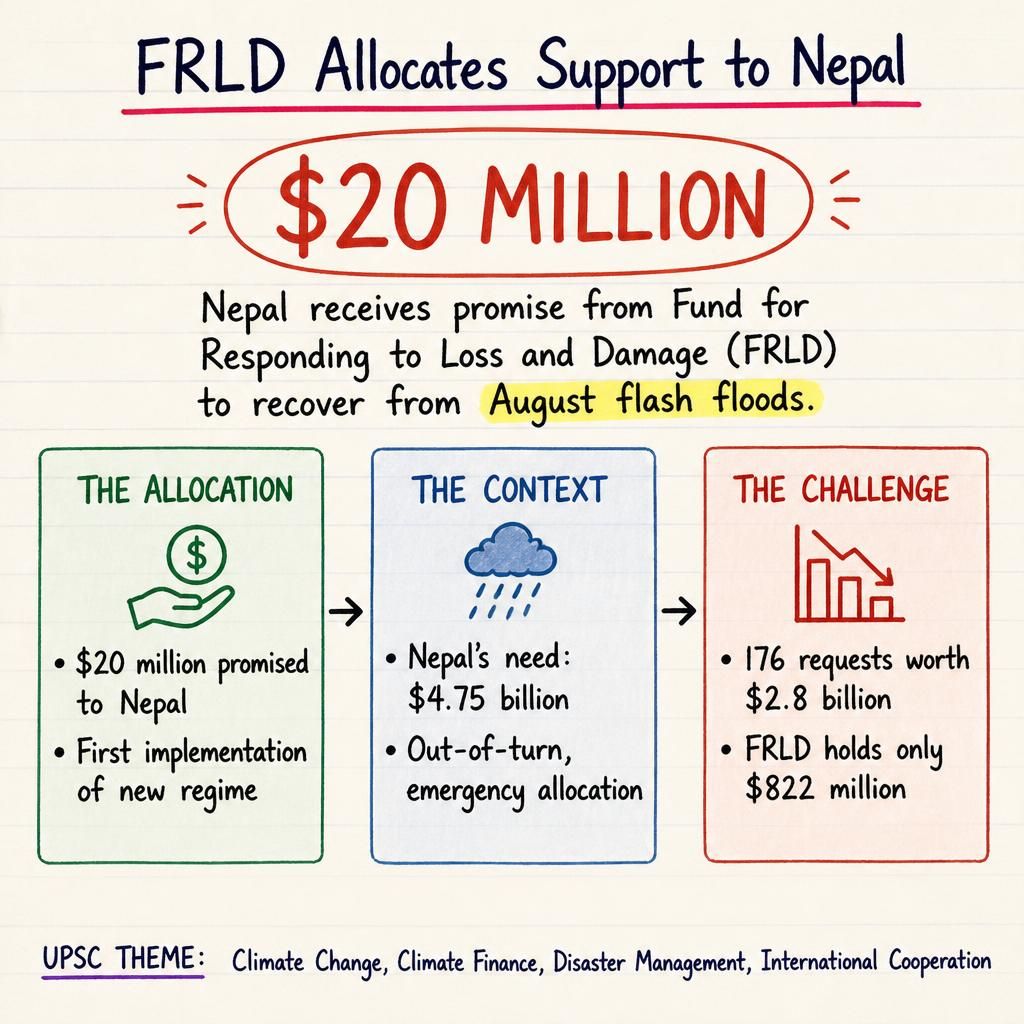
- Nepal received a promise of $20 million from the Fund for Responding to Loss and Damage (FRLD) to recover from devastating flash floods in August.
- This allocation marks the first implementation of the new international regime for loss and damage, despite Nepal's estimated need of $4.75 billion.
- The FRLD, established in 2022 and operationalized in 2023, aims to provide financial assistance to developing countries affected by climate events.
- Nepal's case is an out-of-turn, emergency allocation, setting a potential template for immediate financial aid following large-scale climate disasters.
Nepal Loss and Damage Fund.jpg
Detailed Insights:
- Developing nations, particularly small and vulnerable ones like Nepal, disproportionately suffer climate change consequences despite negligible historical emissions.
- Nepal's contribution to historical global greenhouse gas emissions is a mere 0.01%, highlighting the climate justice aspect of the fund.
- The FRLD received 176 funding requests totaling $2.8 billion from 119 countries after its first call for applications at COP30.
- The fund currently holds only $822 million in pledges, significantly less than the requested amount, necessitating prioritization of applications.
- Developed countries have historically failed to meet their climate finance obligations, including the $100 billion annual commitment between 2020-2025.
- Developing countries require $1.5 trillion annually for climate finance, while developed nations have only committed to $300 billion annually from 2035.
- India has also submitted three requests to the FRLD, totaling over $52 million, for various climate-induced damages and resilience-building efforts.
Key Concepts Involved:
- Fund for Responding to Loss and Damage (FRLD): A new international financing instrument created to provide financial assistance to developing countries affected by climate change impacts.
- Climate Finance: Financial resources provided by developed countries to developing countries to help them address climate change mitigation and adaptation.
- Loss and Damage: The unavoidable negative impacts of climate change that occur despite mitigation and adaptation efforts, requiring financial compensation.
- UN Framework Convention on Climate Change (UNFCCC): An international environmental treaty established in 1992 to combat "dangerous human interference with the climate system."

SuperKalam is your personal mentor for UPSC preparation, guiding you at every step of the exam journey.
Download the App


STUDY RESOURCES
CONTACT US
ⓒ Snapstack Technologies Private Limited