GS 2: GovernanceGS 3: Environment & EcologyGS 3: EconomyPrelimsGS 3: Farm Subsidies and Minimum Support Prices
We Need To Address The Issue Of Soil Health, Pg11
India's imbalanced fertilizer use, exacerbated by flawed subsidy policies, severely degrades soil, pollutes environment, and strains finances, demanding urgent policy reforms for sustainable agriculture.
Practice MCQs
796 Students attempted
Key Highlights:
- Union Minister for Agriculture and Farmers’ Welfare Shivraj Singh Chouhan launched the Khet Bachao Abhiyan (Save the Farm Campaign) on October 22 in Karnal, Haryana.
- The campaign aims to address the imbalanced use of chemical fertilizers, which is harming soil, groundwater, and air quality.
- The Nutrient-Based Subsidy (NBS) policy, introduced in 2010, has worsened the N:P:K ratio to 10.5:4.1:1 against a normative 2.8:1.5:1.
- Nitrogen overuse leads to low soil organic carbon, nitrous oxide emissions, and nitrate contamination of groundwater, while potassium deficiency impacts crop resistance and grain quality.
- The fertilizer subsidy budget for 2026-27 is projected at Rs 1.71 lakh crore, potentially rising to Rs 2.5-3 lakh crore.
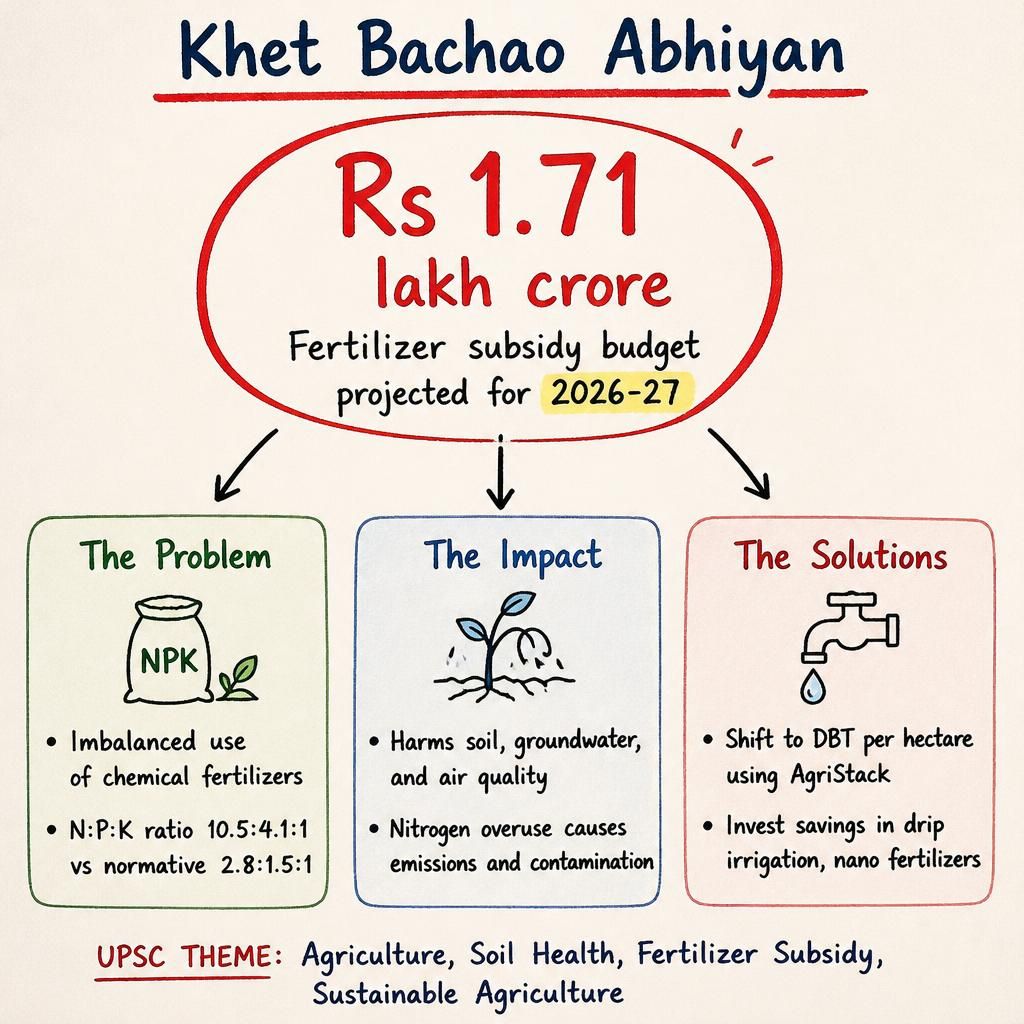
Khet Bachao Abhiyan.jpg
Detailed Insights:
- The current fertilizer pricing policy, particularly for urea, diammonium phosphate (DAP), and muriate of potash (MOP), incentivizes imbalanced nutrient application.
- ICRIER research indicates that nitrogen use is 6% above recommended doses nationally, while potassium deficit has deepened from 48% to 72%.
- The price of DAP nearly tripled and MOP rose six-fold between 2010-11 and 2024-25, while urea prices increased by only 1%, making nitrogen disproportionately cheaper.
- Data from the Soil Health Card scheme in 2025-26 showed 72% of samples were low in nitrogen, 52% in organic carbon, 42% in boron, and 37% in zinc.
- Overuse of nitrogen contributes to greenhouse gas emissions, with nitrous oxide being 273 times more potent than carbon dioxide.
- Proposed solutions include shifting from input price subsidy to Direct Benefit Transfer (DBT) per hectare, leveraging AgriStack for farmer IDs.
- Expediting and fixing the PM-PRANAM scheme is crucial to reward states for balanced fertilizer use.
- Investing fertilizer subsidy savings into drip irrigation, fertigation, and product innovation like nano fertilizers and gene-edited seeds is recommended.
- Adopting the 4Rs (right source, rate, time, place) based on soil tests and reforming power pricing and procurement are also vital steps.
Key Concepts Involved:
- Nutrient-Based Subsidy (NBS): A policy introduced in 2010 to subsidize phosphatic and potassic fertilizers based on nutrient content, while urea remained under fixed pricing.
- Direct Benefit Transfer (DBT): A system where subsidies are directly transferred to beneficiaries' bank accounts, aiming to improve targeting and reduce leakages.
- AgriStack: A proposed digital ecosystem for Indian agriculture, aiming to create a unified database of farmers linked to land records and other agricultural data.
- PM-PRANAM: A scheme aimed at promoting the balanced use of fertilizers and reducing chemical fertilizer use by incentivizing states.

SuperKalam is your personal mentor for UPSC preparation, guiding you at every step of the exam journey.
Download the App


STUDY RESOURCES
CONTACT US
ⓒ Snapstack Technologies Private Limited