GS 2: GovernanceGS 2: International RelationsGS 3: EconomyPrelimsGS 3: Effects of Liberalization on the Economy
Starlink episode points to tightropes in changing political economy, Pg10
Elon Musk's Starlink entry sparks debate on India's capitalist model, regulatory barriers, and the state-business nexus, highlighting the need for robust competition policy.
Practice MCQs
796 Students attempted
Key Highlights:
- Elon Musk's Starlink has accused Reliance Industries of impeding its entry into the Indian market for satellite broadband services.
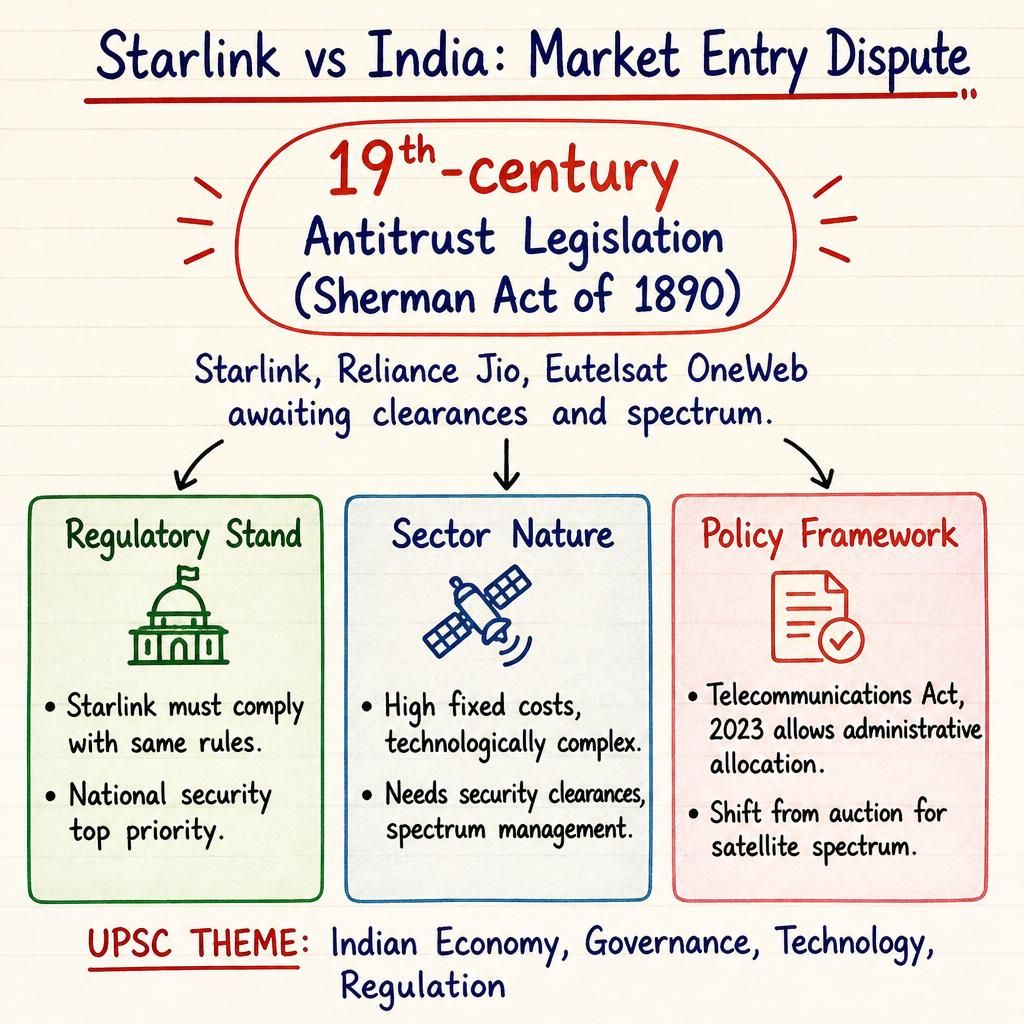
- The Indian government asserts that Starlink must comply with the same regulatory requirements as all other competitors, both domestic and foreign.
- The incident underscores the intricate relationship between business and the state in India's evolving political economy.
- Starlink, Reliance Jio, and Eutelsat OneWeb are currently awaiting final security clearances and spectrum assignment for commercial operations in India.
Starlink Issue.jpg
Detailed Insights:
- The dispute highlights fundamental differences between India's state-influenced capitalist tradition and America's technologically disruptive market model.
- India's historical Licence-Permit Raj fostered rent-seeking behavior and created significant barriers to market entry for new businesses.
- Even after the 1991 economic reforms, state control over critical resources like telecom spectrum continued to shape market opportunities and competition.
- In contrast, the US addressed 19th-century monopolies through antitrust legislation, such as the Sherman Act of 1890, to preserve competition.
- American capitalism is characterized by technological innovation, robust capital markets, and strategic state support for emerging industries.
- Satellite broadband is a technologically complex sector with high fixed costs, requiring stringent security clearances, data integrity protocols, and efficient spectrum management.
- The Indian government has emphasized national security concerns, including data localization and lawful interception, as key conditions for satellite communication providers.
- The Telecommunications Act, 2023 allows for administrative allocation of satellite spectrum, a departure from the auction method typically used for terrestrial mobile services.
- The episode raises questions about the strength of India's institutions in maintaining competition when commercial stakes are high and political influence is concentrated.
Key Concepts Involved:
- Licence-Permit Raj: A pre-1991 Indian economic system characterized by extensive government regulations, licenses, and permits for businesses.
- Sherman Act of 1890: The first US federal law designed to limit monopolies and promote fair competition in the marketplace.
- Competition Policy: Government policies and laws, like India's Competition Act, 2002, aimed at ensuring fair competition and preventing anti-competitive practices in markets.
- Spectrum Management: The process of regulating and allocating radio frequency spectrum to avoid interference and ensure its efficient use for communication services.

SuperKalam is your personal mentor for UPSC preparation, guiding you at every step of the exam journey.
Download the App


STUDY RESOURCES
CONTACT US
ⓒ Snapstack Technologies Private Limited