GS 2: GovernanceGS 1: Indian GeographyGS 2: PolityGS 3: Environment & EcologyPrelims
Narrowed Posture, Pg8
Karnataka faces mounting pressure to accept Western Ghats ESA framework, balancing farmer livelihoods and conservation, as other states advance implementation.
Practice MCQs
789 Students attempted
Key Highlights:
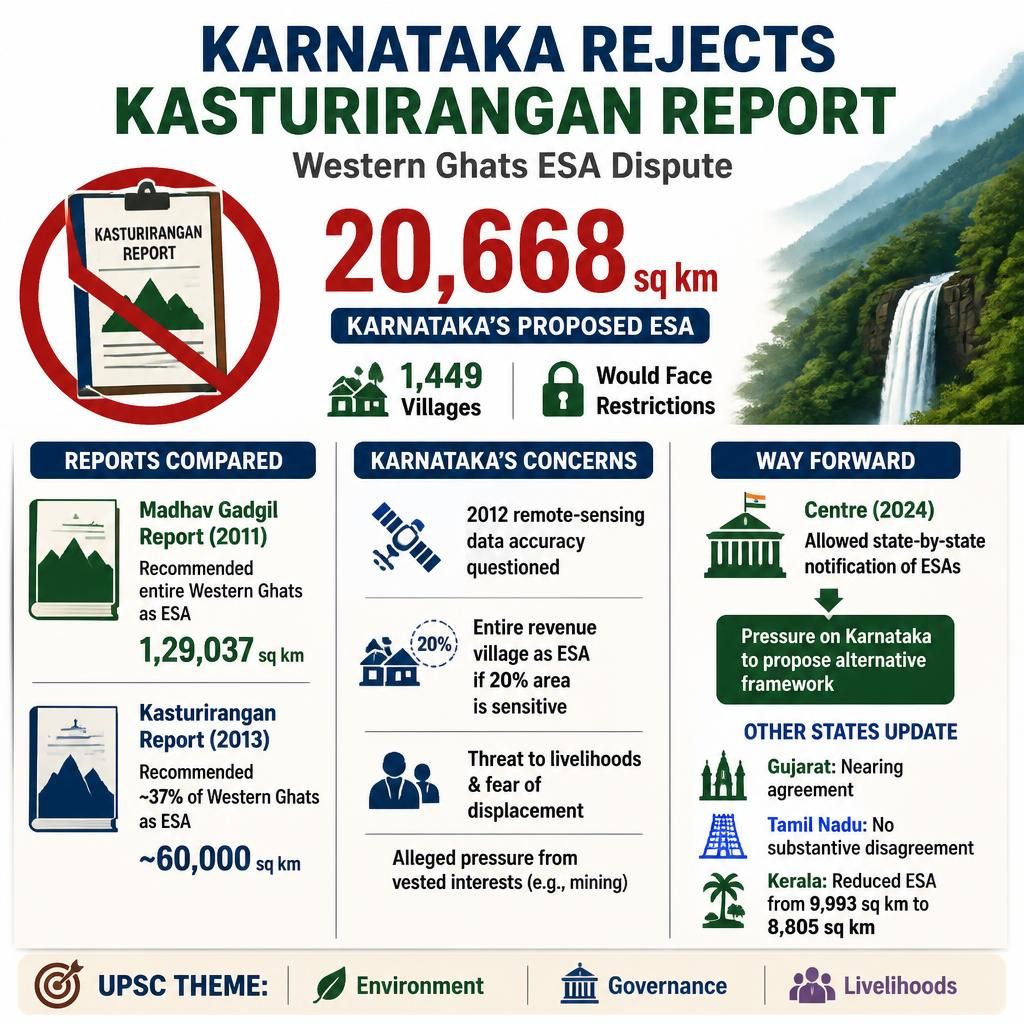
- The Karnataka Assembly unanimously rejected the recommendations of the Kasturirangan Report on Western Ghats conservation.
- Concerns were raised regarding the accuracy of 2012 remote-sensing data used by the report and its recommendation to include entire revenue villages in Ecologically Sensitive Areas (ESAs) if 20% of their area is sensitive.
- Karnataka's resistance stems from fears over livelihoods and potential displacement, allegedly fanned by vested interests including mining stakeholders.
- The Centre's 2024 decision to allow state-by-state notification of ESAs increases pressure on Karnataka to propose an alternative framework.
- Karnataka has the largest share of proposed ESAs, with 20,668 sq km covering 1,449 villages identified for restrictions.
Kasturirangan Report.jpg
Detailed Insights:
- The Kasturirangan Report, submitted in 2013, aimed to balance environmental protection with development, proposing approximately 37% (around 60,000 sq km) of the Western Ghats as ESA.
- This report was a review of the earlier Madhav Gadgil Report (2011), which had recommended declaring the entire Western Ghats (1,29,037 sq km) as an ESA with more stringent restrictions.
- The Western Ghats span six states: Gujarat, Maharashtra, Goa, Karnataka, Kerala, and Tamil Nadu, and are recognized as a UNESCO World Heritage Site and a biodiversity hotspot.
- Following the Centre's directive in 2013-14 for ground-truthing, Karnataka faced bipartisan opposition to the ESA framework.
- Other states have shown progress, with Gujarat reportedly nearing an agreement, Tamil Nadu having no substantive disagreement, and Kerala reducing its proposed ESA from 9,993 sq km to 8,805 sq km.
- Karnataka has sought a year to conduct a fresh forest survey through a technical committee, similar to the approach adopted by Kerala.
Key Concepts Involved:
- Kasturirangan Report: A 2013 report by a High-Level Working Group recommending 37% of the Western Ghats as Ecologically Sensitive Areas with regulated development. [14, 19]
- Gadgil Report: A 2011 report by the Western Ghats Ecology Expert Panel proposing the entire Western Ghats as an Ecologically Sensitive Area with strict conservation measures. [14, 19]
- Ecologically Sensitive Areas (ESAs): Ecologically fragile regions notified under the Environment (Protection) Act, 1986, to regulate activities and conserve biodiversity. [1, 3]
- Ground-truthing: The process of verifying data collected by remote sensing or other systems through direct, on-site observations. [6, 7]

SuperKalam is your personal mentor for UPSC preparation, guiding you at every step of the exam journey.
Download the App


STUDY RESOURCES
CONTACT US
ⓒ Snapstack Technologies Private Limited