GS 3: EconomyPrelimsGS 3: Changes in Industrial Policy and Effects on Industrial GrowthGS 3: Government BudgetingGS 3: Indian Economy, Planning, Mobilization of Resources, Growth, Development and Employment
Growth holds up for now. Inflation clouds outlook, Pg12
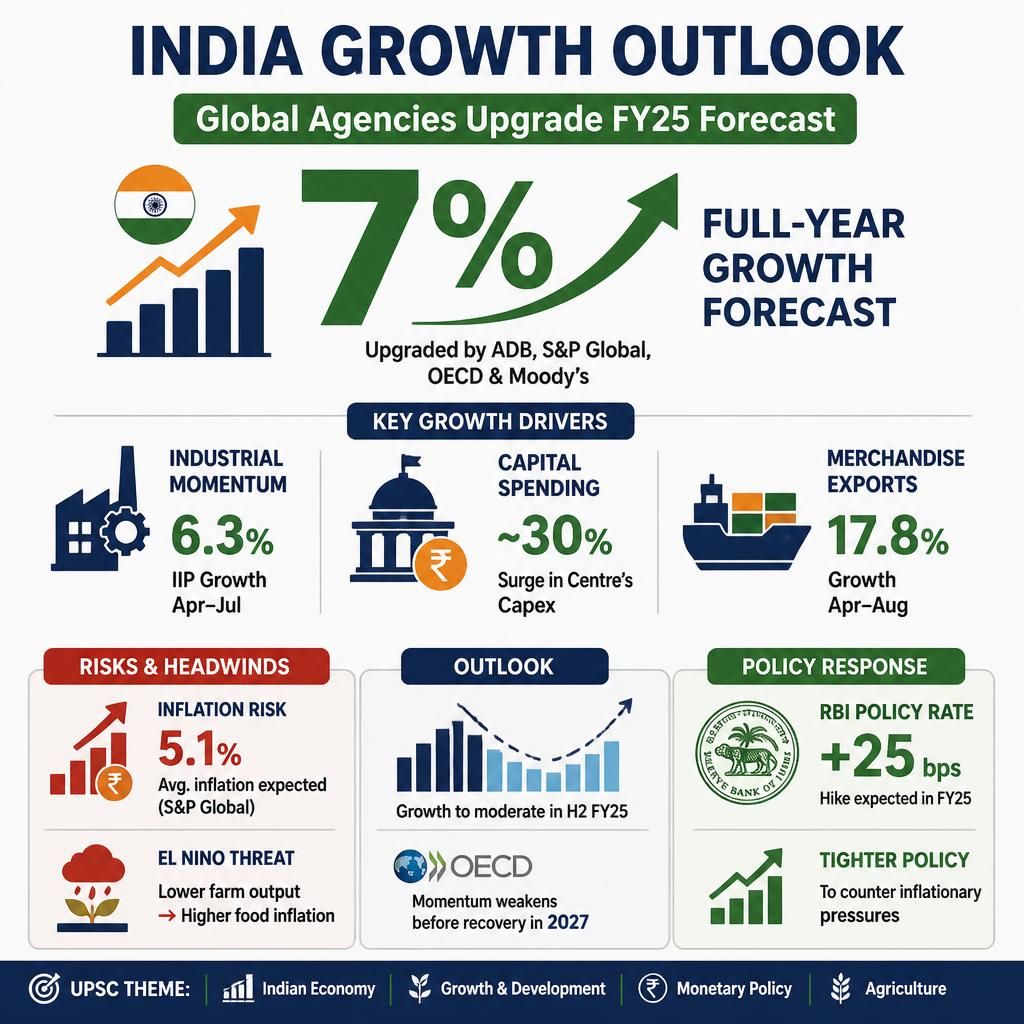
Global agencies upgrade India's growth forecasts to 7%, but rising inflation and potential RBI rate hikes cloud the economic outlook.
Practice MCQs
789 Students attempted
Key Highlights:
- Global agencies like the Asian Development Bank, S&P Global, OECD, and Moody's have upgraded India's full-year growth estimates to around 7% following stronger-than-expected first-quarter GDP.
- Key drivers of growth include robust industrial production, with Index of Industrial Production (IIP) growing at 6.3% during April-July, and a nearly 30% surge in the Centre's capital expenditure.
- Merchandise exports also showed strong growth at 17.8% during April-August.
- Despite current growth, the outlook is clouded by rising inflation, with S&P Global expecting an average inflation of 5.1%.
- The Reserve Bank of India (RBI) is projected to raise its policy rate by 25 basis points in the current fiscal year to counter inflationary pressures.
- The farm sector faces risks from a potential El Nino event, which could reduce agricultural output and increase food inflation.
India's Growth Outlook.jpg
Detailed Insights:
- The upgraded growth forecasts reflect India's economic resilience amidst global uncertainties, including the conflict in West Asia.
- Industrial activity, particularly manufacturing, has been healthy, contributing significantly to the overall economic momentum.
- The government's increased capital spending is a crucial factor stimulating economic activity and infrastructure development.
- Growth is anticipated to moderate in the second half of the fiscal year as tailwinds from tax rationalization and income tax cuts diminish.
- The OECD projects a weakening momentum before a gradual recovery takes place in 2027.
- Building price pressures are leading to expectations of higher interest rates, indicating a shift towards a tighter monetary policy stance by the RBI.
- The Monetary Policy Committee (MPC) is expected to convene soon to address the growth-inflation dynamics.
Key Concepts Involved:
- El Nino: A climate pattern characterized by the unusual warming of surface waters in the eastern tropical Pacific Ocean, often leading to weaker monsoons and droughts in India.
- Index of Industrial Production (IIP): A composite indicator that measures the short-term changes in the volume of production of industrial goods in India, reflecting the health of the industrial sector.
- Monetary Policy Committee (MPC): A statutory body under the Reserve Bank of India Act, 1934, responsible for fixing the benchmark interest rate (Repo Rate) to maintain price stability while supporting economic growth.
- Repo Rate: The rate at which the Reserve Bank of India (RBI) lends money to commercial banks, serving as a key tool for monetary policy to control inflation and liquidity.

SuperKalam is your personal mentor for UPSC preparation, guiding you at every step of the exam journey.
Download the App


STUDY RESOURCES
CONTACT US
ⓒ Snapstack Technologies Private Limited