GS 2: GovernanceGS 2: PolityGS 3: Internal SecurityPrelimsGS 2: Union State Relations and Federal Structure
AFSPA Extended In Parts Of Arunachal, Manipur, Nagaland, Pg12
Union Home Ministry extends controversial AFSPA for six months in parts of Manipur, Arunachal, and Nagaland amid persistent security concerns.
Practice MCQs
789 Students attempted
Key Highlights:
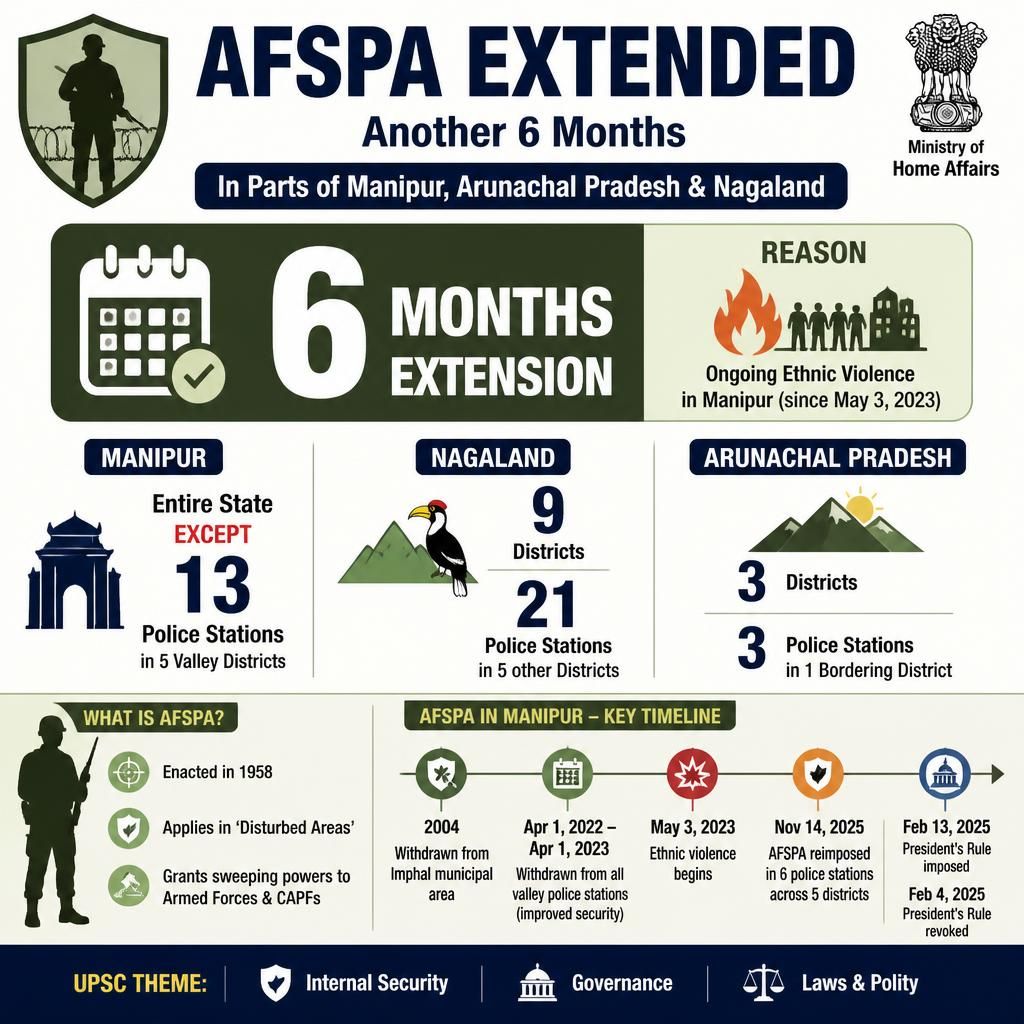
- The Union Home Ministry extended the Armed Forces (Special Powers) Act (AFSPA) for another six months in parts of Manipur, Arunachal Pradesh, and Nagaland.
- In Manipur, the Act remains in force across the entire state, excluding the jurisdiction of 13 police stations in five valley districts.
- The extension in Manipur is attributed to ongoing ethnic violence that began on May 3, 2023.
- Nagaland saw the extension of AFSPA in nine districts and 21 police stations across five other districts.
- In Arunachal Pradesh, three districts and three police stations in a bordering district were declared "disturbed areas."
AFSPA.jpg
Detailed Insights:
- The AFSPA was reimposed in six police stations in five districts of Manipur on November 14, 2024, following the 2023 ethnic violence.
- President's Rule was imposed in Manipur on February 13, 2025, and subsequently revoked on February 4 of the current year.
- Prior to the recent violence, AFSPA had been withdrawn from all valley police stations in Manipur between April 1, 2022, and April 1, 2023, due to an improved security situation.
- The Act was initially withdrawn from the Imphal municipality area in 2004.
- The AFSPA, enacted in 1958, grants sweeping powers to the Army and Central Armed Police Forces in "disturbed areas."
- These powers include the authority to shoot to kill, arrest and search without a warrant, and protection from prosecution without central government sanction.
- AFSPA has been applicable in Manipur since 1981, with the state attaining statehood in 1972.
Key Concepts Involved:
- Armed Forces (Special Powers) Act (AFSPA): A parliamentary act granting special powers to Indian Armed Forces and paramilitary forces in areas declared as "disturbed" to maintain public order.
- Disturbed Area: An area declared by the Central Government or the Governor/Administrator of a state/union territory where public peace is significantly disrupted by disputes among various groups, necessitating the aid of armed forces.
- President's Rule: The temporary suspension of state government and imposition of direct rule by the Central Government, typically due to a breakdown of constitutional machinery in a state.

SuperKalam is your personal mentor for UPSC preparation, guiding you at every step of the exam journey.
Download the App


STUDY RESOURCES
CONTACT US
ⓒ Snapstack Technologies Private Limited