GS 2: GovernanceGS 1: Indian SocietyGS 3: EconomyPrelimsGS 3: Indian Economy, Planning, Mobilization of Resources, Growth, Development and Employment
Why govt jobs are few: The narrow selection pipeline, Pg19
Millions vie for scarce government jobs annually, highlighting India's narrow recruitment pipeline, economic realities, and social appeal amidst paper leak controversies.
Practice MCQs
782 Students attempted
Key Highlights:
- The dream of a sarkari naukri (government job) attracts crores of applicants annually for a limited number of vacancies in India.
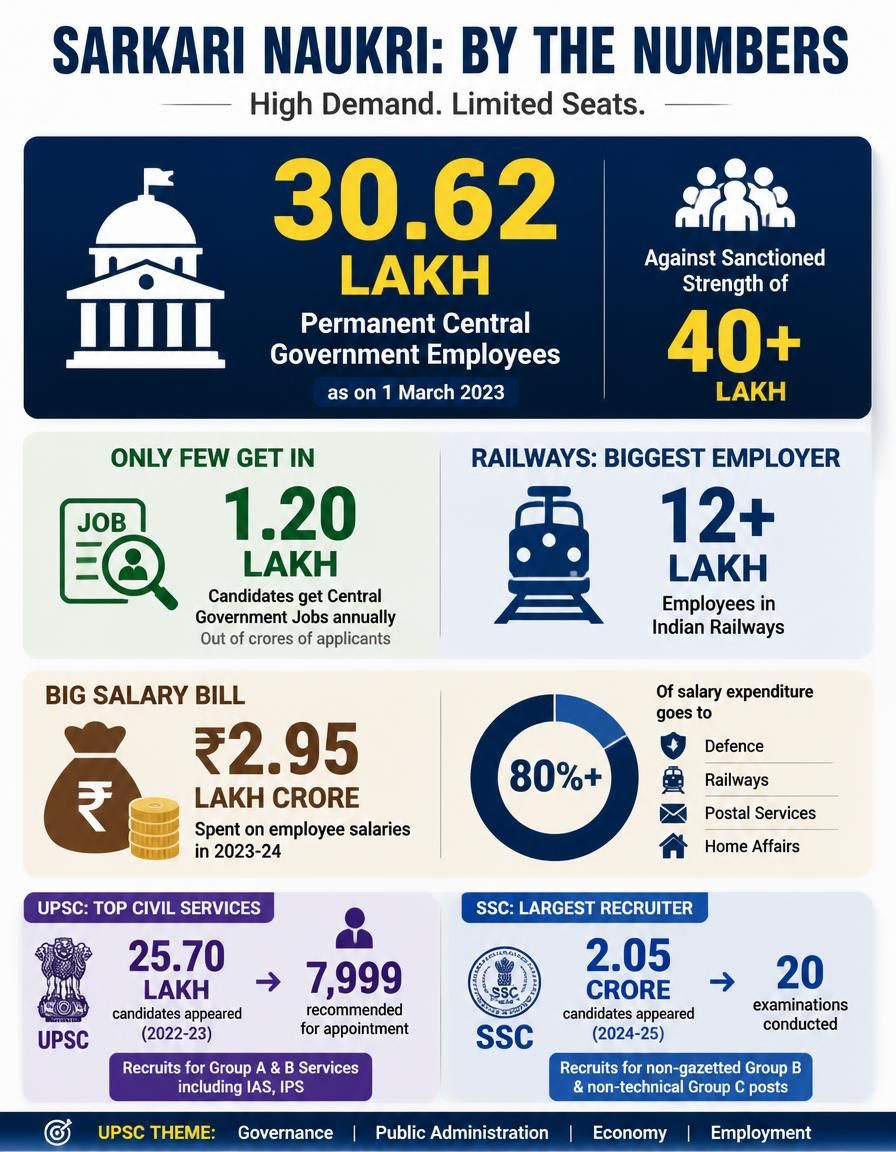
- The Union government employed 30.62 lakh permanent staff as of March 1, 2023, against a sanctioned strength of over 40 lakh.
- Central government recruitments are primarily conducted by agencies like the Union Public Service Commission (UPSC), Staff Selection Commission (SSC), and the Ministry of Railways.
- Annually, only about 1.20 lakh candidates secure central government jobs, despite crores applying.
- The Railways is the largest central government employer, with over 12 lakh employees.
Government Job.jpg
Detailed Insights:
- The strong appeal of government jobs stems from economic realities, lack of private sector opportunities, social psychology, and career benefits.
- The Department of Expenditure data indicates the Union government spent ₹2.95 lakh crore on employee salaries in 2023-24.
- Over 80% of the central government's salary expenditure is allocated to defence, railways, postal services, and home affairs.
- The UPSC primarily recruits Group A and Group B civil servants, including for the Indian Administrative Service (IAS) and Indian Police Service (IPS).
- In 2022-23, 25.70 lakh candidates appeared for 22 UPSC examinations, with only 7,999 recommended for appointment.
- The SSC recruits for most non-gazetted Group B and non-technical Group C positions across various central government ministries and departments.
- In 2024-25, 2.05 crore candidates appeared for 20 SSC examinations, with a significant number applying for Multi-Tasking Staff (Non-Technical) and Havaldar posts.
- State governments have their own recruitment systems, including State Public Service Commissions for Group A and Group B officials like the Provincial Civil Service (PCS).
- All-India Services like IAS, IPS, and Indian Forest Service (IFoS) have a center-state nature, with recruits allotted to state cadres.
- Challenges like paper leaks in recruitment exams, particularly for Group C posts, highlight the intense competition and demand for government jobs.
Key Concepts Involved:
- Sarkari Naukri: A Hindi term referring to government jobs, highly sought after in India for security and benefits.
- Union Public Service Commission (UPSC): India's premier central recruiting agency for Group A and Group B civil services.
- Staff Selection Commission (SSC): A central government body responsible for recruiting Group B (non-gazetted) and Group C (non-technical) staff.
- Group A, B, C Jobs: Categories of government employment based on hierarchy, responsibilities, and pay scales.
- All-India Services: Central services like IAS, IPS, and IFoS whose officers are recruited by the Centre but serve in state cadres.

SuperKalam is your personal mentor for UPSC preparation, guiding you at every step of the exam journey.
Download the App


STUDY RESOURCES
CONTACT US
ⓒ Snapstack Technologies Private Limited