GS 3: Disaster ManagementGS 3: Environment & EcologyPrelimsGS 3: Disaster and Disaster ManagementGS 3: Conservation, Pollution and Degradation
Warmer oceans are sounding a warning, Pg12
Global sea-surface temperatures hit record highs, driven by El Niño and global warming, signaling urgent need for climate adaptation and mitigation strategies.
Practice MCQs
782 Students attempted
Key Highlights:
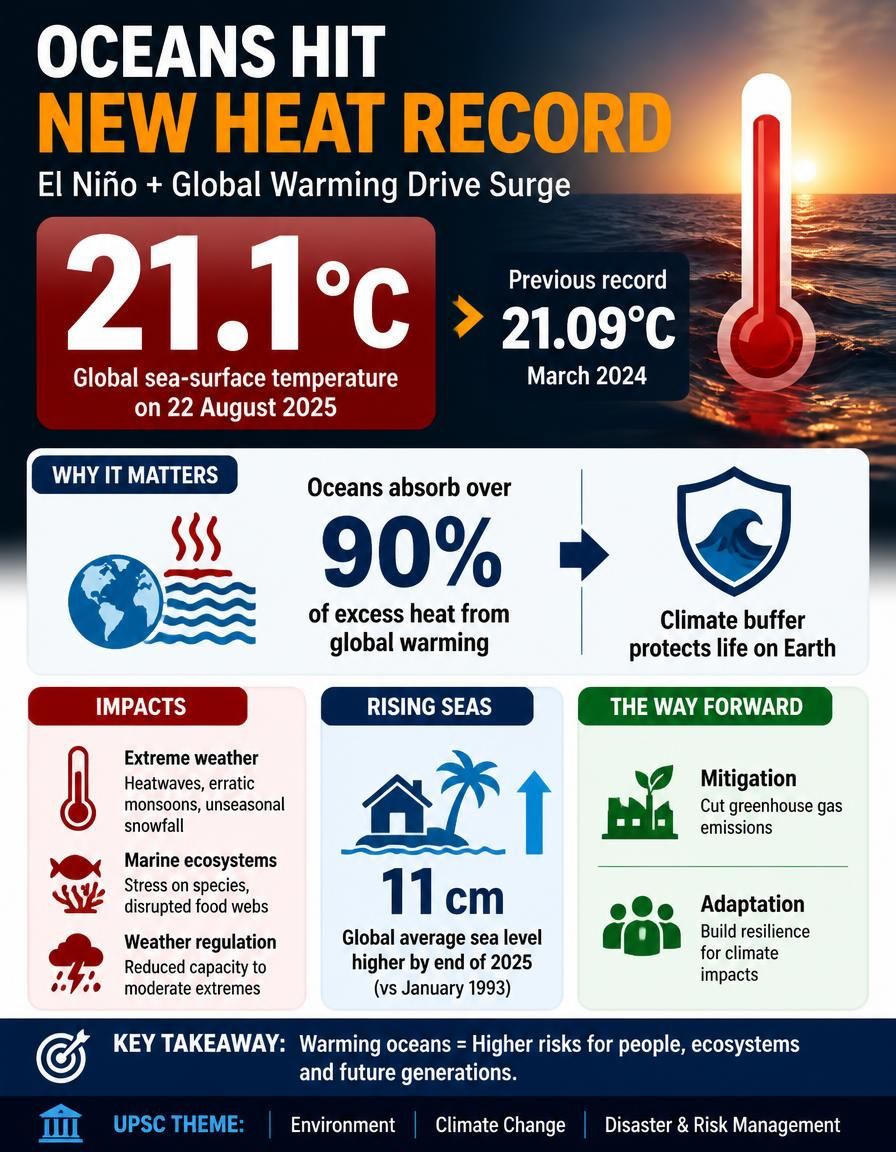
- Global sea-surface temperature reached a record 21.1 degrees Celsius on August 22, driven by a rapidly intensifying El Niño and global warming.
- This new record surpassed the previous high of 21.09 degrees Celsius recorded in March 2024.
- Oceans have absorbed over 90% of excess heat from global warming, acting as a crucial climate buffer, according to IPCC and NASA.
- The warming oceans are causing stress on marine ecosystems, disrupting food webs, and affecting the capacity to regulate weather.
- Global average sea level was approximately 11 centimetres higher by the end of 2025 compared to January 1993.
Ocean Temperature.jpg
Detailed Insights:
- The record temperatures in August followed consistently high sea surface temperatures in June and July, indicating a sustained trend rather than an anomaly.
- The ocean's critical role in sequestering heat has delayed catastrophic climate change impacts, but at the cost of marine ecosystem health.
- Consequences of ocean warming include extreme weather events like European heatwaves, erratic monsoons in India, and unseasonal snowfall in South America.
- Rising ocean temperatures contribute significantly to sea-level rise, posing threats to coastal communities globally.
- The article emphasizes the dual approach of mitigation (reducing greenhouse gas emissions) and adaptation (building resilience to climate impacts).
- India, with its extensive coastline of over 10,000 km, needs to prioritize adaptation strategies such as protecting coastal populations and improving climate-informed agriculture and water management systems.
Key Concepts Involved:
- El Niño: A climate pattern describing unusual warming of surface waters in the eastern tropical Pacific Ocean.
- Intergovernmental Panel on Climate Change (IPCC): The United Nations body for assessing climate change science.
- NASA: The United States' National Aeronautics and Space Administration, responsible for space exploration and aeronautics research.
- Mitigation: Actions taken to reduce or prevent the emission of greenhouse gases and enhance their sinks.
- Adaptation: Adjustments in natural or human systems in response to actual or expected climatic stimuli or their effects.

SuperKalam is your personal mentor for UPSC preparation, guiding you at every step of the exam journey.
Download the App


STUDY RESOURCES
CONTACT US
ⓒ Snapstack Technologies Private Limited