GS 2: GovernanceGS 2: International RelationsGS 3: EconomyPrelimsGS 3: Security Challenges and Management in Border Areas
Repairing ties with Nepal: A strategy of two hands, 10 fingers, Pg13
India and Nepal must adopt a 'two-hand' strategy of economic and technological cooperation to support Nepal's LDC graduation and foster sustainable growth.
Practice MCQs
782 Students attempted
Key Highlights:
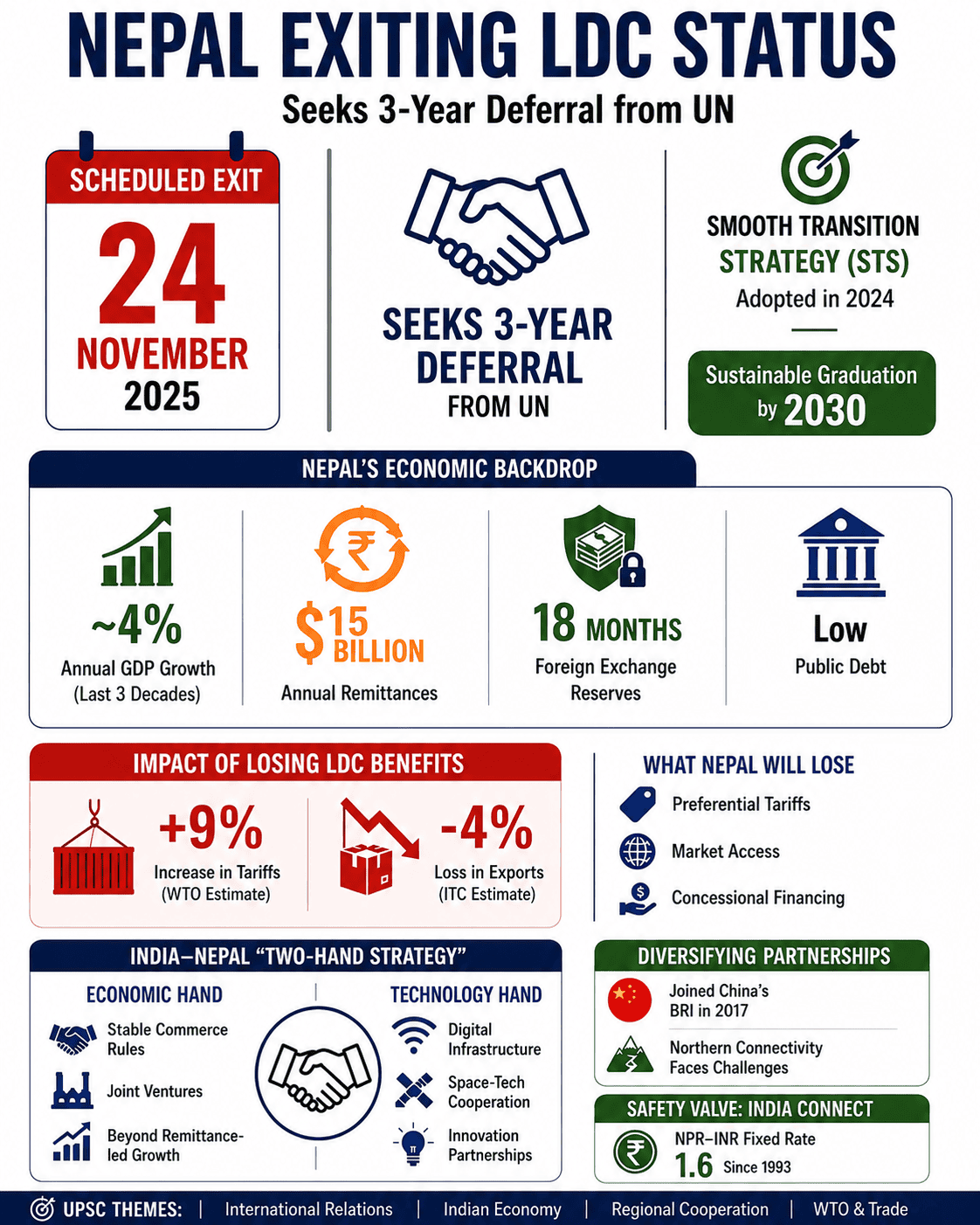
- Nepal is scheduled to lose its Least Developed Country (LDC) status on November 24 but has sought a three-year deferral from the UN.
- The country adopted the Smooth Transition Strategy (STS) in 2024 to achieve sustainable graduation from LDC status by 2030.
- India and Nepal are proposing a "two-hand strategy" focusing on economics and technology to move Nepal beyond its remittance-led growth.
- Nepal's economy has grown at approximately 4% annually for three decades, supported by low debt and $15 billion in annual remittances.
- The WTO estimates a 9% increase in tariffs, and the UN’s International Trade Centre estimates a 4% loss in exports for Nepal post-LDC graduation.
India-Nepal.jpg
Detailed Insights:
- LDC status provides preferential tariffs, market access, and concessional financing, which Nepal will lose upon graduation.
- Nepal maintains macroeconomic buffers, including 18 months' worth of foreign exchange reserves, to mitigate the impact of LDC graduation.
- Bilateral tariff agreements with India, including a fixed NPR-INR rate of 1.6 since the 1990s, offer a safety valve against economic shocks.
- Nepal joined China's Belt and Road Initiative (BRI) in 2017 to diversify its economic partnerships, though northern connectivity faces challenges.
- The proposed "two-hand strategy" with India includes economic measures like stable commerce rules and joint ventures, and technological cooperation in areas like digital infrastructure and space-tech.
- Key risks to be addressed include over-securitisation of the border, adverse perceptions of Indian dominance, and bureaucratic delays in project implementation.
- Recent technical meetings on river waters, railway connectivity, customs, and energy indicate re-established trust and momentum in bilateral relations.
Key Concepts Involved:
- Least Developed Country (LDC) Status: A classification by the UN for countries with low income, human resource weakness, and economic vulnerability.
- Smooth Transition Strategy (STS): A national plan adopted by graduating LDCs to ensure a sustainable and gradual shift from LDC-specific international support measures.
- Remittance-led Growth: An economic model where a significant portion of national income and consumption is driven by money sent home by citizens working abroad.
- Belt and Road Initiative (BRI): A global infrastructure development strategy adopted by the Chinese government in 2013 to invest in nearly 150 countries and international organizations.

SuperKalam is your personal mentor for UPSC preparation, guiding you at every step of the exam journey.
Download the App


STUDY RESOURCES
CONTACT US
ⓒ Snapstack Technologies Private Limited