GS 3: Science & TechnologyGS 3: Disaster ManagementGS 3: Environment & EcologyPrelimsGS 3: Disaster and Disaster Management
Models Struggled to Predict the 2026 Monsoon’s Rapid Changes, Pg II
Monsoon prediction models failed to capture 2026's erratic spatial and temporal changes, necessitating AI integration for improved accuracy amidst climate change.
Practice MCQs
782 Students attempted
Key Highlights:
- Climate models accurately predicted the 2026 El Niño and a deficient monsoon for India.
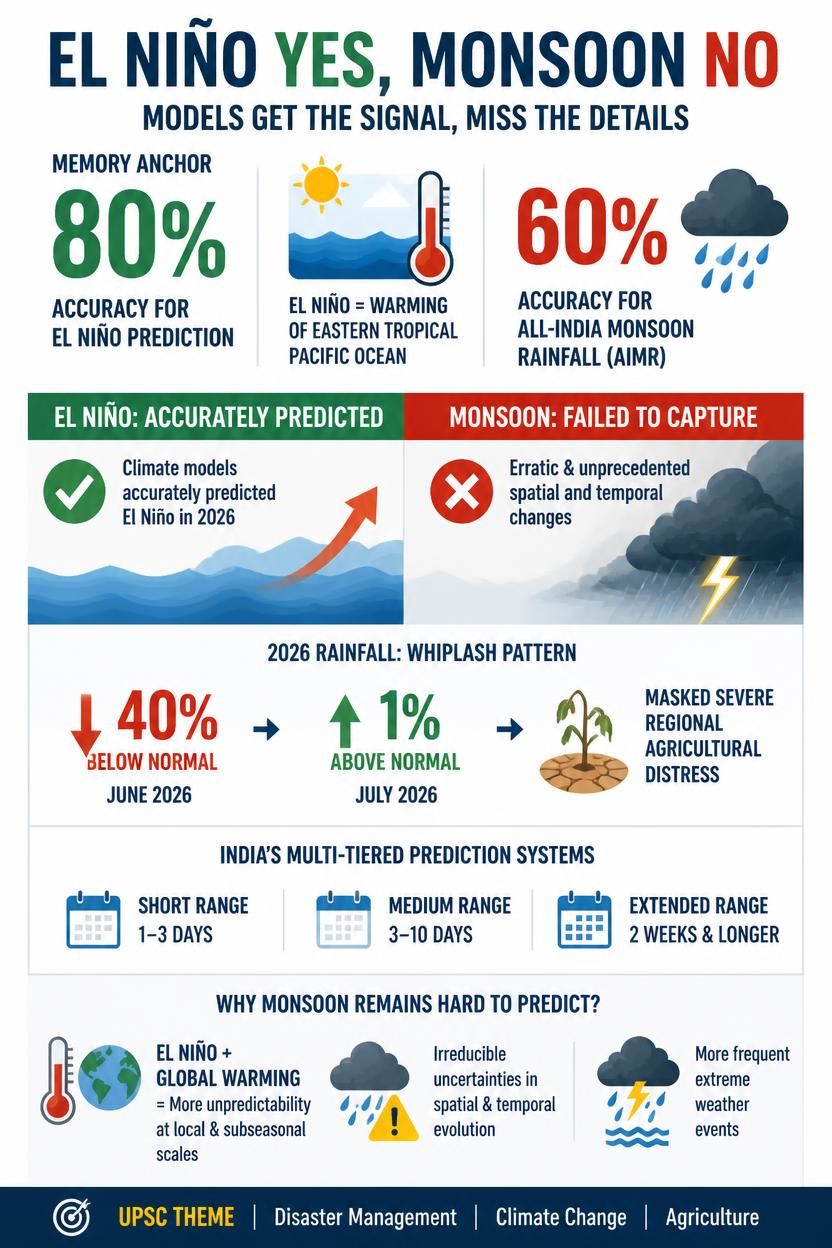
- The 2026 monsoon displayed erratic and unprecedented spatial and temporal changes, which prediction models failed to capture even a few days in advance.
- Monsoon prediction accuracy, particularly for All-India Monsoon Rainfall (AIMR), is around 60%, significantly lower than the 80% accuracy for El Niño events.
- June 2026 experienced 40% below-normal rainfall, followed by a quick recovery to 1% above-normal in July, yet this masked severe regional agricultural distress.
El Nino.jpg
Detailed Insights:
- The El Niño phenomenon, characterized by the warming of surface waters in the eastern tropical Pacific Ocean, is a highly predictable mode of natural variability.
- India's multi-tiered prediction systems cater to short (1-3 days), medium (3-10 days), and extended (2 weeks and longer) range weather information needs.
- While seasonal to interannual predictions of AIMR are relatively straightforward, long-lead forecasts of the monsoon's spatial and temporal evolution present greater challenges due to irreducible uncertainties.
- The combined effects of El Niño and global warming are increasingly making the monsoon unpredictable at subseasonal and local scales, leading to more frequent extreme weather events.
- Artificial Intelligence (AI) tools are emerging as a promising avenue for improving climate models by identifying patterns in vast datasets without requiring a complete mechanistic understanding.
- Future advancements are expected from hybrid dynamic and AI models, which could provide sector-specific predictions at the necessary space-time scales for effective disaster management and agricultural planning.
Key Concepts Involved:
- El Niño: A climate pattern involving the unusual warming of surface waters in the eastern tropical Pacific Ocean, often associated with suppressed monsoon activity and drought conditions in parts of South Asia.
- All-India Monsoon Rainfall (AIMR): The aggregate rainfall received across the entire Indian subcontinent during the monsoon season, serving as a broad indicator but often concealing significant regional and temporal variations.
- Subseasonal to Seasonal (S2S) Prediction: Forecasts that bridge the gap between short-range weather predictions (up to 10-14 days) and long-range seasonal climate outlooks (months to a year), typically covering a period of two weeks to two months.

SuperKalam is your personal mentor for UPSC preparation, guiding you at every step of the exam journey.
Download the App


STUDY RESOURCES
CONTACT US
ⓒ Snapstack Technologies Private Limited