GS 2: GovernanceGS 2: International RelationsGS 3: Disaster ManagementGS 3: Environment & EcologyPrelims
Minister seeks fundamental shift in fight against drought, Pg14
Union Environment Minister urges global shift from reactive relief to proactive, technology-enabled drought resilience at UNCCD COP17 in Mongolia.
Practice MCQs
782 Students attempted
Key Highlights:
- Union Environment Minister Bhupender Yadav called for a fundamental shift from reactive relief to proactive, technology-enabled resilience in global drought management.
- The statement was made at the Ministerial Dialogue on "Accelerating Drought Resilience" during the 17th Conference of Parties (COP17) to the United Nations Convention to Combat Desertification (UNCCD) in Ulaanbaatar, Mongolia.
- Mr. Yadav highlighted that drought is now a "defining development challenge" impacting global water security, agriculture, biodiversity, and economic stability.
- India showcased its multi-institutional approach, integrating early warning systems, mitigation, relief, and community resilience, including rainfall monitoring and satellite-based assessments.
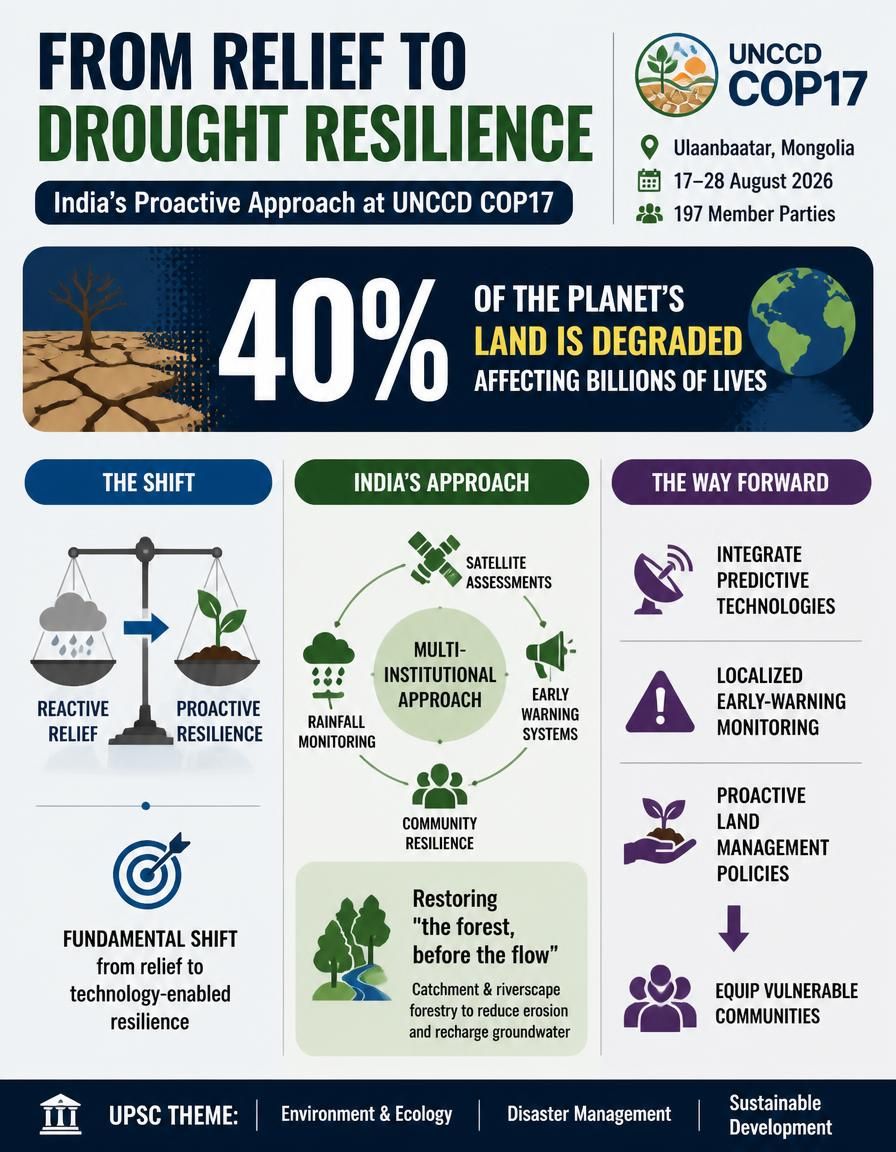
Drought.jpg
Detailed Insights:
- The UNCCD COP17 is being hosted by Mongolia under the theme "Restoring Land. Restoring Hope."
- The conference, held from August 17 to 28, 2026, brings together delegates from 197 member parties to negotiate binding frameworks and policy guidance.
- India's approach emphasizes restoring "the forest, before the flow" through catchment and riverscape forestry to reduce erosion and recharge groundwater.
- The Minister advocated for integrating predictive technologies, localized early-warning monitoring, and proactive land management policies to equip vulnerable communities.
- Land degradation currently affects up to 40% of the planet’s land surface, undermining the livelihoods of billions globally.
- The agreements at COP17 aim to translate high-level environmental commitments into measurable solutions for water and food security over the next decade.
Key Concepts Involved:
- United Nations Convention to Combat Desertification (UNCCD): A legally binding international agreement adopted in 1994, focusing on sustainable land stewardship to combat desertification and mitigate drought effects.
- Rio Conventions: Three major international environmental treaties that emerged from the 1992 Earth Summit: UNCCD, Convention on Biological Diversity (CBD), and United Nations Framework Convention on Climate Change (UNFCCC).
- Land Degradation: A process in which the value of the biophysical environment is affected by a combination of human-induced processes acting upon the land.

SuperKalam is your personal mentor for UPSC preparation, guiding you at every step of the exam journey.
Download the App


STUDY RESOURCES
CONTACT US
ⓒ Snapstack Technologies Private Limited