GS 1: World GeographyGS 2: International RelationsPrelimsGS 2: Bilateral, Regional and Global Groupings and AgreementsGS 2: Effect of Policies and Politics of Developed and Developing Countries on India's Interests
Iran, Oman discuss temporary Hormuz path, mine-clearing, Pg16
Iran and Oman discuss a temporary transit corridor and mine-clearing project in the strategically vital Strait of Hormuz, aiming for regional maritime security.
Practice MCQs
782 Students attempted
Key Highlights:
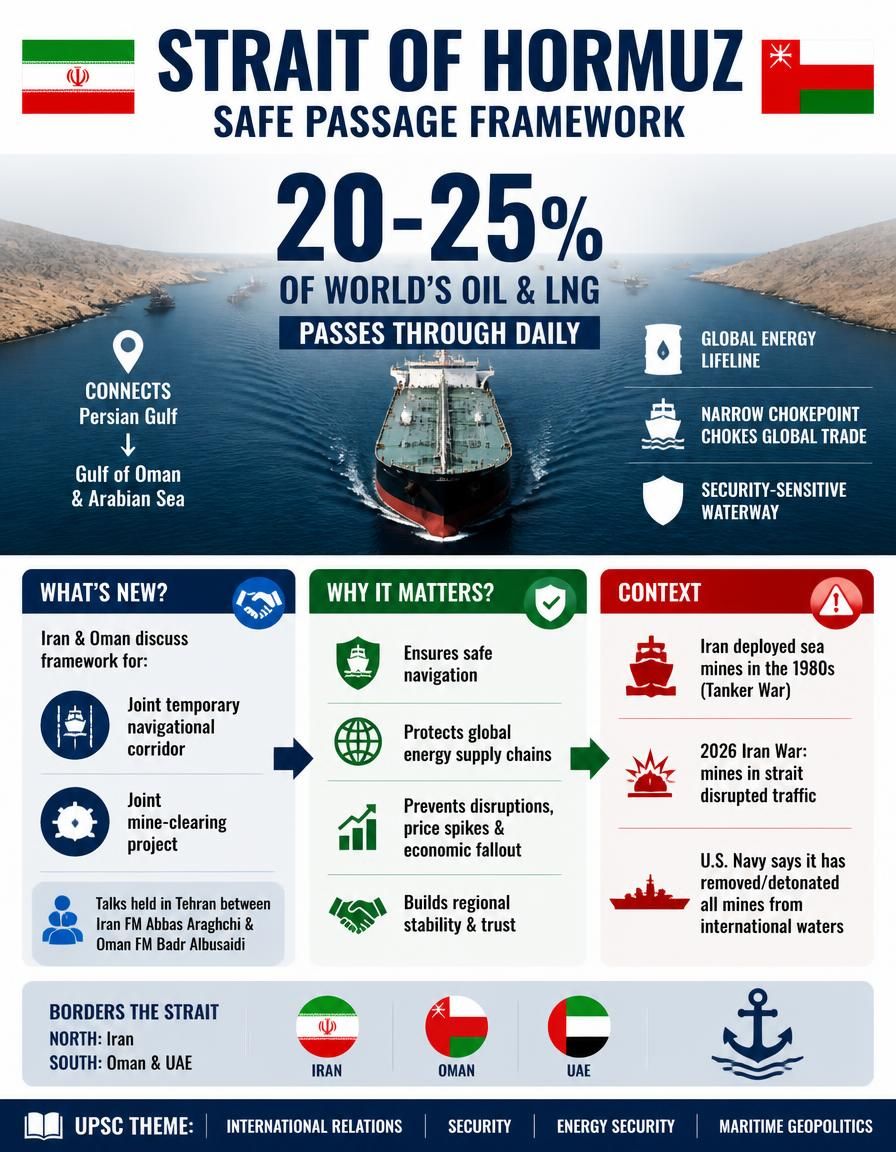
- Iran and Oman have discussed a framework for establishing a temporary transit corridor and a joint mine-clearing project in the Strait of Hormuz.
- The discussions involved Iranian Foreign Minister Abbas Araghchi and Omani Foreign Minister Badr Albusaidi during talks held in Tehran.
- The proposed framework aims to provide a practical basis for moving forward, including a joint temporary navigational corridor and an agreement for mine clearance.
- U.S. President Donald Trump stated that the U.S. Navy had already removed and/or detonated all mines from the international waters of the Strait of Hormuz.
Strait of Hormuz.jpg
Detailed Insights:
- The Strait of Hormuz is a critical maritime chokepoint, connecting the Persian Gulf to the Gulf of Oman and the Arabian Sea.
- Approximately 20-25% of the world's oil and liquefied natural gas (LNG) passes through this narrow waterway daily, making it vital for global energy supply chains.
- Iran borders the strait to the north, while Oman and the United Arab Emirates lie to the south.
- Historically, Iran has deployed naval mines in the strait, notably during the Iran-Iraq Tanker War in the 1980s, which damaged commercial vessels and even a U.S. frigate.
- Recent tensions, including the 2026 Iran War, led to Iran laying sea mines, causing significant disruptions to maritime traffic and contributing to a global fuel crisis.
- The joint statement from Iran and Oman indicated that technical negotiations would continue towards establishing a permanent maritime corridor and future management arrangements for the strait.
- The U.S. has been involved in ensuring safe passage, with the U.S. Navy conducting mine-clearing operations and routing tankers through a southern channel.
Key Concepts Involved:
- Strait of Hormuz: A narrow, strategically vital waterway connecting the Persian Gulf to the open ocean, crucial for global energy trade.
- Maritime Chokepoint: A narrow channel or passage that is strategically important for maritime trade and naval operations.
- Naval Mines: Explosive devices deployed in water to damage or sink ships, often used to restrict maritime passage.

SuperKalam is your personal mentor for UPSC preparation, guiding you at every step of the exam journey.
Download the App


STUDY RESOURCES
CONTACT US
ⓒ Snapstack Technologies Private Limited