GS 2: GovernanceGS 3: Science & TechnologyGS 3: EconomyPrelimsGS 3: Indian Economy, Planning, Mobilization of Resources, Growth, Development and Employment
Escape Velocity, Pg8
India's space sector faces high launch costs and infrequent missions, hindering global competitiveness against players like SpaceX, necessitating a new economic strategy.
Practice MCQs
782 Students attempted
Key Highlights:
- India's space program historically served as a symbol of national pride and technological competence.
- The focus is shifting from national "aura" to the economic utility of space in the information age.
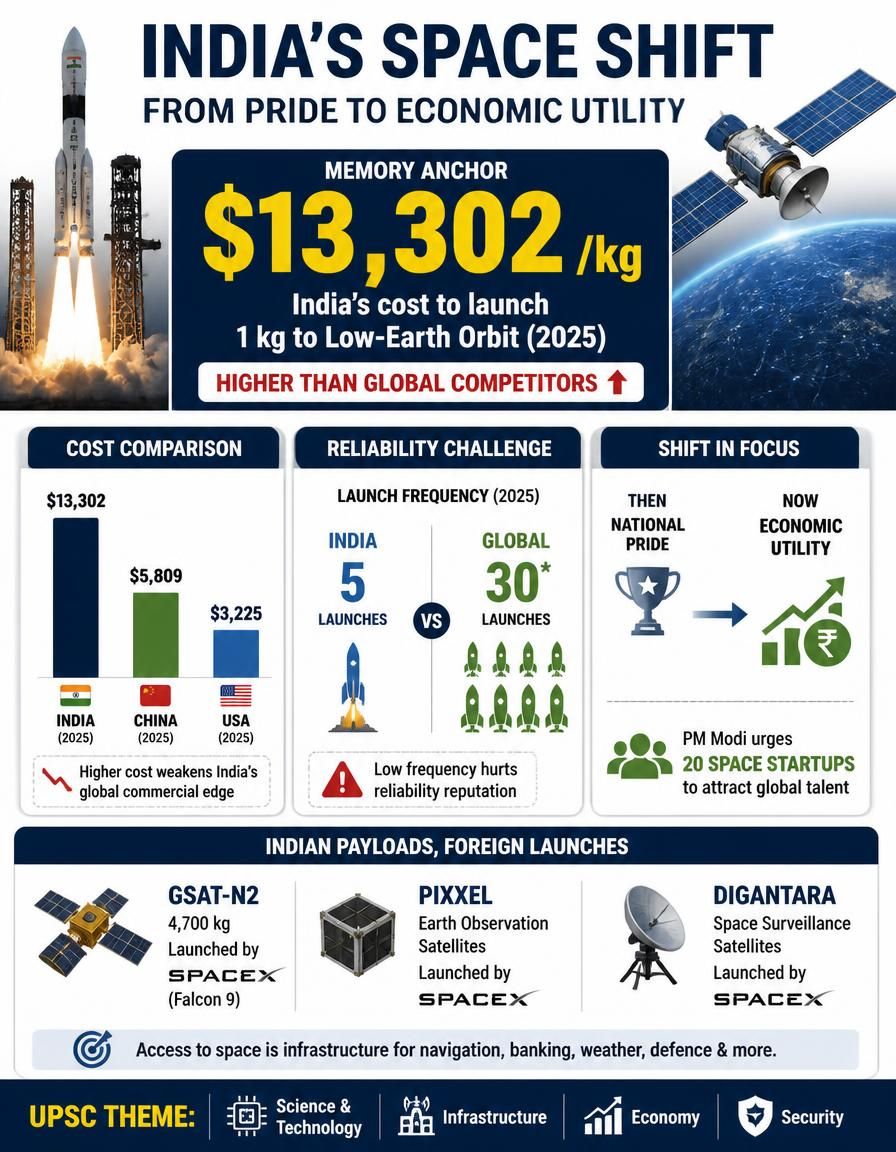
- On the third National Space Day, Prime Minister Modi urged 20 space startups to attract global talent.
- India's cost to launch a kilogram into Low-Earth Orbit was $13,302 in 2025, significantly higher than global competitors.
- Low launch frequency, with only 5 launches in 2025 against 30 projected, impacts India's reliability reputation.
- Indian satellites like GSAT-N2, Pixxel, and Digantara have utilized SpaceX for their launches.
Indian Space Shift.jpg
Detailed Insights:
- In its early years, India invested in rockets and atomic piles as a strategic bet on the future despite economic challenges.
- Today, satellites are crucial infrastructure for navigation, banking, weather forecasting, and defense in the information age.
- National Space Day commemorates the successful touchdown of Chandrayaan-3 in the lunar south polar region on August 23rd.
- A peer-reviewed analysis indicated India's launch cost ($13,302/kg) was higher than China ($5,809/kg) and the US ($3,225/kg).
- This high cost and infrequent launches hinder India's ability to compete effectively in the global commercial space market.
- ISRO's LVM-3 was unable to launch the 4,700 kg GSAT-N2, which subsequently used SpaceX's Falcon 9.
- SpaceX launched three-quarters of the world's payload in 2025, highlighting its significant market dominance.
- The value of India's space sector must now be measured in terms of job creation, capital investment, and tax revenues.
- India needs to develop competitive heavy-lift launch capabilities to offer more affordable services than rivals like SpaceX and China.
Key Concepts Involved:
- National Space Day: Celebrated on August 23rd, marking the anniversary of Chandrayaan-3's lunar landing.
- Low-Earth Orbit (LEO): An orbit relatively close to Earth, commonly used by satellites for various applications.
- Heavy-lift launch vehicle: A rocket designed to carry very large payloads into space.
- ISRO (Indian Space Research Organisation): India's primary national space agency responsible for space exploration and related technologies.
- LVM-3 (Launch Vehicle Mark-3): ISRO's operational three-stage heavy-lift launch vehicle.
- SpaceX: A private American aerospace manufacturer and space transport services company.

SuperKalam is your personal mentor for UPSC preparation, guiding you at every step of the exam journey.
Download the App


STUDY RESOURCES
CONTACT US
ⓒ Snapstack Technologies Private Limited